Sandankyo
"The water was so clear I couldn't tell how deep it was, and neither could the fish."
A long, cool gorge folded into the mountains of northern Hiroshima, where a clear river carves through forest past pools the color of green glass and waterfalls you reach on foot. It is a walking place, an unhurried place. We came for a stroll and stayed until our legs gave out.
We had spent three days in cities and I could feel it in my shoulders, that low urban hum you stop noticing until it stops. Sandankyo cured it in about four minutes. You walk in past the old gateway and the trail narrows and the temperature simply drops, the forest closes over the path, and the river appears below you running over pale stone in pools so clear and so green they don’t look like water at all. Lia leaned over a wooden railing, stared down into one, and said, “How deep is that?” I honestly couldn’t tell. Neither, apparently, could the fish, which hung suspended in the green as though the water had forgotten to exist around them.
A Gorge You Walk Into, Slowly
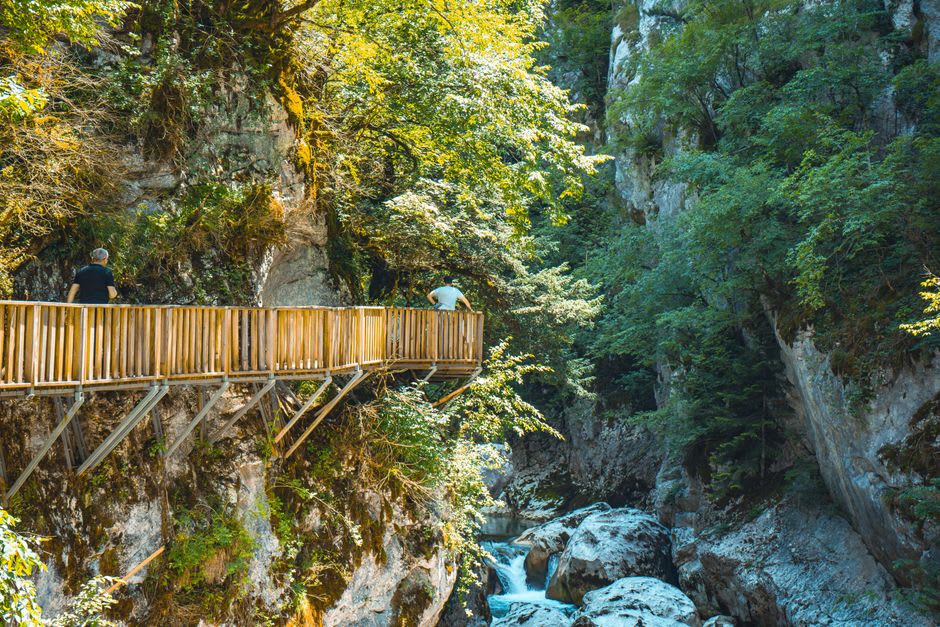
Sandankyo is not a viewpoint you drive to and photograph; it’s a long ravine you enter on foot and keep walking through, kilometer after kilometer, the trail hugging the cliff above the river. That’s the whole pleasure of it. The path threads under overhangs, crosses small bridges, and passes a string of named falls and pools, each one a small event. We fell into the rhythm of it quickly, the walking meditation of a trail that only goes one way and asks nothing of you but to keep putting one foot down. Every so often the gorge would open into a wider pool where the light came down and the water glowed, and every so often it would pinch shut into a shaded slot where moss dripped and the river roared. Lia counted dragonflies. I lost count of the times I said “look at that” until it became a kind of joke between us.
The Boat Across the Green
Deep in the gorge, the trail reaches a stretch where the river widens and stills into a place called Kurobuchi, the black pool, and here a boatman waits with a small flat wooden boat to ferry walkers across the glassy water to continue the trail. We nearly turned back before reaching it, tired and unsure how far it was, and I am so glad we didn’t. The crossing is short and almost silent, the boatman working a pole, the cliffs rising sheer on both sides and reflecting in water so still it doubles the world. Lia trailed her fingers in it and pulled them out laughing at the cold. There’s a little teahouse near the landing where we drank something hot and ate rice cakes with our boots off, watching the next boatload glide across, and it felt like being inside a scroll painting that someone had let us walk around in.
Autumn Colors and Aching Legs
We came in the shoulder of autumn, before the full blaze but with the first maples turning, and I can only imagine what the peak weeks do to this place, because even half-turned the forest was extravagant, reds and golds hanging over that impossible green water. The full gorge runs for kilometers, and the falls that give it its name, the three-tiered Sandandaki, sit far up the trail, a serious walk in and back. We didn’t make it all the way. Somewhere past the boat crossing our legs quietly voted to turn around, and we obeyed, walking back out through the cooling afternoon with the light slanting through the trees. I didn’t feel cheated. Sandankyo isn’t a place you conquer; it’s a place you spend as much of as your body allows, and then promise yourself you’ll return for the rest.
Getting There
Sandankyo lies in the mountains of northern Hiroshima Prefecture, near the town of Akiota, and reaching it takes a little commitment, which is part of why it stays uncrowded. Direct buses run from Hiroshima Bus Center to the Sandankyo entrance and take roughly an hour and a quarter; check the timetable carefully, as services are limited and the last bus back leaves earlier than you’d like. If you’re driving, there’s parking at the trailhead by the old gateway. Wear real walking shoes, because the trail is long and the surface is uneven stone and root, and bring water and a snack, since facilities inside are sparse beyond the teahouse at the boat crossing. Autumn is the famous season, but the gorge is cool and green and beautiful through the warmer months too. Give it a full day, and don’t feel you must reach the final falls to have done it right.
Keep exploring
More of Chūgoku