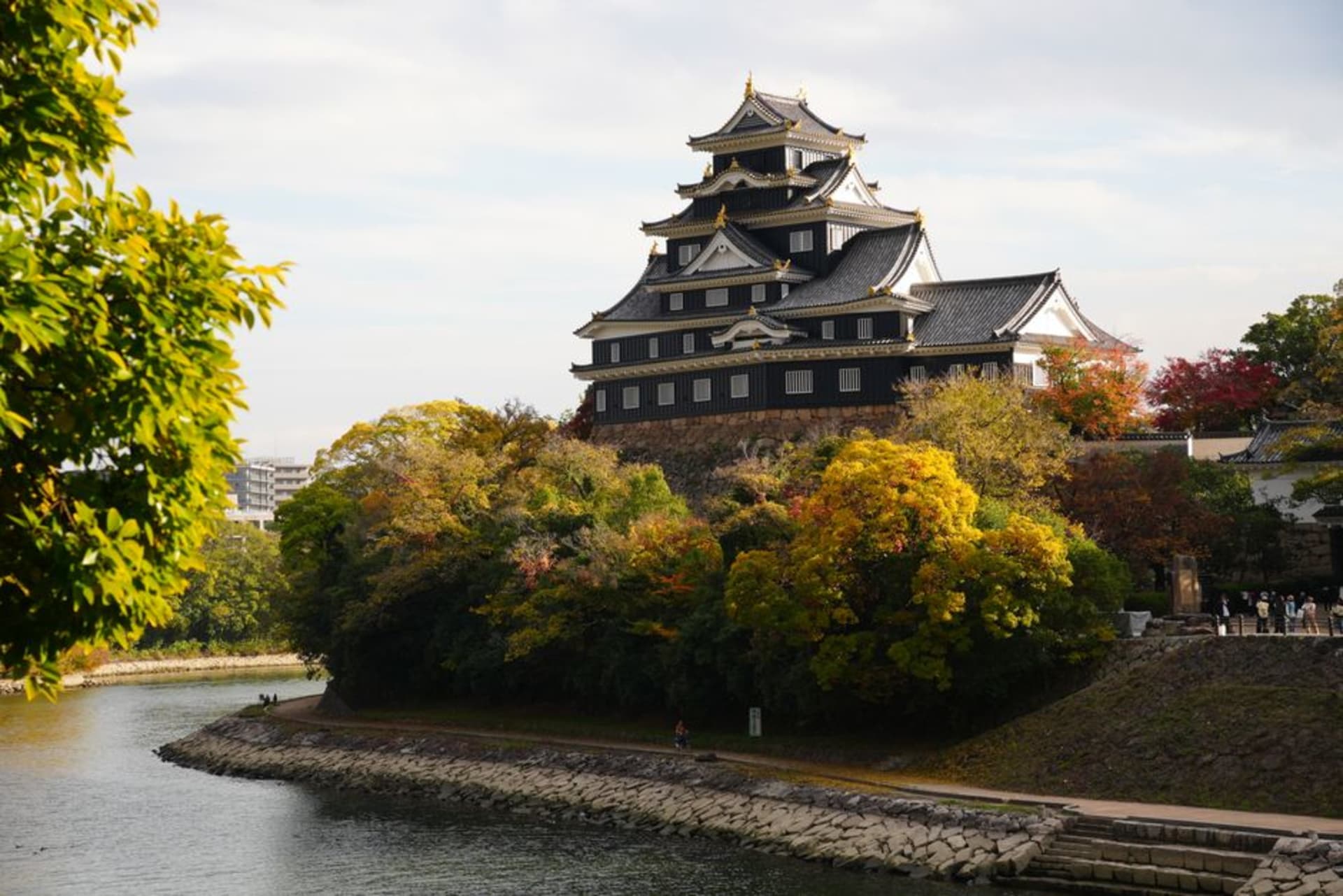
Okayama
"Everyone treats it as a place to change trains for the islands. We stayed, and the garden alone justified the detour."
A sunny castle city on the Inland Sea, home to Kōraku-en — one of Japan's three great landscape gardens — and the black-lacquered 'Crow Castle' that broods beside it. The mainland gateway to the art islands of the Seto sea.
Okayama has a reputation problem, and it’s this: it’s where you change trains. Lia and I had it pencilled in as a two-hour gap on the way to Naoshima, a place to leave our bags and drink a coffee. But the man at the tourist desk said the garden was ten minutes away and closed late, and something in the flat certainty of the afternoon light made us reconsider. We ended up staying the night, and Okayama turned out to be one of those unhurried, sun-warmed cities that asks nothing of you and gives more than you expect.
Kōraku-en
Kōraku-en is counted among the three great landscape gardens of Japan, and unlike its rivals it goes in for open space — wide expanses of lawn, which is rare in a Japanese garden, broken by ponds, tea-plots, a small grove of maples, and gravel paths that lead you in gentle loops. It was laid out around 1700 for the lord of Okayama, a garden meant for strolling and for entertaining, and it still has that generous, unhurried feel. We walked it in the early evening, when the tour groups had thinned and the light went long and gold across the grass, and the black keep of the castle floated above the treeline at the garden’s edge, borrowed scenery in the old sense. Lia found a bench by the pond and refused to move for half an hour, and I didn’t blame her.
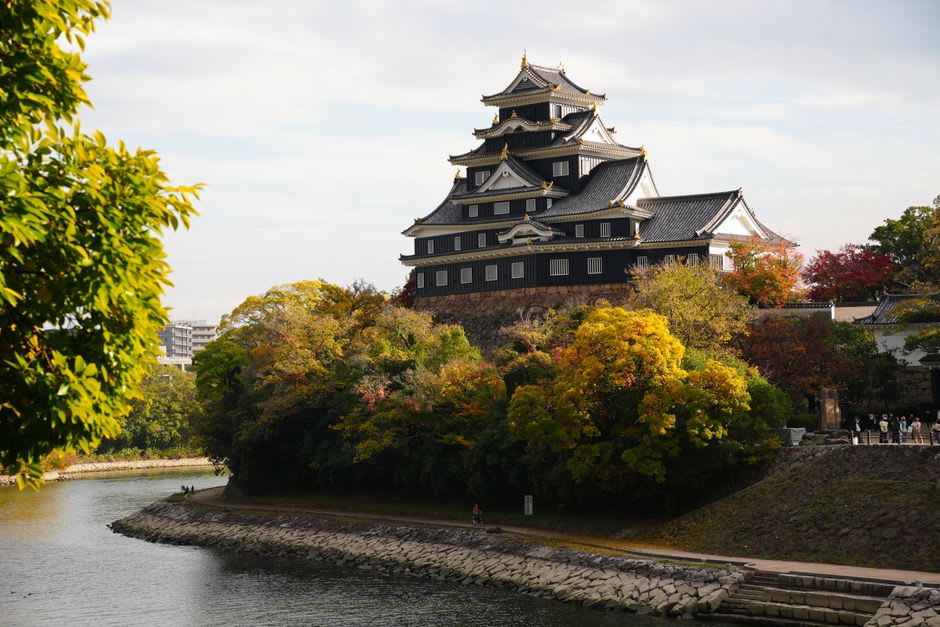
There are tea plantations inside the garden — real ones, harvested each spring — and rice fields, and a plum grove that must be something in February. We had it in July, all deep green and cicada-loud, and that was fine by us.
The Crow Castle
Across the river from the garden stands Okayama Castle, nicknamed U-jō, the Crow Castle, for its black-lacquered weatherboards — a deliberate foil to the white “Egret” castle at Himeji not far west. The original burned in the war and the keep you climb today is a postwar reconstruction, but the black exterior with its gold-leaf trim is genuinely striking, especially reflected in the river at dusk. We crossed the little arched bridge to reach it and climbed to the top for the view: the garden spread green on one bank, the city low and quiet on the other, the Inland Sea somewhere out beyond the haze. Inside there’s a slightly earnest museum and, oddly, a station where you can try on a kimono, which Lia did and I photographed badly.
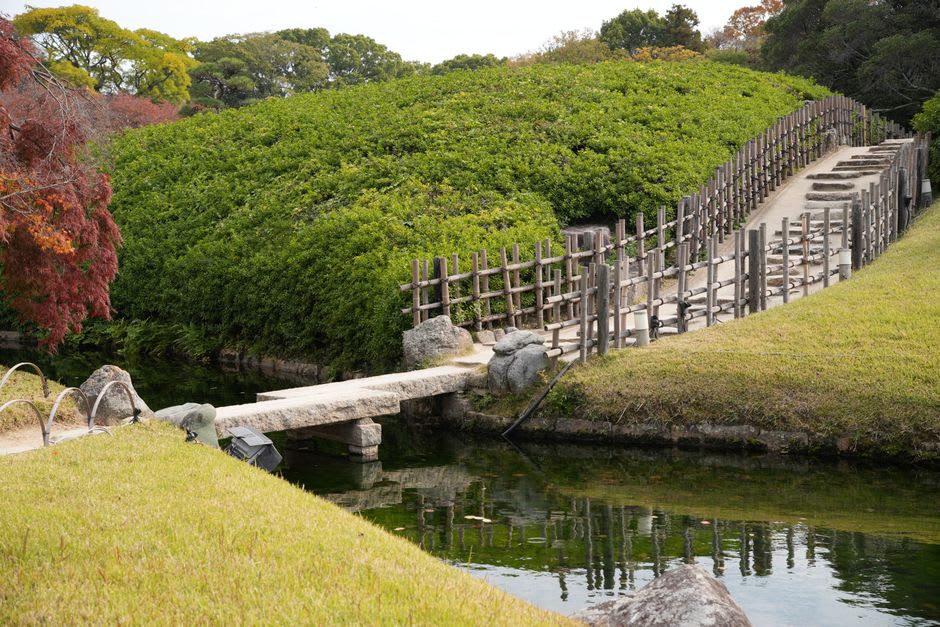
We ate that night on a covered shopping arcade near the station — grilled things and cold beer, the owner cheerful and patient with my Japanese — and walked back along the river with the castle lit up black and gold behind us.
Gateway to the sea
Okayama’s other role, the one that had nearly reduced it to a train platform for us, is real: it’s the mainland launch point for the Setouchi art islands. From nearby Uno port the ferries run out to Naoshima, Teshima and the rest, the ones scattered with Yayoi Kusama pumpkins and buried museums and abandoned schoolhouses turned to installations. We caught our boat from there the next morning, the sea flat and silver and studded with low green islands, and I understood why people rush through Okayama to reach it. But I was glad we hadn’t.
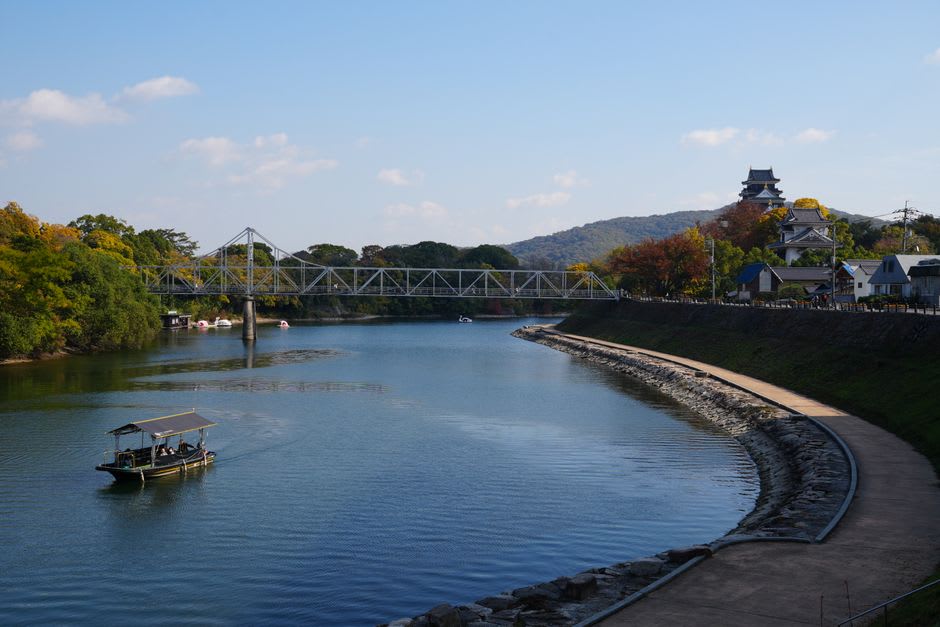
Okayama bills itself as the “land of sunshine,” and the statistics apparently back it up — it gets some of the least rain in Japan. All I know is that both days we had were bright and easy, the kind of weather that makes you forgive a city its train-station reputation.
Getting There
Okayama is a major Shinkansen stop on the San’yō line, around three and a quarter hours from Tokyo, three-quarters of an hour from Osaka, and forty minutes from Hiroshima. Kōraku-en and the castle are a short tram ride or a twenty-minute walk from the station, and easily seen together in an afternoon. For the art islands, take the local line to Uno port (about an hour) for ferries to Naoshima and Teshima. It makes a natural overnight between Osaka and Hiroshima — stay the evening for the castle lit up along the river.
Keep exploring
More of Chūgoku