Kurashiki
"A town that made its fortune storing rice, and spent it, generations later, on Monets. I liked the arc of that."
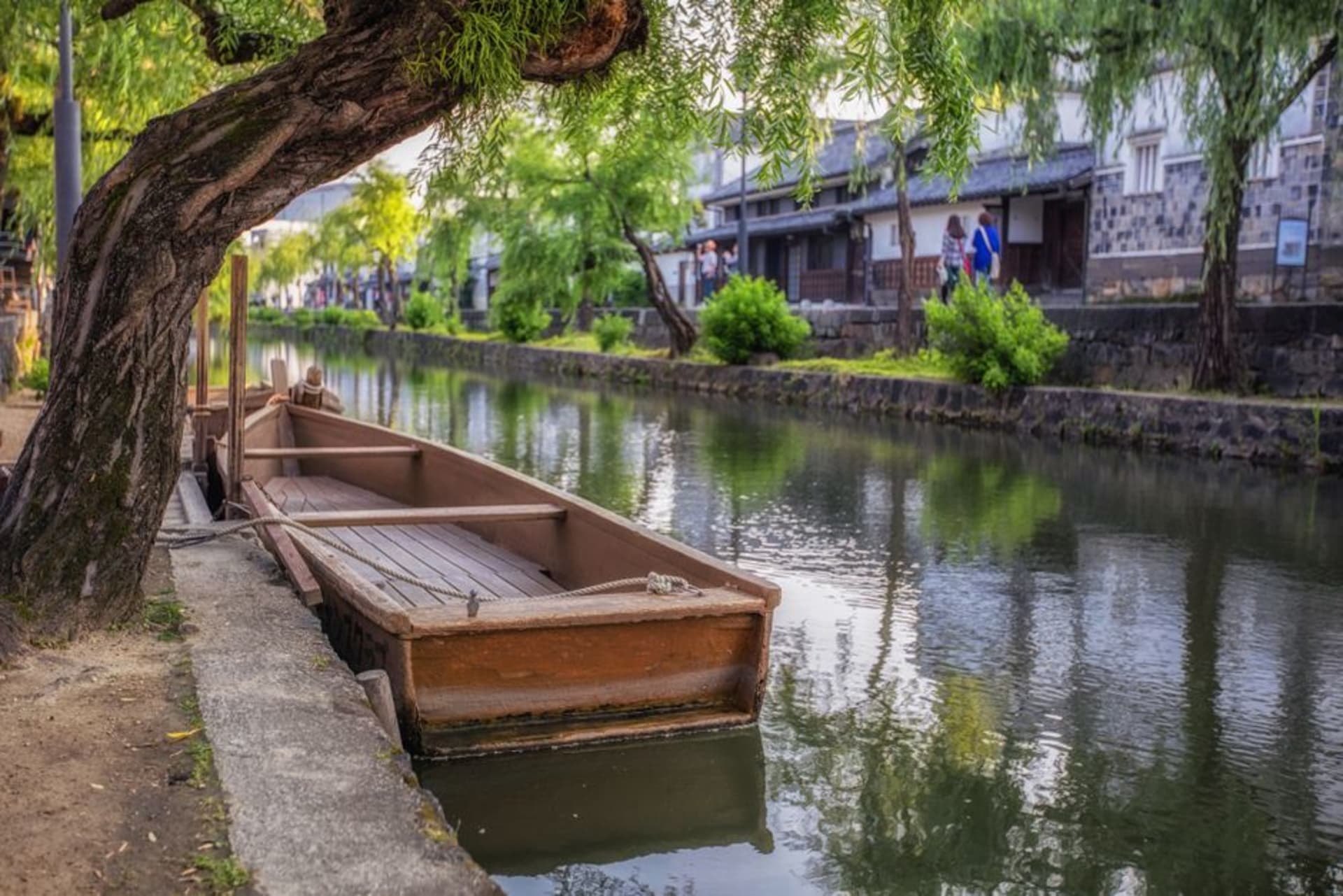
A canal quarter of white-walled Edo merchant warehouses in Okayama, willows trailing over still water plied by flat wooden boats. Art museums, a deep denim heritage, and one of the most quietly beautiful streetscapes in Japan.
We nearly skipped Kurashiki. It’s the kind of place that gets a single line in the guidebooks — “picturesque canal quarter” — and Lia and I had learned to be wary of that phrase, which usually means one photogenic street and a great deal of soft-serve ice cream. But we had an afternoon between trains in Okayama, and the Bikan quarter turned out to be the sort of place that quietly ruins your schedule. We arrived meaning to stay two hours and left, reluctantly, at dusk.
The Bikan canal
The heart of old Kurashiki is a short stretch of canal, lined on both banks with the kura — the storehouses that gave the town its name and its fortune. In the Edo period this was a rice-collection hub, the grain barged in along the canal and stored in these thick-walled warehouses, their lower walls faced in a distinctive black-and-white lattice of tile and plaster called namako-kabe, designed to shrug off fire and damp. Willows lean over the water at intervals, their reflections wavering when a boat passes, and stone bridges arch across at either end. What makes it work is the restraint: no neon, no overhead wires, the shops folded discreetly into the old buildings so that the street reads, at a glance, almost exactly as it did two centuries ago. We walked it slowly, twice, in both directions, watching the light change on the plaster.
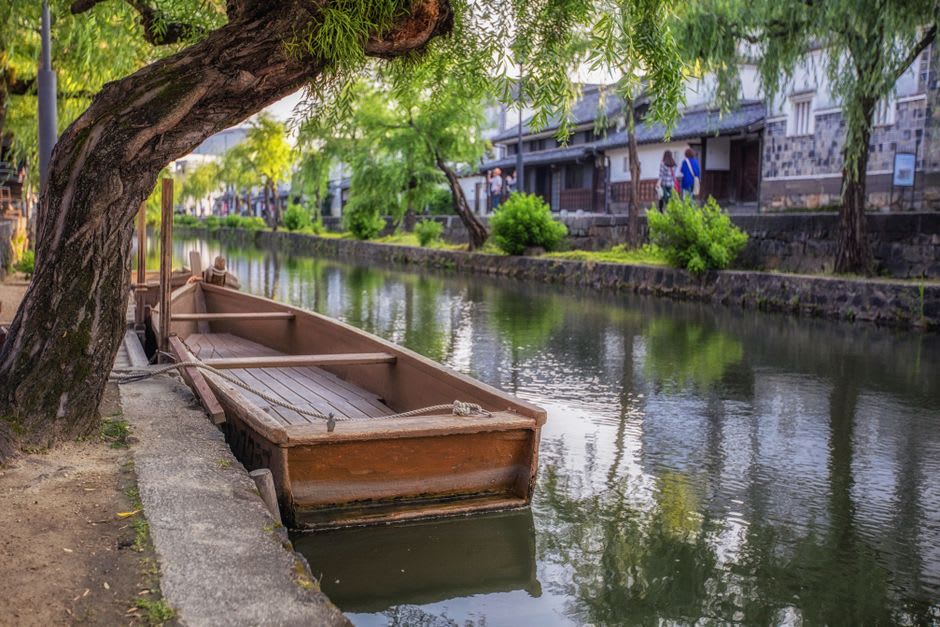
You can take one of the flat-bottomed boats that a boatman poles slowly up and down the canal, twenty minutes of gliding beneath the willows and under the bridges. We watched them go by from a bench instead, which suited us, though Lia said afterwards she wished we’d done it. Next time.
Art in a rice town
The surprise of Kurashiki is the Ohara Museum of Art, sitting incongruously among the warehouses behind a facade of Greek columns. It was founded in 1930 by a local textile magnate, Ohara Magosaburō, who sent a painter friend to Europe to buy — and so this small Japanese canal town holds El Greco, Monet, Gauguin, Matisse, a genuine collection of Western art assembled decades before most of Japan had seen such things. Standing in front of a Monet water-lily canvas in a building a stone’s throw from Edo rice warehouses is a genuinely strange and lovely dislocation. Lia, who trained as a painter before she gave it up for something more sensible, stood in front of the El Greco for a long time and wouldn’t tell me what she was thinking.
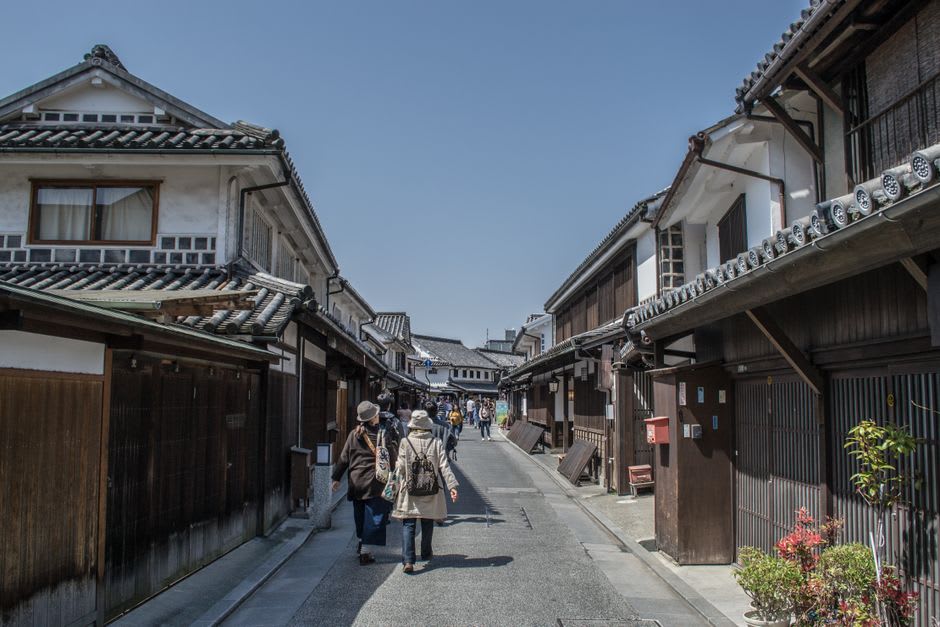
Beyond the Ohara there’s a cluster of smaller museums and folk-craft collections tucked into converted warehouses, and the whole quarter rewards ducking through any open doorway. The Ivy Square complex, a former cotton mill wrapped in creeper, is worth a wander for the courtyard alone.
Denim and the back lanes
Okayama, and Kurashiki in particular, is the denim capital of Japan — the town where the country’s selvedge jeans are woven, dyed and stitched, prized by obsessives worldwide. There’s a whole alley of it, Denim Street, where the shops sell indigo everything and a stand serves denim-blue soft-serve that is exactly as unnecessary and delightful as it sounds. We poked through a workshop where an old machine was clattering out fabric and a man happily explained the indigo-dyeing to us in more detail than my Japanese could follow. I came away with a pair of jeans I couldn’t really justify and have worn ever since.
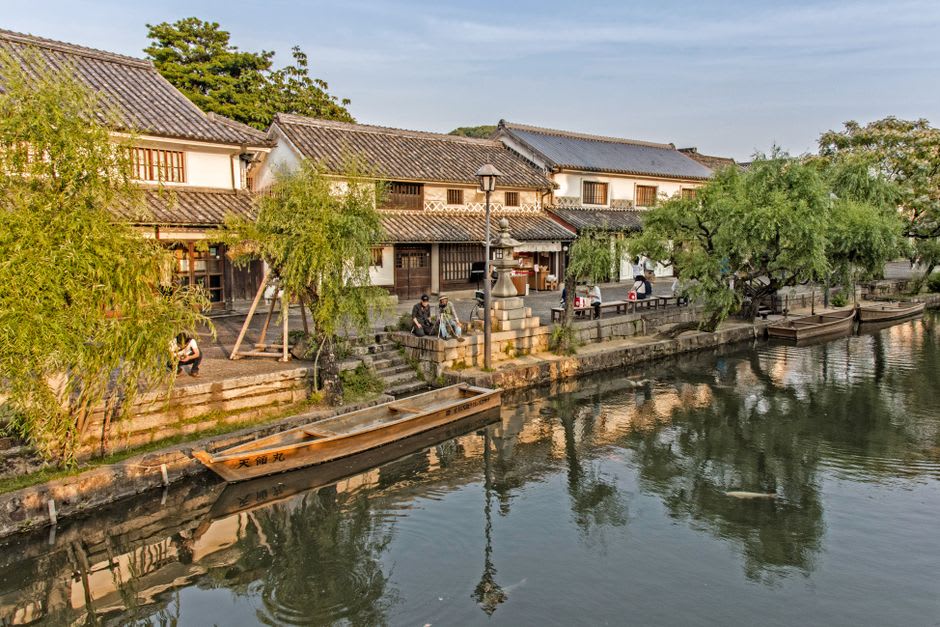
As the afternoon crowds thinned we climbed the low hill of Achi Shrine behind the quarter, and Kurashiki laid itself out below — the grey-tiled roofs, the thread of the canal, the willows going gold in the last light. It’s a small place. It doesn’t ask for much of your time. It quietly takes more than you meant to give.
Getting There
Kurashiki is a short hop from Okayama, itself a major Shinkansen stop under an hour from Osaka and around three and a half hours from Tokyo. From Okayama station, the local San’yō line reaches Kurashiki in about fifteen minutes, and the Bikan quarter is a ten-minute walk from the south exit. It works well as a half-day stop between Osaka and Hiroshima, but stay into the evening if you can — the canal empties out at dusk and the warehouses light up softly along the water.
Keep exploring
More of Chūgoku