Vicenza
"The city where one man's obsession with columns became the blueprint for half the world's government buildings."
A whole city built as one architect's private laboratory, where the villas and palaces of Andrea Palladio taught the world what a column should look like.
I didn’t fully understand Palladio until I stood in Vicenza. You think you know the style — every capitol building, bank, and plantation house from Washington to Saint Petersburg borrowed his vocabulary of pediments and porticoes — but seeing it concentrated in the one city where Andrea Palladio actually built is a different experience entirely. Vicenza, tucked between Verona and Padua in the Veneto plain, is essentially an open-air catalogue of his work, and UNESCO recognized it as such, inscribing the city and the Palladian villas of the surrounding Veneto region as a joint World Heritage Site.
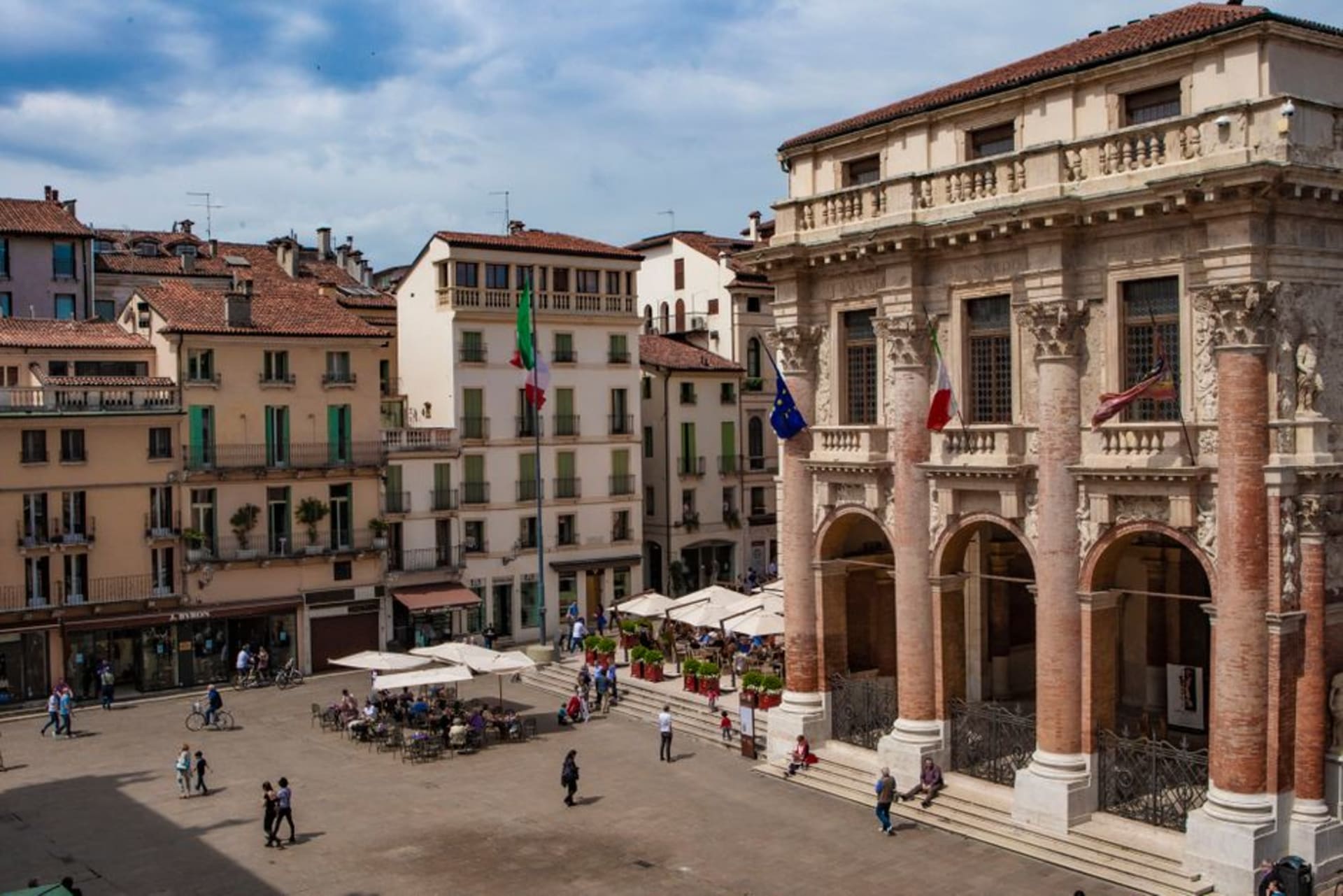
Palladio wasn’t from money — he trained as a stonemason before a local nobleman, Gian Giorgio Trissino, took him under his wing, sent him to study ancient Roman ruins, and gave him the classical education that let him translate what he saw into a coherent architectural language: proportion, symmetry, and the temple front applied to everything from churches to farmhouses. Vicenza’s central square holds his masterpiece civic project, the Basilica Palladiana, where he wrapped a medieval town hall in a two-story loggia of arches and columns so elegant that the design became the template for the term “Palladian window” used by architects for the next four centuries. I climbed to its rooftop terrace on a clear afternoon and watched the whole town unfold beneath a copper-green ship’s-hull roof, the Dolomites’ foothills visible on the horizon.

A Theater and a Villa
At the edge of the old town sits the Teatro Olimpico, Palladio’s final work, completed after his death by his student Vincenzo Scamozzi in 1585. It’s the oldest surviving enclosed theater in the world, and its stage set is a permanent, fixed piece of trompe-l’oeil trickery: seven streets radiating backward in forced perspective, built at a shrinking scale so that actors walking down them appear to recede into an entire imagined city. I sat in the wooden tiered seating for a long while just working out how the illusion was constructed, and I still don’t think I fully cracked it.
Just outside town, on a low hill, stands the Villa Almerico Capra, better known as La Rotonda — a private villa Palladio designed with four identical porticoed façades and a central dome, so that whichever direction you approach from, you’re greeted by the same perfect temple front. It has been imitated more than perhaps any residential building in history, from Chiswick House in London to Thomas Jefferson’s Monticello, and standing in front of it you understand instantly why: it doesn’t look like a house so much as an idea about what a house could aspire to be.
Gold and Everyday Life
Vicenza has a second, less romantic identity: it’s one of Italy’s major centers for gold and jewelry manufacturing, home to the Vicenzaoro trade fairs that draw buyers from across the world. It gives the town’s evening passeggiata a slightly different glint than elsewhere in the Veneto — window displays of gold alongside the usual gelato and Aperol crowd. I liked that contrast, the working city sitting comfortably beside the museum city, neither one performing for the other.
When to go: May through June or September, when the villas and gardens around the city are open and green, and before the summer heat settles over the Veneto plain.