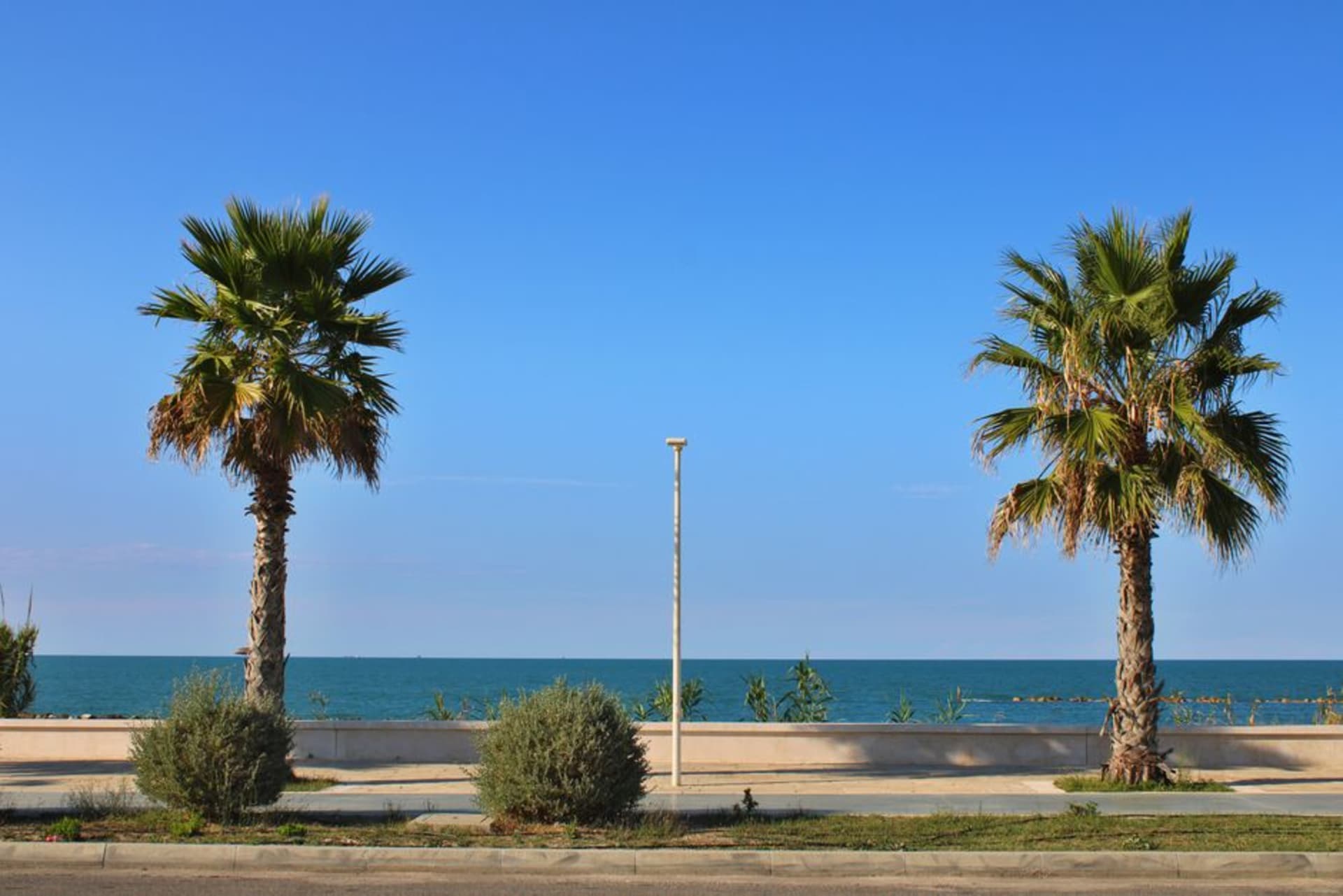
Molise's one real seaside town, a walled old quarter on a rocky spur above the Adriatic, where the fishing boats still work the trabucchi at dawn.
If Molise has a resort town, it’s Termoli, and even calling it that overstates things in the best possible way — this is still a working fishing port first, a beach town second. The Borgo Antico, the old walled quarter, sits on a low rocky promontory jutting into the Adriatic, encircled by fortifications the Swabians strengthened under Frederick II in the thirteenth century. From certain angles, especially from the water, the whole old town looks like it’s floating just above the sea.
The Borgo and the Cathedral
Inside the walls, Termoli’s streets narrow into the kind of whitewashed, sun-bleached alleys that make you instinctively lower your voice. At the center stands the Cattedrale di Santa Maria della Purificazione, a Romanesque church built in the twelfth century over an earlier structure, with a facade of pale stone and a rose window that catches the late afternoon light in a way that stopped me mid-step the first time I walked past. Beneath the cathedral, a crypt holds relics believed to be those of Saint Basso, and the building survived a partial collapse from a 1456 earthquake and later reconstruction — a reminder that this stretch of the Adriatic has never been entirely gentle with the people who settled it. The Castello Svevo, the squat Swabian castle at the promontory’s tip, still guards the approach from the sea, built for exactly the kind of raids — Ottoman, Venetian, pirate — that plagued this coast for centuries.

Trabucchi and the Tremiti Crossing
What I didn’t expect was the trabucchi — the spindly wooden fishing platforms, all beams and pulleys and suspended nets, that dot this stretch of Adriatic coast between Molise and Gargano in Puglia. They look almost prehistoric, built by fishing families generations ago to work the water without boats, lowering huge nets from platforms anchored directly to the rock. A few near Termoli still operate, and at least one has been converted into a small restaurant where you eat what was caught hours earlier, suspended over the waves. Termoli is also the departure point for ferries to the Isole Tremiti, a small volcanic archipelago out in the Adriatic with clear water and a scattering of coves that draws day-trippers all summer — I took the crossing on a whim and spent the day regretting nothing about it.

Eat fish soup here — brodetto termolese, the local variant made with at least a dozen kinds of seafood and a base that varies from cook to cook, no two versions quite alike, each family swearing theirs is correct. The old town’s fish restaurants, tucked into arches along the sea wall, serve it with bread for dipping and no ceremony at all, which is exactly how it should be.
When to go: June and September for warm sea temperatures without the peak-August crowds, and calm enough water for the Tremiti ferry crossing to be pleasant rather than a test of endurance.