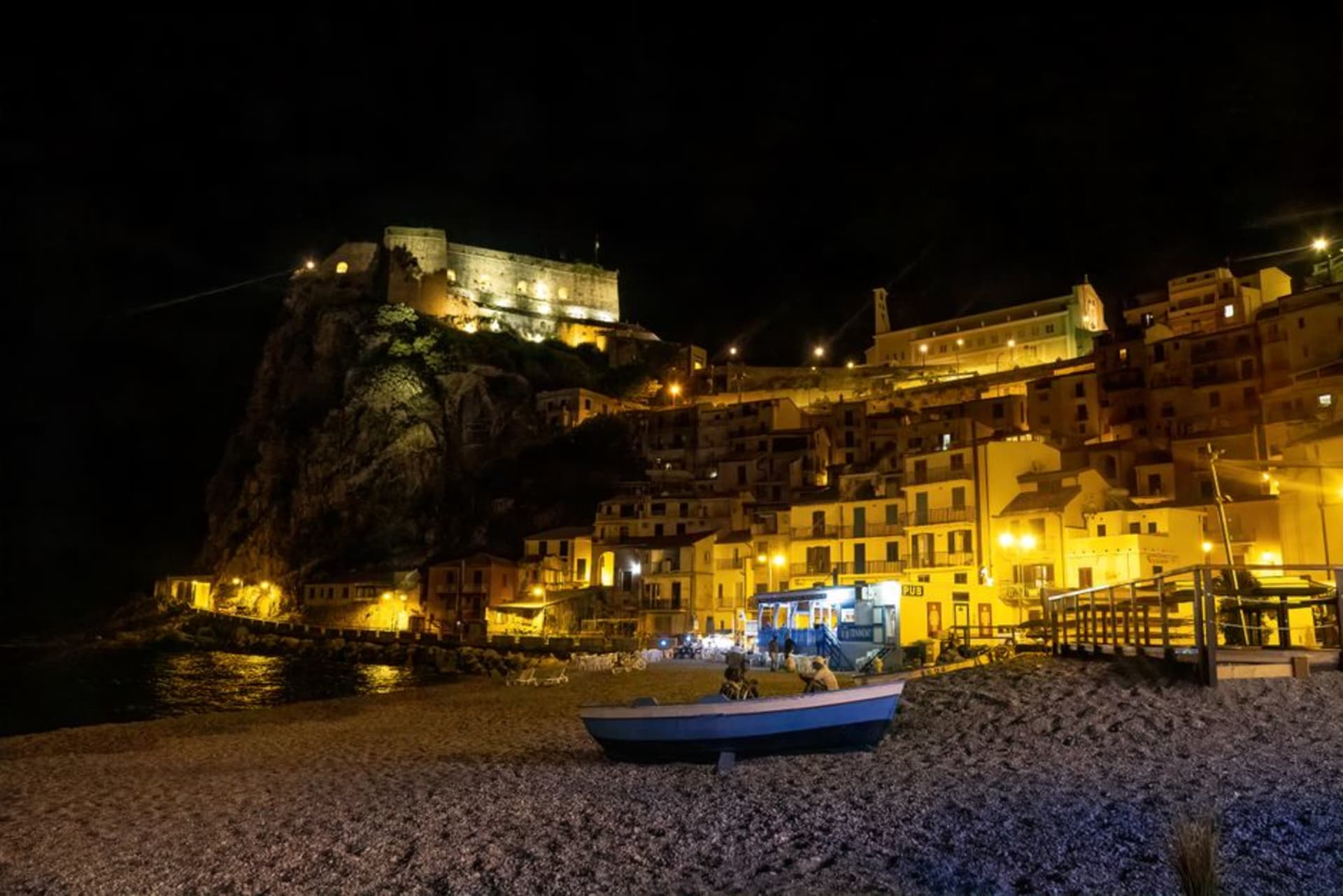
The fishing village that gave Homer a sea monster, and gave me the best sunset I've seen on the Calabrian coast.
Scilla is named for a monster, which is either the best or worst marketing decision a town has ever made depending on how you feel about mythology. In the Odyssey, Homer placed the six-headed sea creature Scylla on the Calabrian side of the Strait of Messina, opposite the whirlpool Charybdis on the Sicilian shore, and told sailors that navigating between them meant choosing your poison — hence the phrase “between Scylla and Charybdis,” still used by people who have never once thought about where it came from. Standing on the beach here, looking across the strait at Sicily close enough to make out its coastline in detail, the myth makes perfect sense: this narrow, current-thrashed channel really did need an explanation, and a monster was as good as any.
The town itself splits into distinct pieces that somehow function as one place. Above, on the headland, sits the Castello Ruffo, a fortress with roots going back to Greek and Roman times and a long history of changing hands between Normans, Aragonese, and the Ruffo family, who gave it its current name. Below the castle spreads Marina Grande, the main beach and town center. But the part of Scilla that stopped me mid-sentence the first time I saw it is Chianalea, the old fishing quarter, where houses rise directly out of the water with boats moored practically at the front doors, earning it the nickname “the Venice of the South” — a comparison I’d usually roll my eyes at, except here it actually holds up.
Walking Through Chianalea
I spent an entire evening just wandering Chianalea’s single narrow lane, which runs parallel to the shore with the sea on one side close enough to touch and centuries-old fishermen’s houses stacked on the other. Laundry strung between buildings, cats asleep on warm stone steps, the sound of the water slapping against foundations that have absorbed that same sound for hundreds of years. Fishing has defined this quarter for as long as anyone can trace it, and it still does — small boats tied up right against the buildings, nets drying over railings, the whole neighborhood organized around the rhythm of people who go out before dawn and come back with the day’s catch.

Swordfish and the Strait
The Strait of Messina is famous for its swordfish, and Scilla has fished them using a method that looks almost absurd from a distance: tall, narrow boats called feluche with towering masts, from which a lookout spots the fish and a harpooner strikes from a long bow platform — a technique with roots stretching back to Greek antiquity, adapted over centuries but recognizably the same idea. I didn’t manage to see one out on the water during my visit, the season and the light not cooperating, but the tradition shapes everything about how the town eats: swordfish grilled simply, swordfish in involtini, swordfish that ends up on nearly every trattoria menu along Chianalea’s edge.

I climbed up to the castle terrace as the sun went down behind Sicily, the strait turning gold and then a deep violet, ferry lights beginning to blink across the water toward Messina. Between the myth, the fortress, and the fishing lane below, Scilla manages to compress most of what makes Calabria worth the detour into one small headland.
When to go: Late spring through early autumn for warm swimming and the liveliest Chianalea evenings; aim for a clear day if you want the best visibility across the strait to Sicily.