Pompeii
"I've walked through a lot of ruins. Pompeii is the only one that made me lower my voice without meaning to."
Pompeii doesn't ask you to imagine ancient Rome — it hands you the bread ovens, the wheel ruts, and the plaster casts of the people who didn't make it out, and lets the silence do the rest.
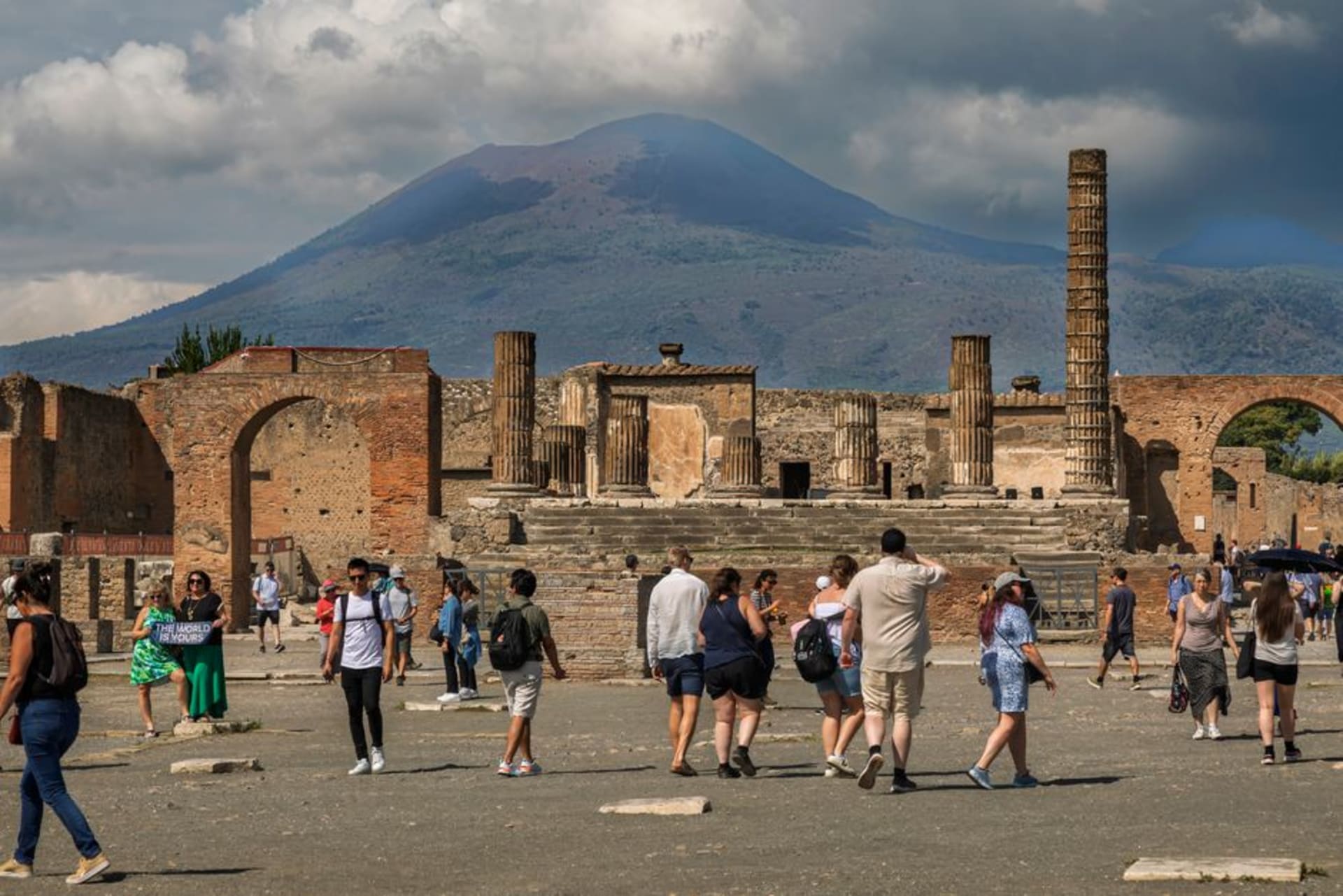
I got to the Porta Marina gate early, before the tour buses from Naples and Sorrento had fully unloaded, and it still wasn’t early enough to have the place to myself — but it was early enough to walk the first stretch of the Via Marina alone, wheel ruts worn deep into the volcanic stone paving under my feet, exactly where Roman cart wheels ground them down two thousand years ago. Mount Vesuvius sits there the whole time, unavoidable, greenish and almost gentle-looking from this distance, which is the entire problem. On August 24th, 79 AD — the traditional date, though modern research suggests it may have actually been October — Vesuvius buried this city of an estimated ten to twenty thousand people under six meters of ash and pumice in under a day. It’s the volcano’s proximity that makes Pompeii unbearable in the best way: you’re never looking at the ruins without also looking at the thing that caused them.
Streets Frozen Mid-Sentence
What gets me about Pompeii isn’t the grand buildings, though the Forum and the amphitheater — one of the oldest surviving Roman amphitheaters, predating the Colosseum by over a century — are genuinely impressive. It’s the smaller, stupidly specific details. A bakery on Via dell’Abbondanza still has its millstones and brick oven intact, blackened, exactly as the baker left it. Fast-food counters called thermopolia line several streets, with round holes cut into stone counters where jars of wine, oil, and hot food once sat, serving Romans who didn’t cook at home any more reliably than I do now. Political campaign slogans are still legible, painted in red on exterior walls, endorsing candidates for offices that stopped existing the same afternoon the endorsements went up. I stood in front of one for a long time doing the math on how ordinary that Tuesday must have felt to whoever wrote it.

The Casts
Nothing prepares you for the plaster casts, even when you know they’re coming. In the 1860s, excavator Giuseppe Fiorelli realized that the ash had solidified around the decomposing bodies of victims, leaving voids in the compacted pumice — hollow spaces in exactly the shape of the people who died there. He poured plaster into the cavities, and what emerged were casts of actual human beings in their actual final positions: a family huddled together in the Garden of the Fugitives, a dog still on its chain, a figure with an arm raised against something that had already killed him. These aren’t sculptures. They’re negative space filled in, the literal shape of a moment of death eighteen centuries preserved in volcanic rock. I’ve read plenty of history that tells you what happened here. The casts are the only thing I’ve encountered that make you feel it happening.

I ended the afternoon at the Villa of the Mysteries just outside the main walls, where a cycle of nearly life-sized frescoes — thought to depict initiation rites into the cult of Dionysus — has kept its color with a clarity that shouldn’t be possible after two thousand years underground. Red backgrounds, figures mid-ritual, robes still faintly luminous. It’s a fifteen-minute walk from the crowds at the Forum and I saw maybe six other people the whole time I was inside.
When to go: Early morning in spring or autumn — the site has almost no shade, summer heat on exposed stone is brutal by midday, and arriving at opening beats the Naples day-trip crowds by a couple of hours.