Ischia
"I sat in a thermal pool carved straight into volcanic rock, wine in hand, and thought: Capri gets the fame, but Ischia got the better deal."
Ischia is Capri's volcanic, unpolished sister — thermal springs bubbling out of the ground, castles on islets, and a pace slow enough that I stopped checking my phone by the second day.
The ferry from Naples to Ischia takes about an hour, and I spent most of it watching Capri’s silhouette recede in the other direction, half-wondering if I’d picked the wrong island. I hadn’t. Ischia announces itself differently — bigger, greener, visibly volcanic, with Monte Epomeo rising almost 800 meters out of the island’s center and vineyards terracing down toward a coastline that alternates between black volcanic sand and pale ordinary sand depending on which town you’ve wandered into. This is the largest island in the Bay of Naples, and it doesn’t try to compress itself into a single piazza the way Capri does. It sprawls, and I liked it for that.
A Castle That Isn’t a Metaphor
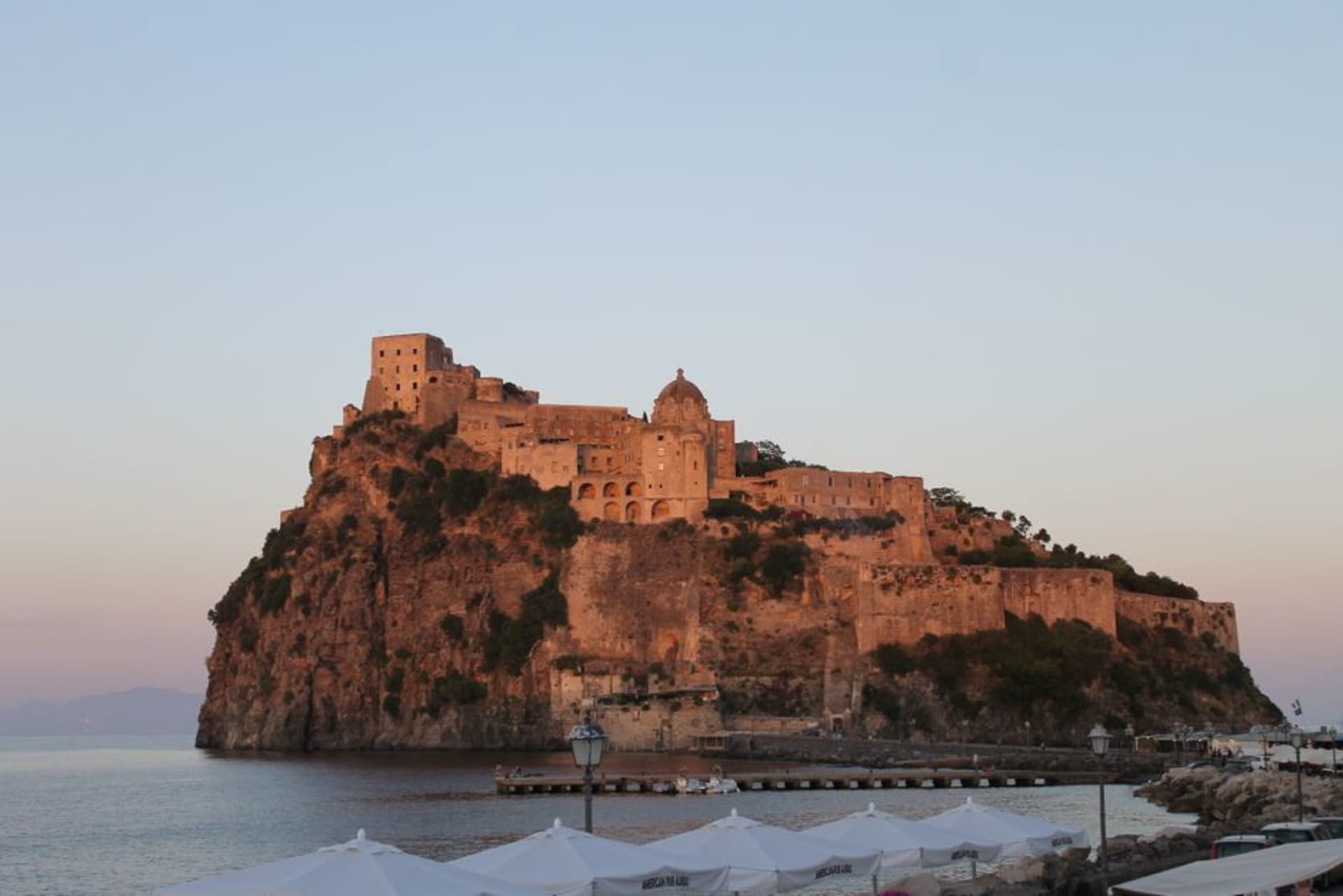
Ischia Ponte, one of the island’s six comuni, is built around the Castello Aragonese, a genuinely formidable fortress perched on its own volcanic islet and connected to the main island by a stone causeway built in the 1400s. Greeks first fortified this rock in the 5th century BC, and over the following two thousand years it passed through Roman, Byzantine, and finally Aragonese hands — Alfonso V of Aragon built the current bridge and expanded the fortifications in 1438, and at its peak the islet held a small city of its own, complete with a cathedral, convents, and roughly two thousand residents. I walked up through olive groves and past a former convent with a genuinely unsettling crypt — the nuns of the Poor Clares used to seat their dead sisters in stone chairs to decompose in view of the living, a memento mori nobody asked for but nobody forgets either. From the top, the view stretches back over Ischia Ponte’s fishing boats and out to the mainland.

The Water That Made the Island Famous
Ischia’s real business, though, has always been thermal water. The island sits on active volcanic ground, and hot mineral springs surface everywhere — some feeding elaborate spa parks with terraced pools of varying temperature, others just bubbling up on public beaches where locals dig their own hand pools in the sand at Sorgeto, a cove reachable only by a few hundred steep steps down a cliffside near Panza. I went in the early evening, when the tour groups had thinned out, waded into water hot enough to make me gasp, and sat there with the Tyrrhenian Sea lapping cooler water in from a few meters away, mixing hot and cold depending on where I positioned myself. It’s the kind of experience that resists exaggeration because it really is as good as it sounds — free, unglamorous, and entirely dependent on geology doing something the Romans also noticed two thousand years earlier, which is why they built baths here too.

Inland, the island’s volcanic soil produces genuinely excellent wine — Biancolella and Forastera grapes grown on terraces that require hand-harvesting because no machine can manage the slopes. I had a bottle of Biancolella with dinner in Ischia Porto that tasted faintly of the same minerality I’d just been soaking in, which felt less like coincidence than like the whole island being made of one substance wearing different outfits.
When to go: May, June, or late September for warm thermal water without peak-August crowds; the spa parks are genuinely pleasant even in cooler shoulder-season weather since the water itself runs hot year-round.