
A Norman cathedral, a crescent of golden sand, and a rock looming over both — Cefalù is Sicily distilled into a single postcard that somehow still feels lived-in.
I arrived in Cefalù by train from Palermo, the coastline unspooling on one side and the interior’s dry hills on the other, and the town announced itself the way all the best Sicilian towns do — suddenly, around a bend, with a mountain behind it and the sea in front. La Rocca, the limestone outcrop that hangs over the old town, is what you notice first. It has watched over this stretch of the Tyrrhenian coast since the Greeks fortified it, and its silhouette does more to define Cefalù than any single building does, which is saying something given what sits at its base.
That something is the Cattedrale di Cefalù, one of the great Norman-Arab-Byzantine buildings of Sicily, commissioned by King Roger II in the twelfth century after — legend has it — he survived a shipwreck on the beach below and vowed to build a church in gratitude. Whatever the truth of that story, the result is extraordinary: twin towers flanking a facade that looks almost defensive, and inside, a Christ Pantocrator mosaic in the apse so severe and luminous it stops conversation. I have seen the more famous mosaics at Monreale and in Palermo’s Palatine Chapel, and I will say plainly that Cefalù’s Christ, alone in that half-dome with gold pooling around him, is the one that stayed with me longest.
The Town Below the Rock
Walk down from the cathedral into the medieval core and Cefalù turns into a labyrinth of narrow lanes, laundry strung between balconies, and the smell of fried arancini drifting from doorways. The Lavatoio Medievale, a medieval public washhouse built over a natural spring, sits down a stone staircase near Via Vittorio Emanuele — a strange, damp, atmospheric little monument to the town’s ordinary history rather than its grand one. I ducked in mostly out of curiosity and ended up staying twenty minutes, watching light filter through the grates onto water that has apparently never stopped flowing since antiquity.
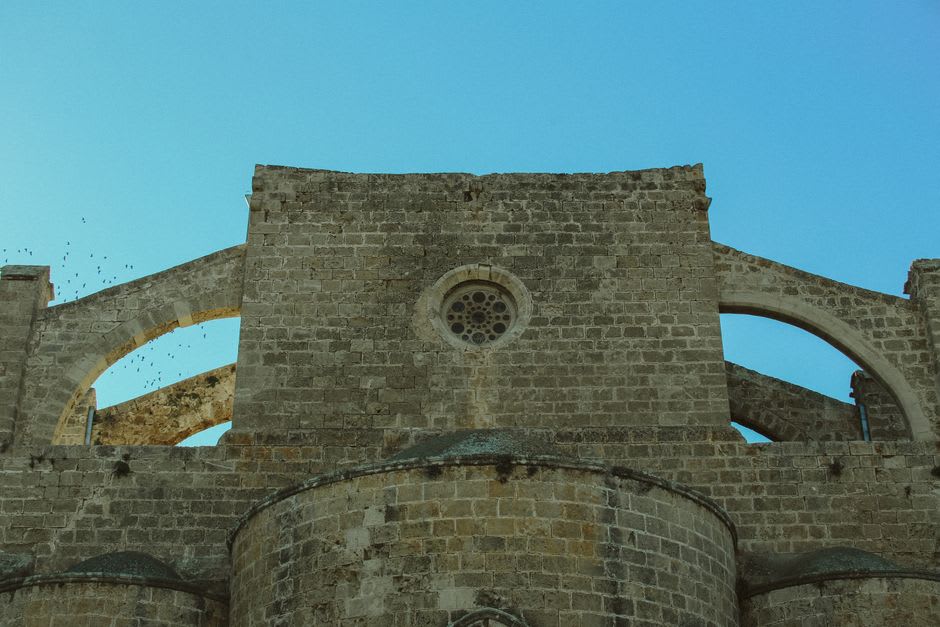
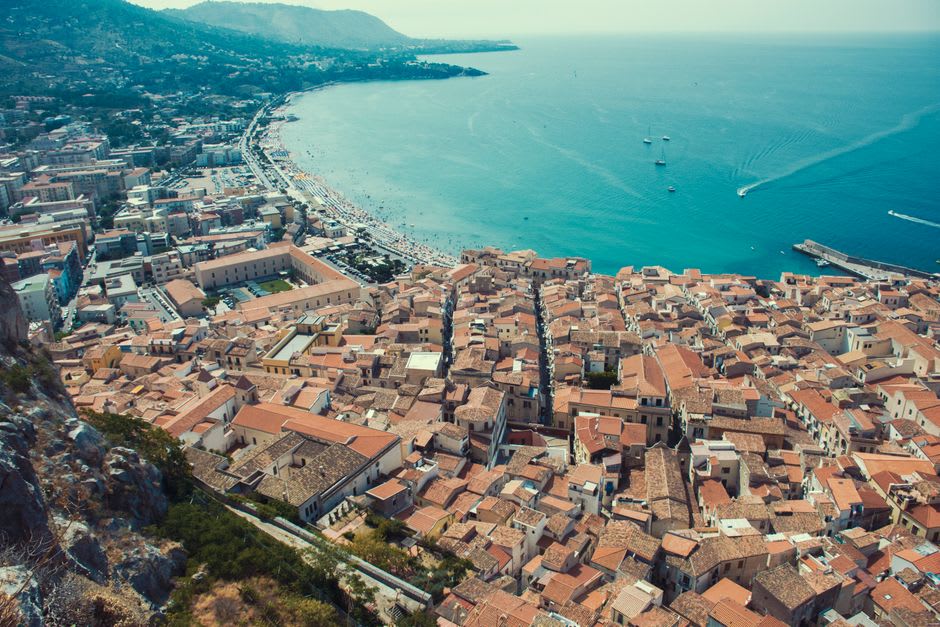
Then there is the beach, which is the part of Cefalù most people actually come for, and which I will not pretend to look down on. The main strand curves right up against the old town walls, so you can swim in clear water with the cathedral’s towers rising behind you — a combination of monument and mediterranean that few places manage without irony. In summer it fills fast, fishing boats pulled up alongside sunbathers, but walk toward the far end near the old fishermen’s houses and the crowd thins considerably.
Climbing La Rocca
If you have the legs for it, the climb up La Rocca is worth the sweat. A signposted path switchbacks up through scrub and wild fennel to the Temple of Diana, a megalithic structure that predates the Greeks, and continues to fragments of the fourth-century BC fortification walls at the summit. From up there Cefalù reduces itself to a diagram — the cathedral’s roofline, the grid of the old town, the curve of the bay — and the wind off the sea makes the whole ascent worthwhile even before you’ve caught your breath.
I ate dinner that night at a table set up almost on the sand, a plate of pasta con le sarde — sardines, wild fennel, pine nuts, raisins, a dish that manages to taste like the whole island’s contradictions resolved into one bowl — while the cathedral’s floodlit facade watched from up the beach. Cefalù is touristy now, more than it was even a decade ago, but it earns the attention. Not every town can carry a Norman masterpiece and a proper beach without one undercutting the other.
When to go: Late May to June or September offers warm sea temperatures without the peak-July crush; the cathedral and La Rocca are best tackled in the cooler morning hours regardless of season.