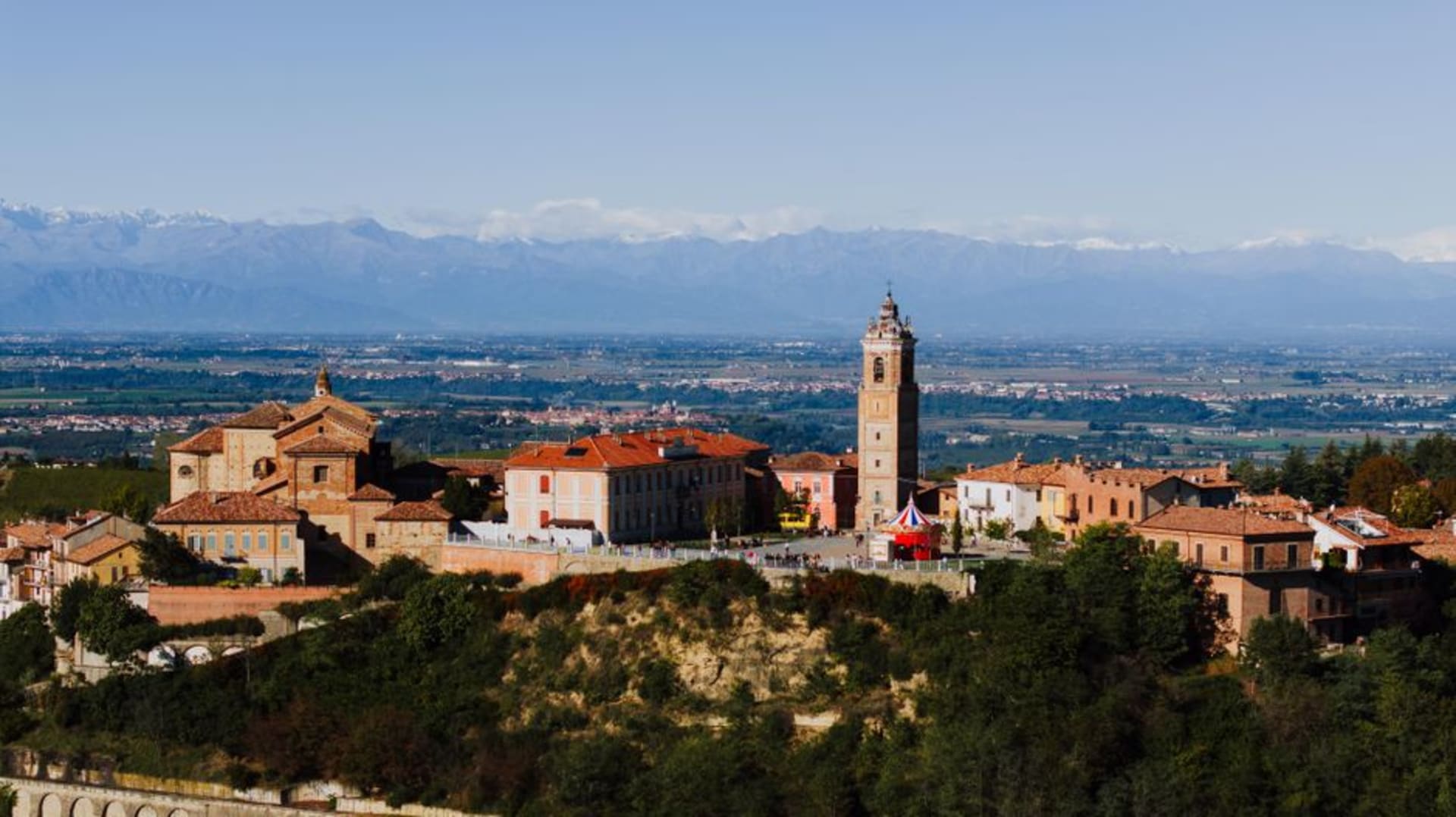
A city that smells faintly of fermenting grapes for one week a year and quietly of Romanesque stone the other fifty-one.
I came to Asti expecting a footnote to Barolo — the place printed on the label of the sparkling wine my mother-in-law brings out at Christmas — and left slightly embarrassed at how little I’d known. Asti is one of Piedmont’s oldest cities, a Roman colony that later became a fiercely independent medieval commune, rich enough on wool and banking to build dozens of defensive towers, the kind Bologna and San Gimignano get all the tourist credit for. A handful survive: the Torre Troyana and the Torre Comentina still punch up out of the rooftops, brick fists left over from a time when Asti’s noble families feuded so viciously that height itself was a weapon — the taller your tower, the harder you were to burn out.
A Cathedral and a Square
The Collegiata di San Secondo anchors the main square, dedicated to the city’s patron saint, a Roman soldier martyred here in the third century and later folded into Asti’s civic identity so completely that the Palio di Asti, one of Italy’s oldest horse races, predates even Siena’s more famous version — some records place it as early as 1275. I happened to be passing through in September once, not for the Palio itself but close enough to see the contrade banners already strung across side streets, and the whole town had that pre-festival hum, half-decorated, half-impatient. The Duomo di Asti, meanwhile, is one of the great unheralded Gothic buildings of northern Italy — brick, soaring, and almost always empty of the crowds that choke Milan’s.

The Wine Underneath Everything
But it is impossible to talk about Asti without talking about what’s in the glass. This is the beating heart of Moscato d’Asti and Asti Spumante, sweet, low-alcohol sparkling wines made from the aromatic Moscato Bianco grape grown on the hills that ring the city. I’ll admit a prejudice here: I came from Bordeaux country and grew up mildly snobbish about sweet sparkling wine, the kind of thing served at baby showers rather than taken seriously. Piedmont cured me of that. A glass of properly cold Moscato d’Asti, drunk in the hills above the city with a plate of hazelnuts and a wedge of Robiola, is one of the more purely pleasurable things I’ve had in a glass, and at 5-6% alcohol you can actually keep drinking it through an afternoon without the evening collapsing. Barbera d’Asti, the region’s other great export, is the working red — sharp acidity, dark fruit, the wine every Piedmontese trattoria pours by the carafe without ceremony.

Asti rewards the traveler who treats it as a base rather than a destination — a place to sleep and eat well while the vineyards of Barbaresco, Barolo, and the Langhe unfold within a short drive. But give the city itself an afternoon. Wander the porticoed streets near Via Cavour, find a wine bar that still pours by the glass without an app or a sommelier’s monologue, and let a place that has spent a thousand years being slightly overlooked make its own case.
When to go: September is unbeatable, both for harvest season in the surrounding vineyards and for the Palio di Asti, usually run on the third Sunday of the month. Late spring works too, before the summer heat settles into the Piedmont plain.