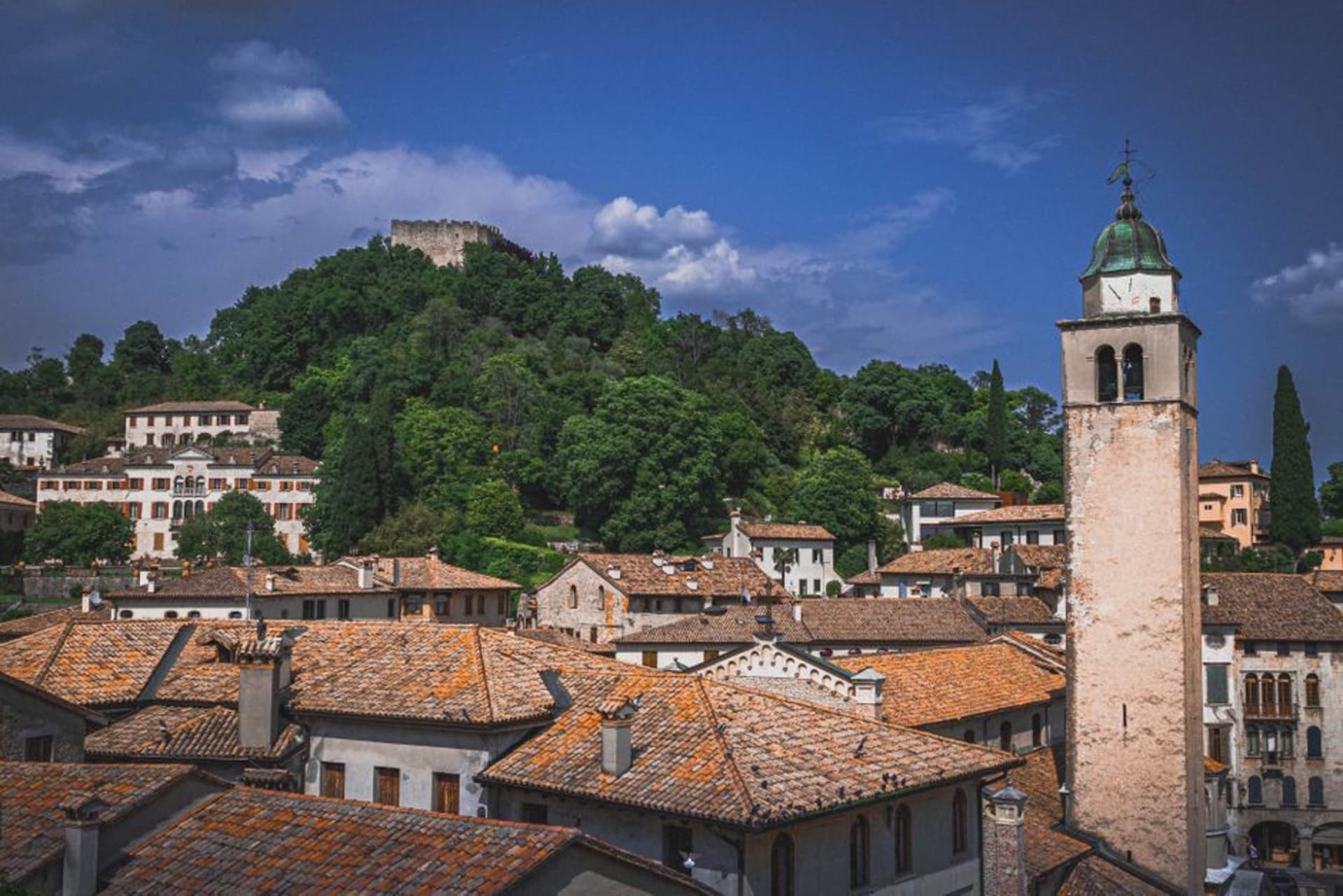
A hilltop town so poised and so quiet that a queen chose it for exile and a poet coined a word just to describe its light.
Asolo sits on a hill above the Venetian plain the way a lookout post sits above a valley — you can see the whole approach before you arrive, church towers and cypress rows and the fortress ruin on the summit, and by the time you’re actually walking its arcaded main street the anticipation has already done half the work. This is a town that has always attracted people who wanted to disappear a little. Caterina Cornaro, the deposed Queen of Cyprus, was given Asolo as a consolation prize by the Venetian Republic in 1489 and held a small, cultured court here for two decades — poets, musicians, philosophers gathering in what was essentially a gilded retirement. It set the tone the town has kept ever since.
The word “asolare” — to pass time aimlessly and pleasantly, without particular purpose — was coined here, or at least popularized by the Renaissance writer Pietro Bembo, who wrote his dialogues on love, “Gli Asolani,” while a guest at Cornaro’s court. Robert Browning loved the town so much he wrote a whole book of poems called “Asolando” and more or less claimed to have invented the English verb “to asolate” in its honor. I don’t think I’ve ever been anywhere whose entire cultural identity is built around the concept of unhurried wandering, and walking the porticoed streets under the arcades, past shuttered pastel façades and the odd fresco peeling gently off a wall, I understood the impulse completely.
The View From the Rocca
Climb up to La Rocca, the medieval fortress at the very top of the hill — it’s a stiff walk through olive groves and cypress, but the reward is a 360-degree view over the pre-Alps to the north and the flat Veneto plain running all the way toward Venice and the sea to the south on a clear day. I sat up there with a bottle of water and no plan for close to an hour, which felt appropriately in the spirit of the place. Down in the town itself, the eight-hundred-year-old Rocca aside, there’s a small but excellent museum dedicated to Eleonora Duse, the great Italian actress who is buried in Asolo’s cemetery and who, like Cornaro before her, chose this town as her retreat from a much louder public life.

A Town Built for Slowness
There isn’t a headline attraction that demands hours of your day here, and that’s rather the point. You wander the arcades of Via Browning, stop for a coffee at a café that’s been open since the town’s belle-époque heyday, admire the frescoed facades of the old palazzi, and let the afternoon dissolve. The surrounding countryside is prosecco and villa territory too — several Palladian villas dot the hills nearby, part of the same UNESCO-listed architectural landscape that stretches across the Veneto. I remember the specific quality of light in the late afternoon, gold and slightly hazy over the plain below, and thinking that if a word had to be invented for a place, this was the right place for it.

When to go: Late spring or early autumn, when the hill town is at its greenest and the terrace cafés are busy with locals rather than day-trippers from Venice.