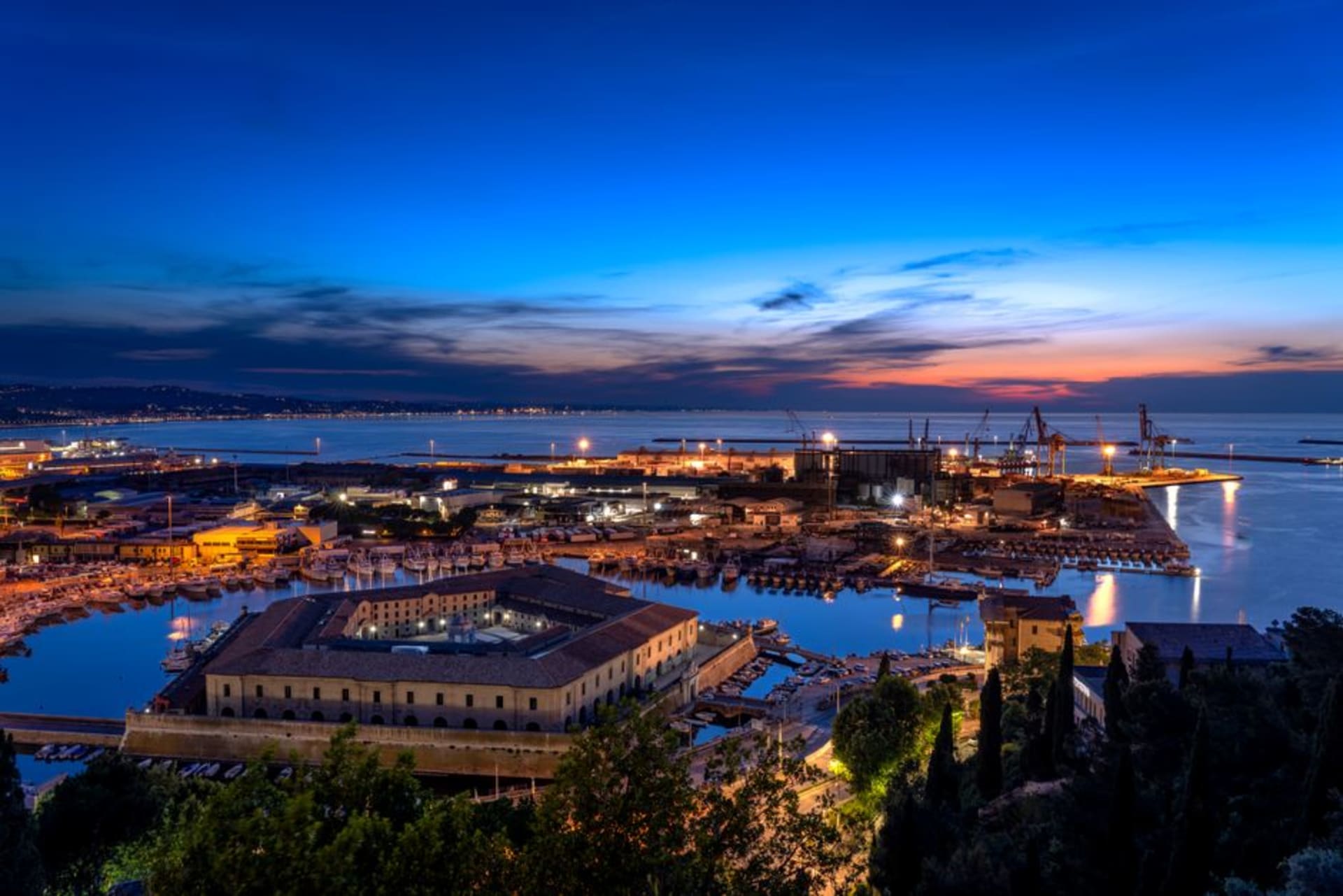
A working port city built inside the elbow of a limestone headland, where a Byzantine-domed cathedral watches ferries leave for Croatia and Greece.
Ancona doesn’t try very hard to charm you, and that’s precisely what I ended up liking about it. Most Italian coastal towns lean hard into postcard prettiness — pastel houses, curated harbors, a promenade built for evening strolls. Ancona, the regional capital of the Marche, is a real working port first: container cranes, ferry terminals sending boats to Split and Patras and Igoumenitsa, a naval history that goes back to the Greeks, who founded the city around the fourth century BC and gave it a name derived from ankon, meaning “elbow,” for the sharp bend in the coastline that still shapes the harbor today. It got bombed hard in World War II and rebuilt in a mostly practical, unglamorous style, and it wears that history plainly rather than dressing it up for visitors.
The Cathedral on the Elbow
Climb Monte Guasco, the hill at the city’s northern edge, and you reach the Cattedrale di San Ciriaco, Ancona’s cathedral, standing on the site of what was once a Greek acropolis and later a Roman temple to Venus. The building itself is a genuine oddity in an Italian context — Romanesque in its bones but crowned with a Byzantine-influenced dome, its floor plan a Greek cross, betraying just how much this Adriatic port looked east across the water as much as it looked toward Rome. I climbed up there in the early evening and had the terrace almost to myself, looking straight down at the curve of the harbor with its ferries lit up and idling, waiting for their overnight crossings. It’s one of the better cathedral views on the Adriatic coast, and one of the least crowded I’ve found.

Trajan’s Arch and the Fish Market
Down at sea level, right on the harbor, stands the Arco di Traiano, a pristine white marble Roman arch built in the early second century AD to honor the emperor Trajan for expanding and improving Ancona’s port — the same fundamental function the city still serves two thousand years later. It’s a strange, quiet thing to find a nearly intact Roman monument standing feet from working ferry docks and container ships, ancient infrastructure literally overlooking modern infrastructure doing the same job. Ancona is also, unsurprisingly for a fishing port, one of the best places on the Adriatic to eat seafood without paying resort prices — brodetto, the local fish stew, varies by cook and by catch, and I had a version thickened with saffron and tomato at a no-frills place near the old fish market that outclassed fancier meals I’ve had elsewhere on this coast.

When to go: Late spring or early autumn — May and June especially, when the Adriatic is warming up but the summer ferry crowds haven’t hit the port yet, and the seafood is at its best.