Pazin
"Lia leaned over the railing, looked down into the hole the river vanishes into, and said one word: nope."
Everyone drives through Pazin on the way to somewhere prettier. It sits dead in the middle of the Istrian peninsula, equidistant from every hilltop town and beach that people actually photograph, and so it has the unhurried, slightly grumpy air of a place that has given up trying to compete. I came on purpose, because I’d read that the town is built on the edge of a chasm where a river simply disappears into the earth, and I have never been able to resist that kind of sentence.
The hole the river goes into
The Pazin Chasm — Pazinska jama — is the reason the town exists and the reason it’s worth the detour. The Pazinčica river runs along the bottom of a gorge and then, at the foot of the castle, slams into a cave mouth and vanishes underground, draining away through a karst system nobody has fully mapped. Standing on the bridge above it, you can hear the water before you see the drop, and then the ground just ends. Lia leaned over the railing, looked down, and declined to participate further. I understood. The walls fall away maybe a hundred metres into a green half-darkness, and the whole thing smells of wet stone and moss.
Jules Verne, who never set foot here, set part of Mathias Sandorf on this exact spot — his hero escapes the castle by being swept down the chasm. Dante is supposed to have used the gorge as inspiration for one of his circles of hell, though Dante is supposed to have been inspired by half the unpleasant geography in Europe, so take that with salt. What’s undeniable is that there’s now a zipline strung across the abyss, and I watched a teenager scream the entire way across while his friends filmed it, which felt like an appropriately modern footnote to the literary mythology.

The castle and the quiet
Pazin Castle (Kaštel) is the largest and best-preserved fortress in Istria, which surprised me, because nobody talks about it. It hangs right on the lip of the chasm — defensively brilliant, since one side simply cannot be attacked — and inside there’s an ethnographic museum with the kind of dim, dusty rooms full of farm tools and folk costumes that I find oddly moving. I had the place almost to myself on a Tuesday. The woman at the ticket desk seemed pleased and faintly astonished that I’d come.
The town itself rewards an aimless hour. There’s a Franciscan church with frescoes, a covered market, and cafés where men play cards with a seriousness usually reserved for surgery. I drank a coffee in the main square and ate a sandwich of Istrian prosciutto — the air-dried kind, drier and sharper than the Italian — and watched ordinary Croatian life happen, unbothered by anyone trying to sell me anything.

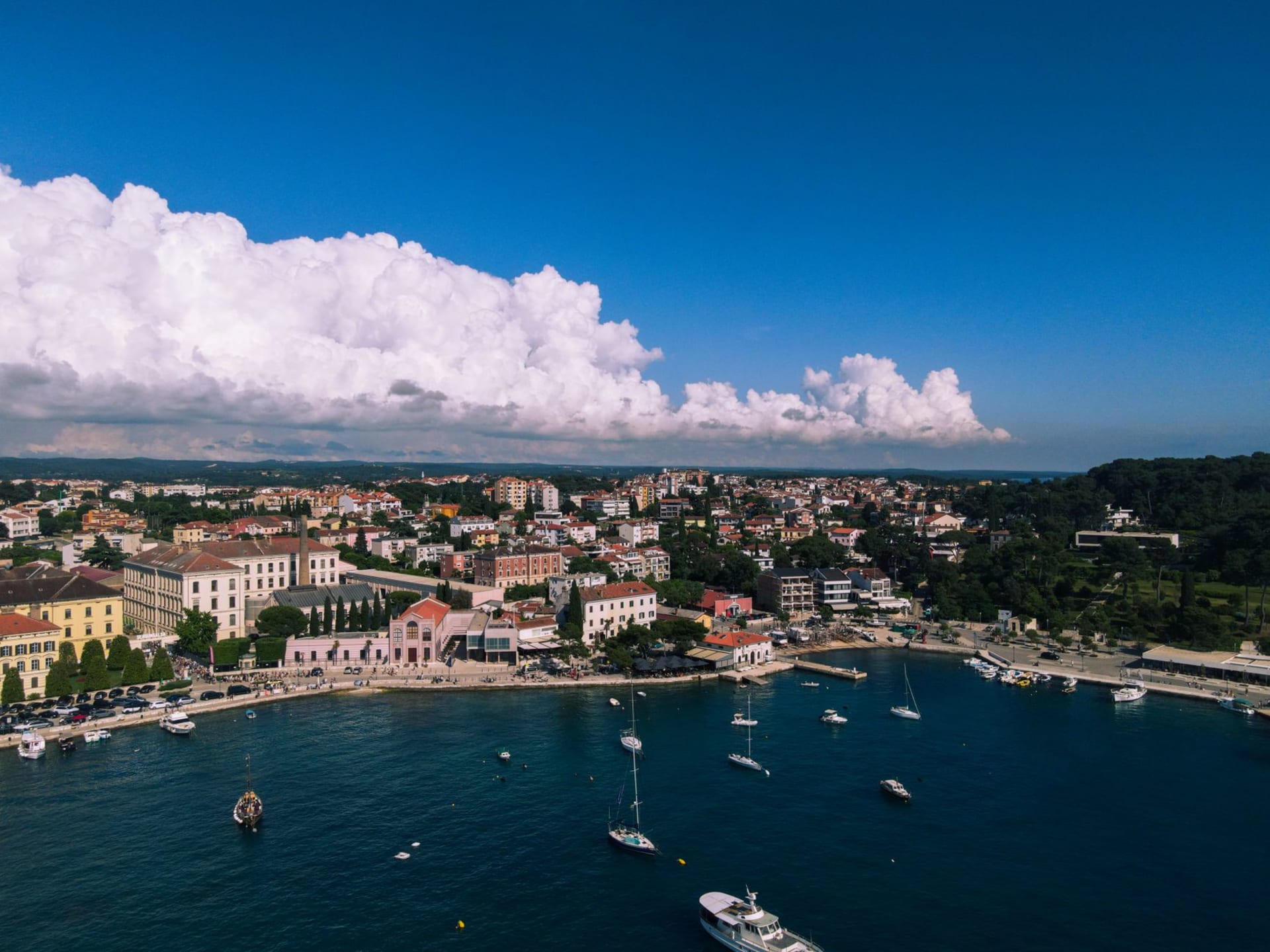
That’s the case for Pazin, really. It’s the anti-Rovinj: no Venetian postcard harbour, no crowds, no sunset crowd jostling for the same shot. Just a strange and genuine town wrapped around a geological accident, in the middle of a peninsula everyone else is busy driving across. Give it a morning. The coast will still be there.
When to go: Spring and autumn, when the chasm runs full and loud after rain — in high summer the river can shrink to a trickle and lose half its drama. The castle museum keeps shorter hours off-season, so check before you build a day around it.