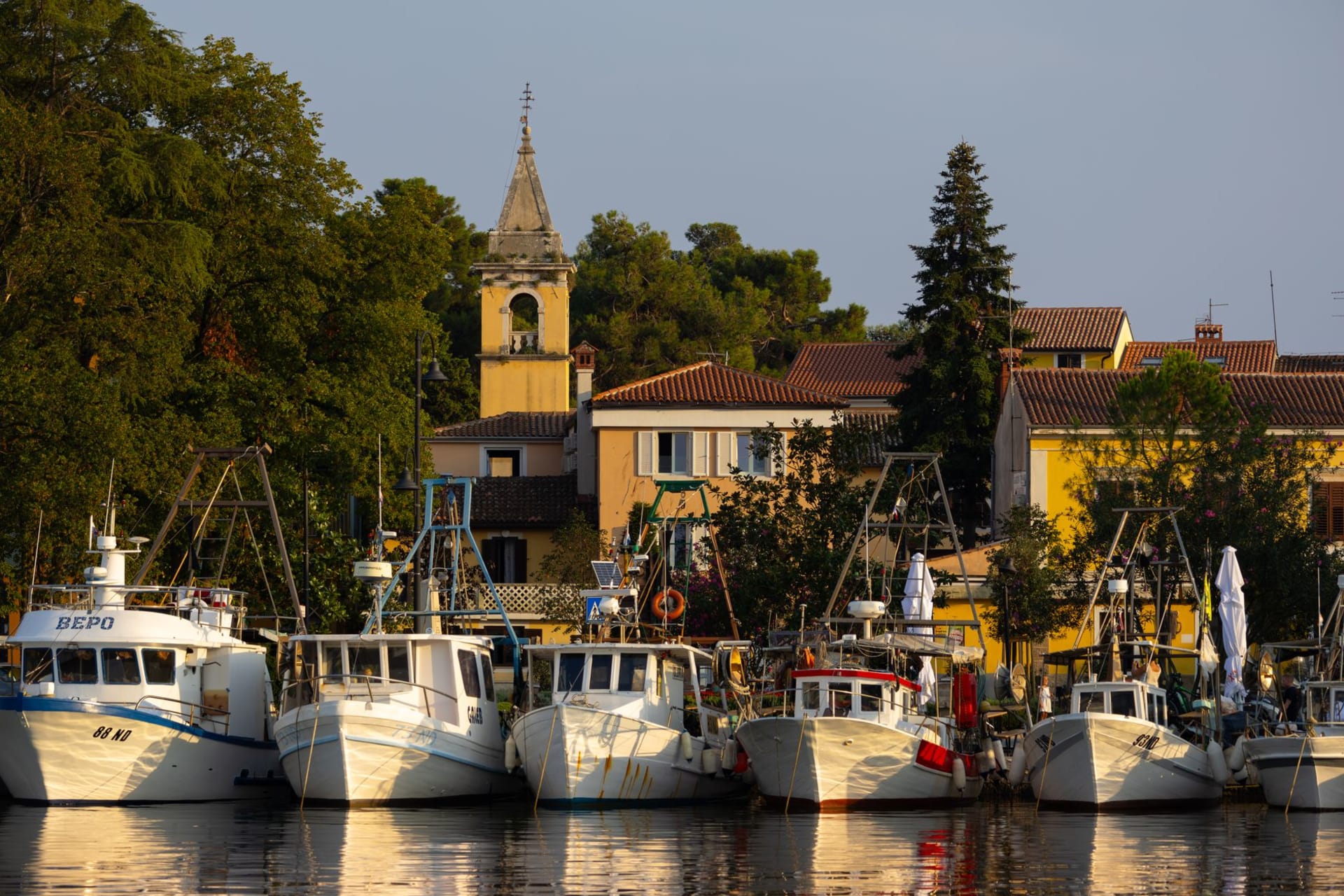
Grožnjan
"The village was dying so they gave it to the artists. Now it's alive in a way that makes you wonder about the original inhabitants."
The bar had a cat on the counter and paintings on every wall, including the ceiling, and the man behind it was both the barista and, as I gathered from the business card propped against the coffee machine, the artist responsible for the paintings. He brought me a macchiato without being asked, which seemed about right for a place that had decided en masse to skip several decades of conventional development and land somewhere more interesting.
Grožnjan sits at 245 metres in the Mirna valley hinterland, a medieval town that lost most of its Italian-speaking population after World War II and spent the following decades in a kind of productive forgetting. By the 1960s it was nearly empty. The Croatian authorities, with an inspired act of pragmatic surrealism, gave the village over to artists, offering studios in the abandoned stone houses. They came. They stayed. The International Youth Music Festival, running every summer since 1969, brings musicians from across Europe for weeks of rehearsal in a hilltop village with a population of a few dozen full-time residents. The acoustics in the old church are, apparently, exceptional.

Walking Grožnjan in the off-season — which is most of the year — is an exercise in comfortable disorientation. Galleries occupy spaces that were obviously, not long ago, a house where someone’s grandmother lived. A ceramicist works in a room that still has the outline of a hearth. The main loggia at the edge of town, which the Venetians built for administrative purposes, is now where people sit in the evening and look out over the valley toward the Mirna below, talking about nothing in particular. The view from the loggia is spectacular in any season: the valley floor quilted in olive groves and vineyards, the limestone ridges building toward the Slovenian border, the light in late afternoon turning everything a particular shade of amber that explains why painters ended up here.
The village has roughly two hundred and forty inhabitants now, depending on the season. In summer that number multiplies. In November it contracts to something that feels closer to a private arrangement between the remaining residents and the landscape. I visited in late October, between the summer crowds and the real winter emptiness, and found the balance close to perfect: a handful of galleries open, the music festival over but some of the musicians still around and audible through walls, a restaurant serving pasta with truffles from the nearby forest.

The Italian name was Grisignana, and the past lives on in the stonework: Venetian lions above doorways, a romanesque bell tower, the layout of a town built for function first and beauty incidentally, then inherited by people for whom beauty was the entire point. That tension between the utilitarian origins and the artistic present gives Grožnjan something that purpose-built art villages conspicuously lack — the weight of a place that was genuinely something else before it became what it is now.
When to go: July and August bring the International Youth Music Festival — worth timing your visit around if you enjoy chamber music drifting from open windows at midnight. Late September through October offers the truffle season ambiance and thin crowds. Spring, particularly May, is underrated: the valley below is extraordinarily green, and several galleries reopen with new work after winter.