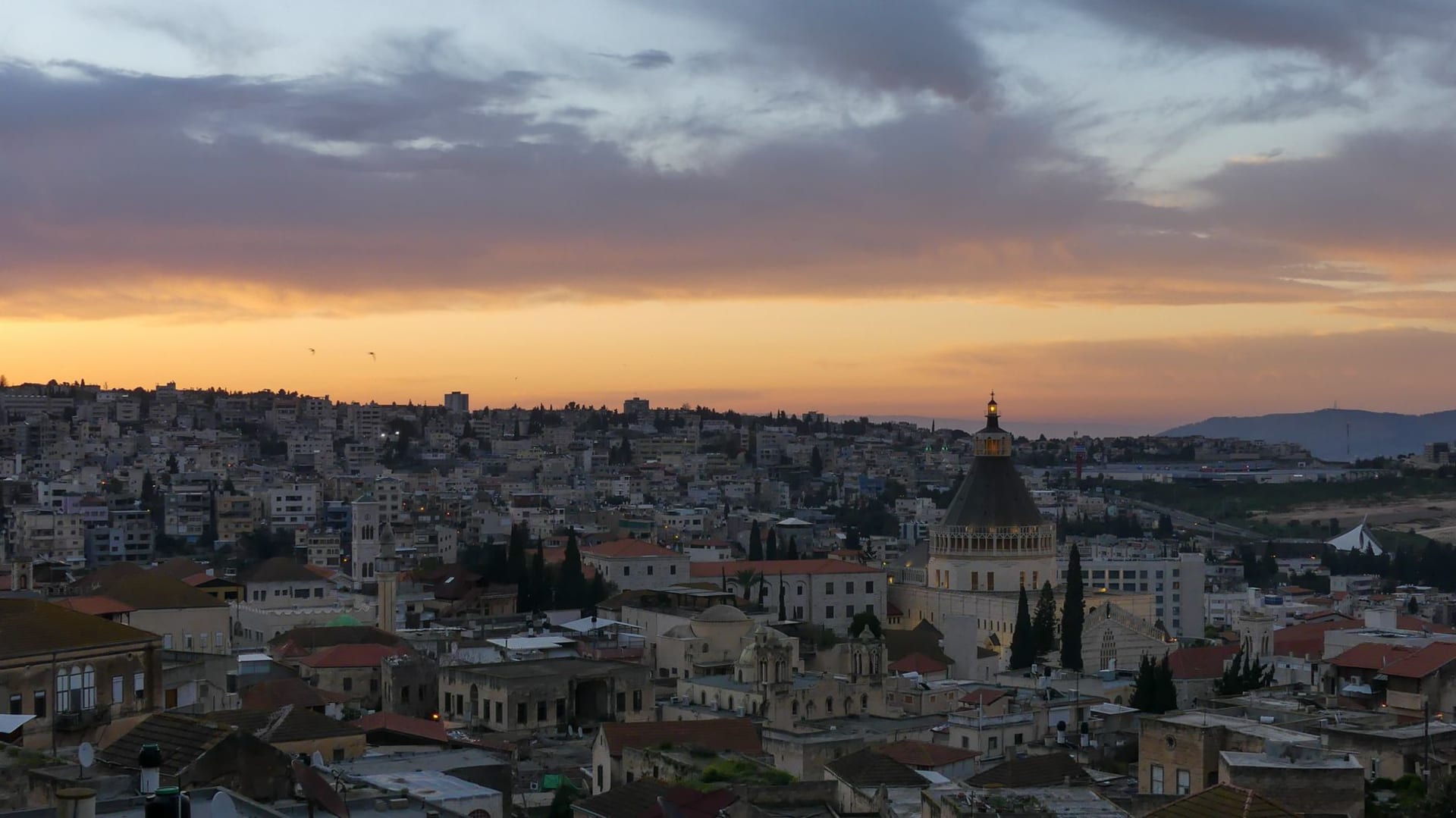
Nazareth surprised me, which I hadn’t expected it to. I’d built it up as a pilgrimage stop — the city where Jesus grew up, obligatory site, photo of the basilica, move on. What I found instead was a genuinely alive Arab city of 75,000 people who are quietly running one of the most interesting food scenes in the country and who seem only mildly interested in the religious tourism happening in their midst.
The old city sits on a hillside, its alleys steep and tightly wound, with a souk that sells everything from fresh herbs to plastic kitchenware. It smells of roasting coffee and diesel and, in the mornings, of bread baking somewhere nearby. The architecture is Ottoman stone overlaid with decades of renovation and neglect in equal measure, which gives the whole area a pleasantly unpolished quality.
The Basilica and What Surrounds It
The Basilica of the Annunciation is unmissable — it’s the largest church in the Middle East, a modern building from the 1960s that sits over the remains of earlier churches and, beneath those, what is believed to be the house of Mary. The interior is striking in a way I hadn’t anticipated: the upper and lower churches have a light quality that shifts as the day moves, and the outer courtyard is decorated with mosaics of the Virgin Mary donated by Catholic communities from around the world. Japan’s contribution, with its gold-leaf Kannon-like Mary in Buddhist aesthetic, is the most disorienting and somehow the most beautiful.
What I found equally interesting was the White Mosque directly adjacent to the basilica — two major religious sites essentially sharing a wall. The muezzin call during my visit to the church was not background noise. It filled the space.
Eating in the Old City
Nazareth’s food reputation is well-earned and I’d argue slightly undersold. The city has become a destination for Israeli food critics, and several chefs here are doing serious work with Arab-Palestinian cooking that goes well beyond the hummus-and-falafel shorthand most tourists expect.
I ate lunch at a restaurant in a restored Ottoman house with stone archways and tables that felt provisional, like the dining room had been improvised in a space primarily used for something else. The meal started with a dozen small dishes — labne with olive oil and za’atar, roasted cauliflower with tahini, a warm lentil soup, fresh pita that arrived in stacks. The main course was slow-cooked lamb with a spiced freekeh pilaf that had a smokiness I kept trying to identify. We ate for two hours. This is not a city for people in a hurry.
Afternoon in the Souk
The old souk is best mid-morning, before the heat peaks and while the vendors are still setting up. I bought a bag of mixed spice from a man who ground it to order — cumin, coriander, allspice, something else he didn’t name — and it’s been in my kitchen since. The spice shops have a cumulative aromatic weight as you walk through: each stall adds a layer until the air feels thick with it.
Lia picked up a small hand-painted ceramic bowl from a workshop off the main souk alley, made by a craftsman whose family had been doing the same work for generations. He showed her the difference between the tourist pieces near the front and the finer work he kept in the back. We bought the finer work.
When to go: Spring (March–May) and autumn (September–November) are ideal — moderate temperatures, fewer tour groups than summer. Ramadan brings a different and fascinating energy to the Muslim neighborhoods, with the city coming alive after dark; restaurants are closed during daylight but the evening atmosphere is worth experiencing.