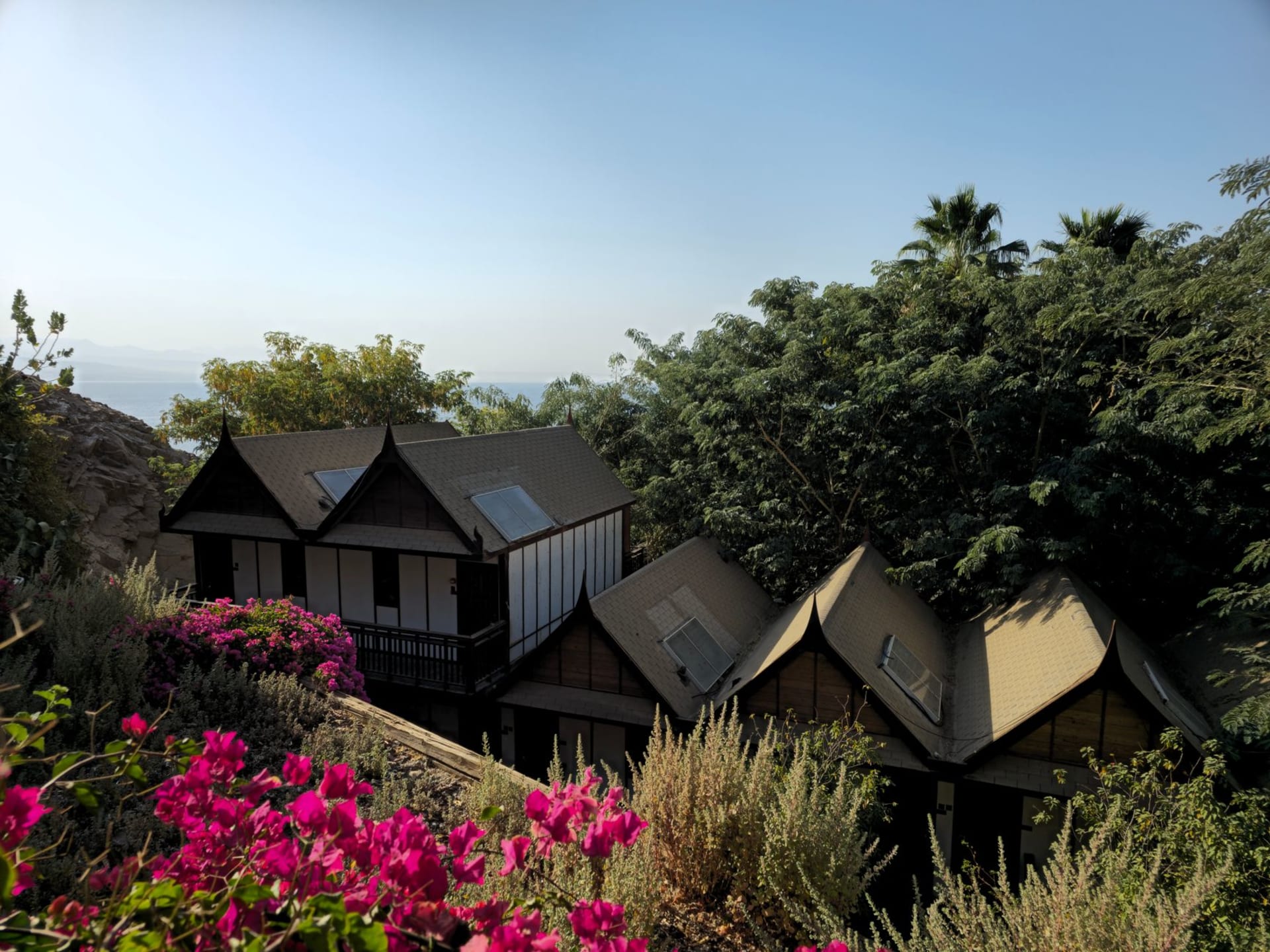
Eilat occupies one of the stranger geographical positions I’ve encountered traveling: a city at the very southern tip of Israel, at the apex of the Gulf of Aqaba, with Jordan visible a few kilometers to the east and Saudi Arabia discernible on the far shore on a clear day. The Jordanian city of Aqaba is close enough that you can hear music from it on calm nights. The Red Sea narrows here to something almost intimate.
I came primarily for the underwater world, which is the correct reason to visit. The reefs along Eilat’s shoreline are among the most accessible and intact in the Red Sea — the water temperature stays warm year-round, visibility runs to twenty meters or more, and you can snorkel directly off public beaches without a boat.
Underwater: The Coral Reserve
The Coral Beach Nature Reserve, south of the main hotel strip, is where the serious reef life concentrates. I rented a mask and fins at the entrance for a few dollars and walked in off the beach. Within thirty meters of shore, the bottom drops away and the coral begins in earnest: table corals the diameter of a small car, brain corals in deep purples and greens, soft corals waving in the mild current. Fish everywhere — parrotfish, surgeonfish, a school of glassfish that turned in unison as I approached, their movement like a single organism.
I’m a confident snorkeler but not a diver, and the reserve was enough. The water is reliably clear, the coral undeniably alive, and the experience of floating above it in silence — just the sound of your own breathing through the tube — has a meditative quality that I wasn’t expecting from a city beach.
The Desert Behind
What gives Eilat its specific character is the landscape surrounding it. The city is built in a narrow coastal valley, and the mountains of the Negev and Edom rise immediately behind it — bare, red-brown, dramatic in a way that makes the turquoise water in front seem even more improbable. I spent one morning driving up into the Eilat Mountains on a dirt road, stopping at the Red Canyon — a short hike through slot canyons in sandstone banded red and ochre and cream — and feeling, genuinely, like I was in the American Southwest. The silence up there was total except for wind and the occasional distant bird.
The contrast when you come back down and see the gulf glittering below is one of those moments that earns its cliché: desert and sea, both extreme, both beautiful, a few hundred meters apart.
Evenings on the Promenade
Eilat’s tourist infrastructure is, let me be honest, fairly aggressive — hotels that would look at home in the Las Vegas suburbs, a promenade lined with the same international chain restaurants that appear in every beach resort from Cancún to Bali. I found this easier to navigate by accepting it as context rather than fighting it. The promenade at sunset has a pleasant energy, the light turning the Jordanian mountains across the water into something painterly, and if you walk far enough north you reach quieter stretches where the city stops and the waterfront opens up.
I ate my best meal of the trip in Eilat at a small fish restaurant two streets back from the promenade, run by a family from Ethiopia who had been in the city for thirty years. The owner explained that the fish came from Aqaba’s fish market, which technically meant my dinner had crossed an international border that morning. He seemed to find this funny. So did I.
When to go: October through May, with the sweet spot in February and March when European winter has made northern Israel chilly but Eilat stays at 22–25°C. Summer is technically possible but the heat is significant — upwards of 40°C regularly — and the dive visibility remains good if you can manage the temperatures. It’s also the only place in Israel with essentially guaranteed sunshine year-round.