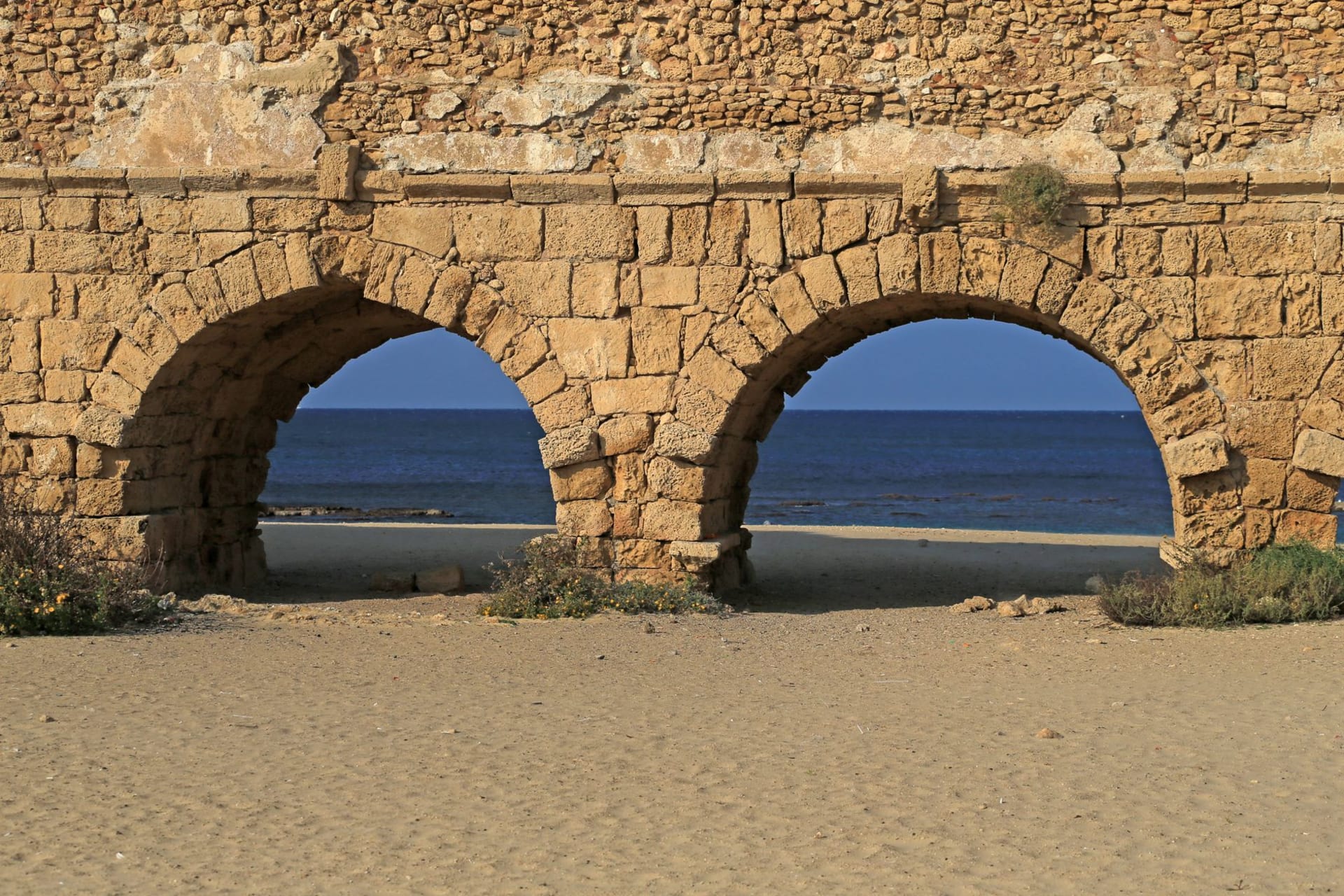
Caesarea
"The amphitheater faces the sea and the acoustics still work. Some things were built to last."
I arrived at Caesarea not knowing what to expect and left having reshuffled my mental map of Israel entirely. The country is not short on history, but Caesarea has a quality the others don’t quite match: scale without crowds, ruins that sit at the actual edge of the Mediterranean, and the peculiar pleasure of standing in a Roman hippodrome while fishing boats move past in the background.
Herod the Great built the city in the first century BCE, naming it after Augustus Caesar and turning a small anchorage into one of the most important ports in the eastern Mediterranean. At its height it housed a hundred thousand people. The harbor was an engineering marvel — underwater concrete vaults, an artificial breakwater, a lighthouse. Most of it is now submerged, visible on glass-bottom boat tours in fragments, which gives it an almost dreamlike quality.
The Amphitheater on the Water
The Roman theater at Caesarea is the oldest in Israel, and it still functions as a concert venue. I visited on a Tuesday afternoon when there was no performance scheduled, which meant I had the place largely to myself. The stone seats face directly west toward the sea, and in the late afternoon the light comes in horizontally across the stage. I sat in the upper rows and listened to the wind and the distant crash of waves and felt the particular silence that only very old places carry.
The acoustics are what make it genuinely extraordinary — a whisper from the stage reaches the back rows with startling clarity. The Romans understood this in ways that still impress acoustical engineers. The fact that modern artists come here to perform feels less like novelty and more like the correct use of the space.
The Crusader City and Harbor
The crusader-era fortifications form the center of the archaeological park — thick walls, a moat, a harbor that the crusaders reused from the Roman original. Walking the ramparts gives you a good sense of the medieval city’s footprint and, more practically, the best elevated view of the coastline north and south.
The harbor itself has been restored into an outdoor dining and shopping area, which might sound like a compromise but is actually done with some restraint — restaurants with sea terraces, a small museum in a restored Ottoman building, a gallery or two. On weekend evenings, Israelis from Tel Aviv come up to eat here. The drive is forty minutes and the contrast — ancient harbor, modern couples with children, someone’s dog stealing bread from a café table — felt characteristically Israeli in its layering of the mundane and the monumental.
Underwater Caesarea
The submerged Roman harbor can be explored by snorkel or, more impressively, by diving. I’m not a diver, but I rented a glass-bottom kayak and paddled over the outer breakwater remains, which are visible a few meters below in clear water as low grey shapes, colonized by sea grass and small fish. The harbour’s ancient entrance markers — two columns that once flanked the channel — are still standing underwater, identifiable by their shape. It’s a strange and quiet thing to paddle over, and the water that close to shore on a calm day is very clear.
When to go: April–June and September–October are best — warm enough for the water, not so hot that the open archaeological site becomes uncomfortable at midday. If a concert is scheduled at the amphitheater during your visit, go. It’s the kind of experience that requires no context and no architectural imagination — you sit in the seats, the music starts, and the setting does the rest.