Glendalough
"Glendalough is a thin place, as the Irish say — somewhere the distance between this world and whatever lies behind it feels narrower than usual."
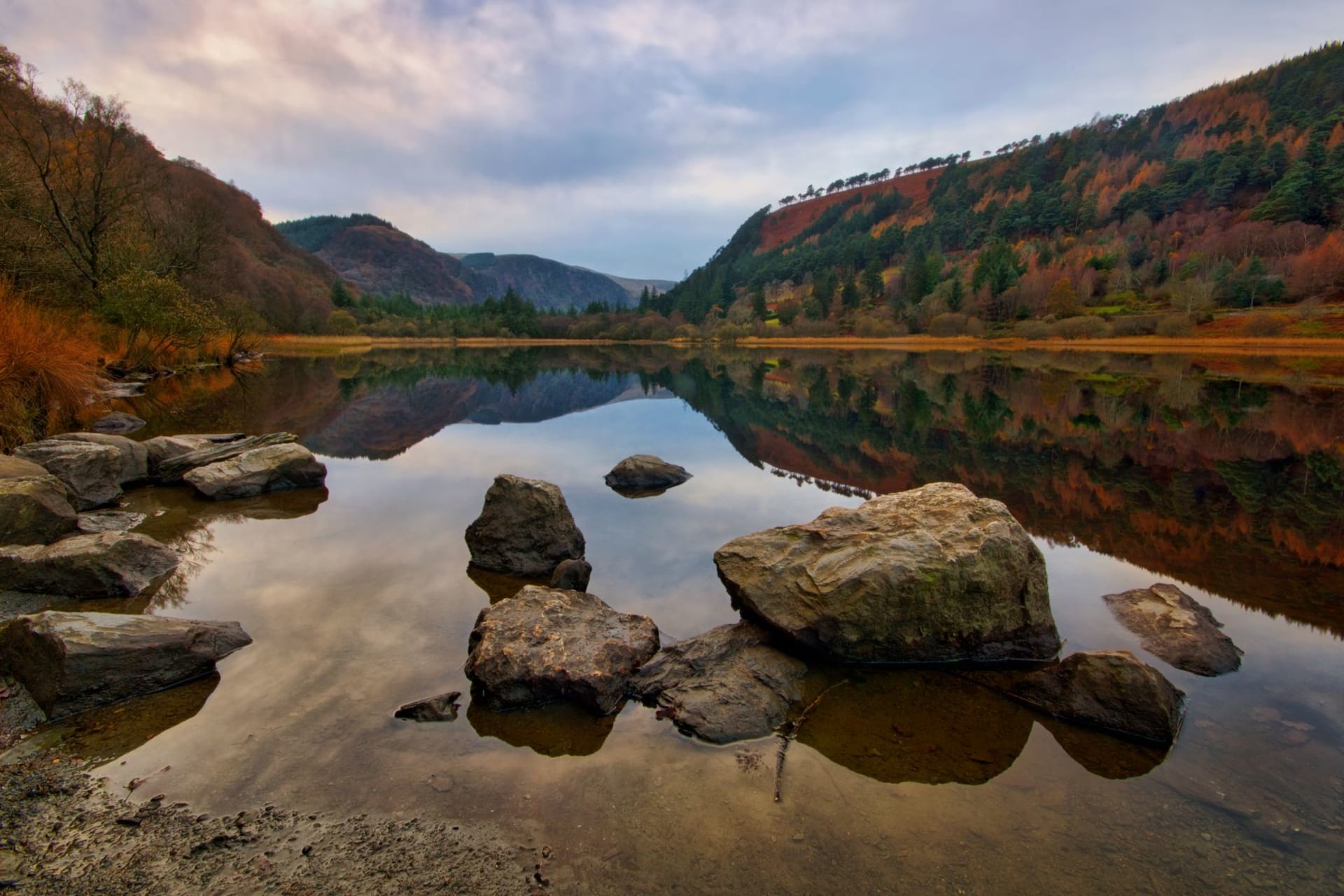
Glendalough is only an hour south of Dublin, deep in the Wicklow Mountains, which means that on a fine Sunday it can feel less like a remote monastic valley and more like the entire city has decided to go for a walk. We went on a wet Tuesday in October instead, which is the correct way to do it, and had long stretches of the valley almost to ourselves, the rain coming and going in the soft, committed Irish way that does not so much fall as simply exist in the air around you. The name means “valley of the two lakes,” and the two lakes sit dark and still in a glacial trough between steep wooded slopes, and the whole place has an atmosphere that survives even the car parks and the coach tours.
The monastic city
Saint Kevin founded a monastery here in the sixth century, choosing the valley precisely because it was remote and hard and conducive to the kind of ascetic misery that early Irish monks seem to have actively enjoyed. What survives is a scattering of stone churches, a gateway, a graveyard still in use, and above it all the round tower — thirty metres of slender grey stone, its conical cap intact, its doorway set high off the ground where monks could pull up the ladder when raiders came. I have seen photographs of that tower my whole life without quite registering it as a real object. Standing under it in the rain, I registered it.

The graveyard around the churches is the part that got me. It is still a working burial ground, so among the ancient grave slabs and high crosses there are modern headstones, families still being buried where monks were buried fourteen hundred years ago. Lia, who has a thing about old cemeteries, moved through it slowly, reading names, and I left her to it and stood by Saint Kevin’s Kitchen — a tiny stone church with a miniature round tower for a belfry that looks, against all dignity, exactly like a chimney, hence the name.
Up to the upper lake
The valley really opens up if you walk past the monastic site and up toward the Upper Lake. The path runs through oak woodland, then opens onto the lakeshore with the cliffs rising sheer on the far side, scarred with the remains of old miner’s workings. We walked the boardwalk along the water as the cloud came down over the tops, and a pair of hikers passed us coming the other way, soaked and grinning, and one of them said “lovely day for it” with the deadpan that I have come to understand is not sarcasm in Ireland so much as a kind of weather-stoicism raised to an art.

We finished, inevitably, in the pub at Laragh down the road, drying out by a turf fire with a bowl of soup and a pint, the windows fogged, the rain still going outside. There is a particular pleasure in being warm and dry in a country that is determined to make you neither, and Glendalough, having soaked us thoroughly, made that pint taste better than almost any I can remember.
When to go: Weekday mornings outside summer, ideally in spring or autumn, give you the valley at its quietest and most atmospheric. Bring proper rain gear whatever the forecast says — the Wicklow Mountains make their own weather, and most of it is wet.