
Wonosobo
"Cold enough for a jacket, high enough for temples older than the Javanese kingdoms that came after them."
A highland market town that hands you off to the Dieng Plateau's sulfur craters and thousand-year-old temples without ever quite letting you forget you're still in Java.
Wonosobo is not, on its own, a destination anyone travels far for. It’s a market town in Central Java’s highlands, ringed by two volcanoes — Sindoro and Sumbing, standing almost symmetrically on either side — and functioning mostly as the last real town before the road climbs to the Dieng Plateau. But I’ve come to think that dismissing it as a mere gateway misses what makes the region work: Wonosobo is where the plateau’s strangeness gets grounded back into ordinary Javanese life, and that contrast is worth sitting with.
The town sits around 770 meters above sea level, which doesn’t sound dramatic until you feel the temperature drop as you arrive from the sweltering lowlands. The main market, Pasar Induk, sells produce that looks almost alpine next to what you’d find near the coast — carrots, potatoes, strawberries, and above all mountain cabbage, grown on the volcanic soil of the surrounding slopes. Wonosobo’s signature dish, mie ongklok, reflects the climate: a bowl of thick noodles in a starchy, slightly sweet gravy thickened with kucai (garlic chives) and served with satay on the side, the kind of warming, carb-heavy meal that makes total sense once you understand you’re eating it at altitude in a light drizzle.
Up onto the plateau
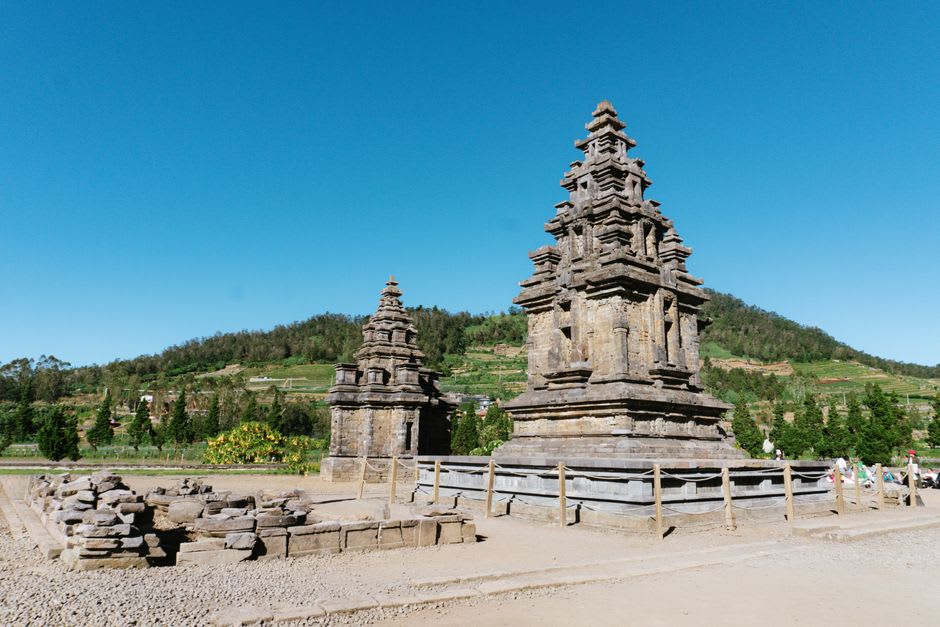
The real reason to base yourself in Wonosobo is Dieng, roughly two hours up a winding road that climbs through pine forest and terraced vegetable fields until the air turns properly cold — Dieng sits above 2,000 meters, and mornings there regularly drop close to freezing, occasionally producing a frost locals call bun upas that blackens the potato crops. The plateau takes its name from “Di Hyang,” roughly “abode of the gods” in Old Javanese, and it earned the name honestly: the Arjuna temple complex here, a cluster of small stone shrines dedicated to Shiva, is thought to be among the oldest Hindu temple architecture surviving in Java, predating the great complexes at Prambanan by a century or more, built by the Sanjaya dynasty starting around the 8th century.
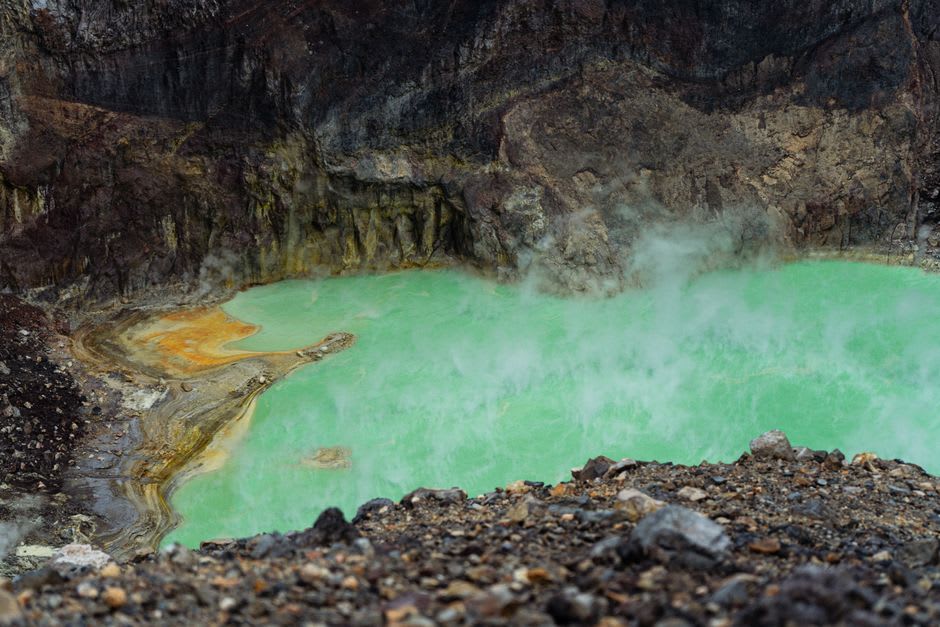
But Dieng is also a live volcanic complex, and that geology sits uneasily close to the ancient temples and the villages around them. Kawah Sikidang is a crater you can walk right up to, bubbling grey mud and hissing steam vents fenced only loosely, sulfur smell thick enough to taste. In 1979, a sudden release of carbon dioxide from the Sinila crater killed over a hundred villagers in their sleep — a reminder, still discussed locally, that this landscape’s beauty and its danger come from the exact same source. Telaga Warna, the “color lake,” shifts between turquoise, green, and murky yellow depending on mineral content and light, and I stood at its viewpoint at dawn watching the color genuinely change as mist burned off the surface.
Back down in Wonosobo that evening, eating mie ongklok at a stall near the alun-alun while motorbikes circled the town square, the plateau’s ancient temples and sulfur craters felt like a story from somewhere else entirely — which is, I think, exactly the role this town has quietly played for centuries.
When to go: June through September, dry season, for the clearest views and a real chance at Dieng’s frost phenomenon in July and August. The Dieng Culture Festival, held annually around August, adds traditional Javanese performances and a lantern release to the highland backdrop.