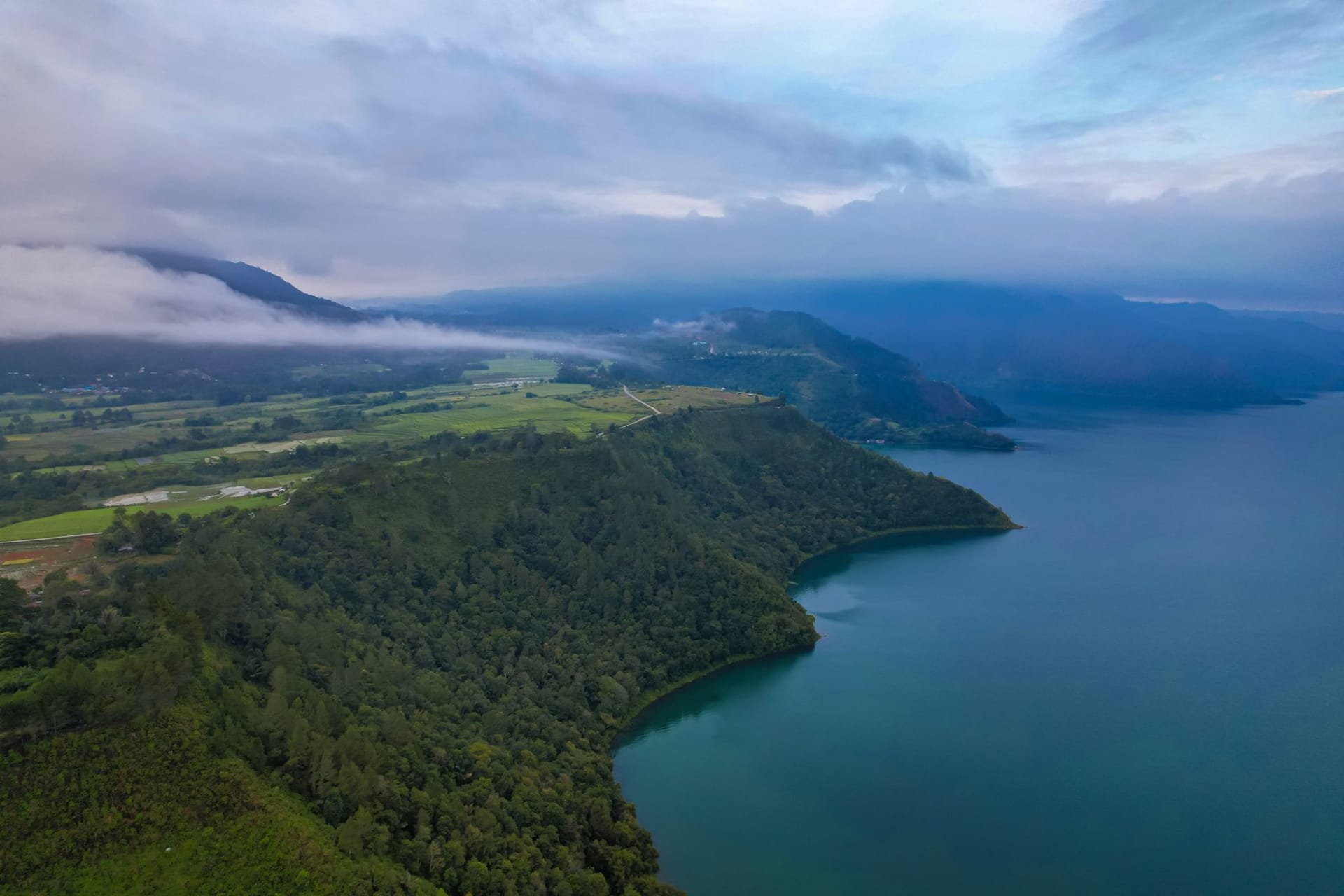
Lake Toba
"You're swimming in the flooded crater of a volcano that nearly ended the human story. The water is warm. It's a strange feeling to relax in."
It takes some effort to get to Lake Toba, which is part of why it stays the way it is. From Medan it’s a long, winding road through palm plantations and Sumatran traffic, and then suddenly the land falls away and there it is — a sheet of water so large it reads as sea, ringed by green ridges, with the island of Samosir sitting in the middle like a country of its own. Lia gasped. I, who had read the geology beforehand, said something insufferable about supervolcanoes, and was rightly ignored.
Standing inside a catastrophe
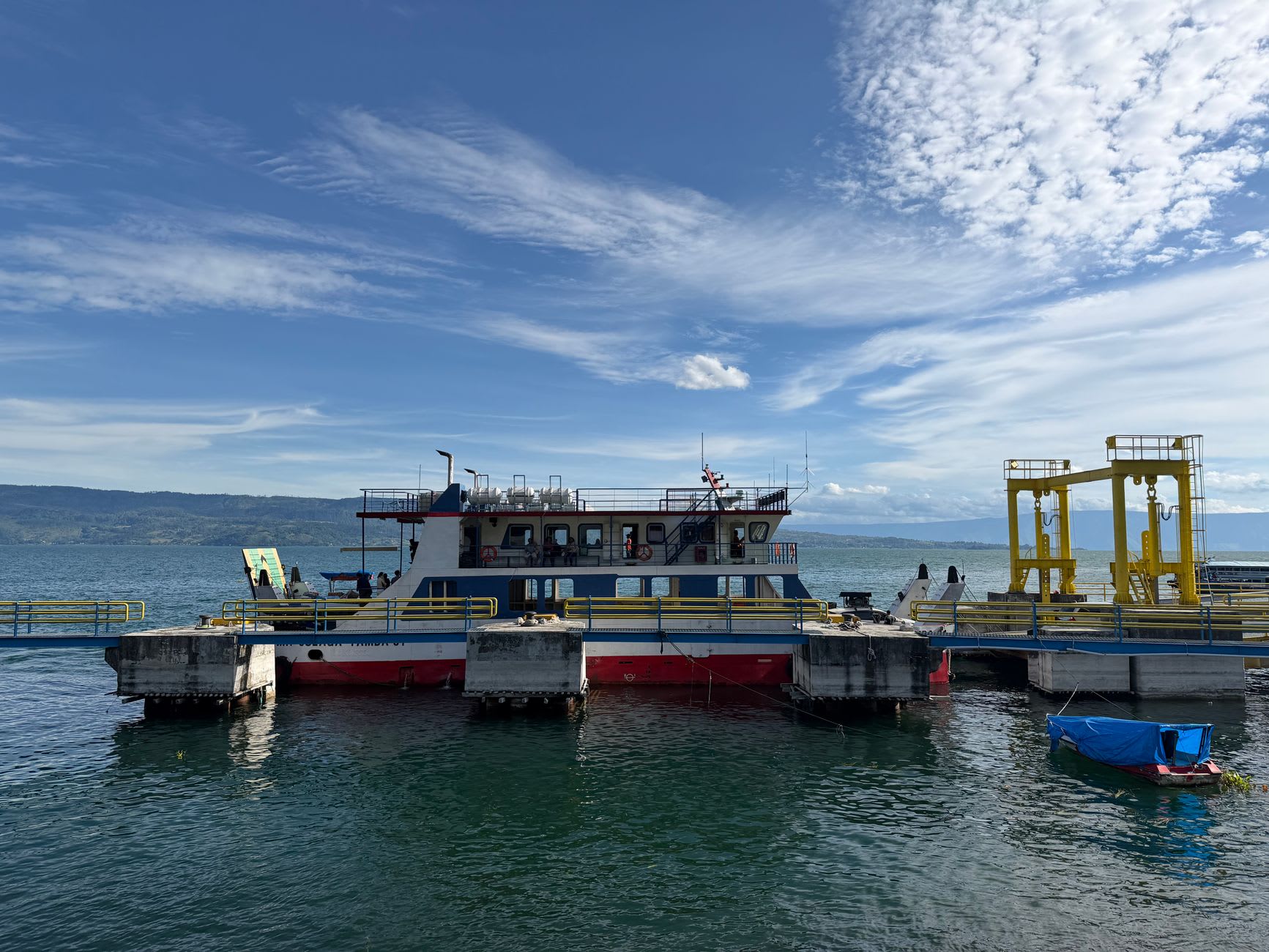
Toba is the caldera of one of the largest eruptions in the planet’s history — a blast some 74,000 years ago so enormous that some scientists think it nearly wiped out our species, leaving the entire human population a few thousand survivors. You cannot feel any of that drama now. The lake is serene to the point of being soporific; the water is warm, faintly sulphurous in places, and deep enough that swimming out from the shore gives you a small thrill of the void beneath. We took a slow ferry across to Samosir, and the act of crossing water inside a volcano while a man beside me calmly ate fried bananas felt like one of travel’s better absurdities.
Samosir is Batak land, and the Batak are a distinct people with their own language, their own Christianity layered over older animist roots, and an architecture you won’t forget: tall houses with soaring saddle-backed roofs, the gable ends rising into points like the prows of ships. In the village of Ambarita we saw stone chairs and a slab where, the guide explained with relish, the Batak once executed and — he paused for effect — ate their enemies. Whether that history is fact, folklore or tourist theatre I genuinely couldn’t tell, and the ambiguity was somehow very Toba.
The pleasure of doing nothing
What you actually do at Lake Toba is very little, and that is the point. We rented a scooter on Samosir and rode the quiet lanes past rice fields and grazing water buffalo and small Batak churches, stopping to swim whenever a stretch of shore looked inviting. We ate grilled lake fish with sambal at a warung where the owner’s children did their homework at the next table. In the evening the mist came down off the ridges and the whole caldera went soft and silver and silent.

Toba does not perform for visitors the way Bali does, and the tourist infrastructure is patchy and a little faded — there was clearly a busier era here, decades back, that never fully returned. I found that melancholy appealing. It’s a place to read, swim, ride aimlessly and let the scale of the thing work on you slowly. Lia called it the most relaxed she’d been in months, somewhere around day three, floating on her back in the warm water of a sleeping giant.
When to go: May to September for the driest, clearest skies. The lake sits at altitude, so evenings are cool year-round — bring something warm. Avoid rushing it; Toba punishes the over-scheduled and rewards anyone willing to stay an extra two days.