Bukittinggi
"The air here is the first cool breath you get after the lowland heat of Sumatra, and it changes everything."
A hill town wedged between two volcanoes where the clock tower keeps Dutch time and the canyon below keeps its own, older secrets.
You feel Bukittinggi before you see it — the road climbs out of the Sumatran lowlands and the humidity that’s been sitting on your shoulders since Medan or Padang just lifts. At roughly 930 meters, wedged between the volcanoes Marapi and Singgalang, this is highland Minangkabau country, and the temperature drop alone explains why the Dutch made it their administrative hill station and why locals still treat it as a retreat from the heat.
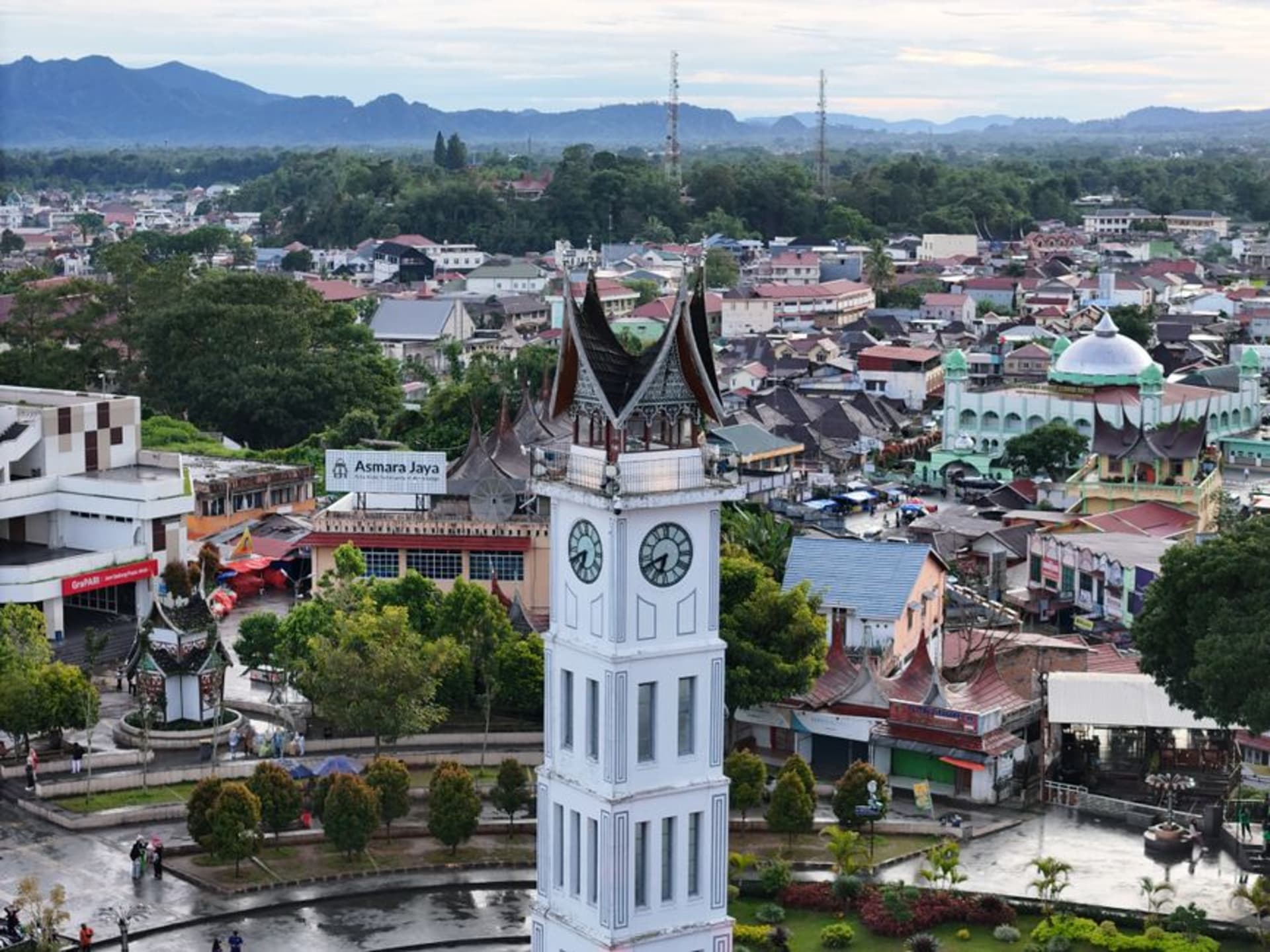
The town’s landmark, Jam Gadang, is a clock tower built in 1926 as a gift from the Dutch colonial government, its roof reworked over the decades to match Minangkabau architecture — that dramatic upswept gable, like buffalo horns, that you see on every traditional rumah gadang across West Sumatra. It’s a strange little object: a European clockwork mechanism, one of only a handful in the world of its type, wearing indigenous Sumatran clothes. I climbed the hill to the fort above it, Fort de Kock, built by the Dutch in 1825 during the Padri War against Minangkabau religious reformers, and looked down at the tower from above — a good vantage for understanding how thoroughly colonial and indigenous history got stitched together here, sometimes uneasily.
The canyon that swallows sound
What actually kept me in Bukittinggi longer than planned was Ngarai Sianok, the canyon that cuts along the town’s western edge — a deep green gash, roughly 15 kilometers long, carved by a river and framed by sheer volcanic walls. Legend and local guides both mention that the canyon’s isolation made it a natural hideout, and during the Japanese occupation the walls were honeycombed with tunnels — the Lubang Jepang, or Japanese Cave, dug by forced Indonesian romusha laborers as a bunker and ammunition depot. Walking through those cold tunnels after the open brightness of the canyon rim was disorienting in the way genuine history often is; there’s no polish on it, just damp stone and low ceilings and a guide’s flashlight picking out old air vents.

Matriarchal country
Bukittinggi sits at the cultural heart of the Minangkabau, one of the world’s largest matrilineal societies, where property and family names pass through the mother’s line and men traditionally leave home young to earn their standing elsewhere — a custom called merantau that has scattered Minangkabau entrepreneurs and restaurateurs across every corner of Indonesia. It’s why nasi padang, the rice-and-side-dish feast this region invented, is everywhere in the country; it travels with the people. I ate an absurd spread of rendang, gulai, and sambal at a warung near the Pasar Atas market, where the fruit and vegetable sellers — mostly women, per custom — ran the stalls with a brisk authority that made the matrilineal thing feel less like an anthropology footnote and more like something I was watching happen in real time.

Bukittinggi rewards slowness. Sit at a warung near the clock tower with a glass of teh talua, the frothy egg tea locals swear by, and watch the town go about its business — students in white-and-grey uniforms, motorbikes weaving past the fort’s old cannons, the muezzin’s call rolling out over the canyon at dusk. It’s not a checklist town. It’s a place to breathe.
When to go: May through September for the driest, coolest weather; bring a light jacket for evenings, since the altitude means Bukittinggi genuinely gets cold after dark by Sumatran standards.