Thanjavur
"The Cholas built a temple a thousand years ago that modern engineers still argue about how they managed to finish."
A Chola dynasty capital whose thousand-year-old granite temple still carries a dome carved from a single eighty-ton block, and whose painters and musicians never stopped working.
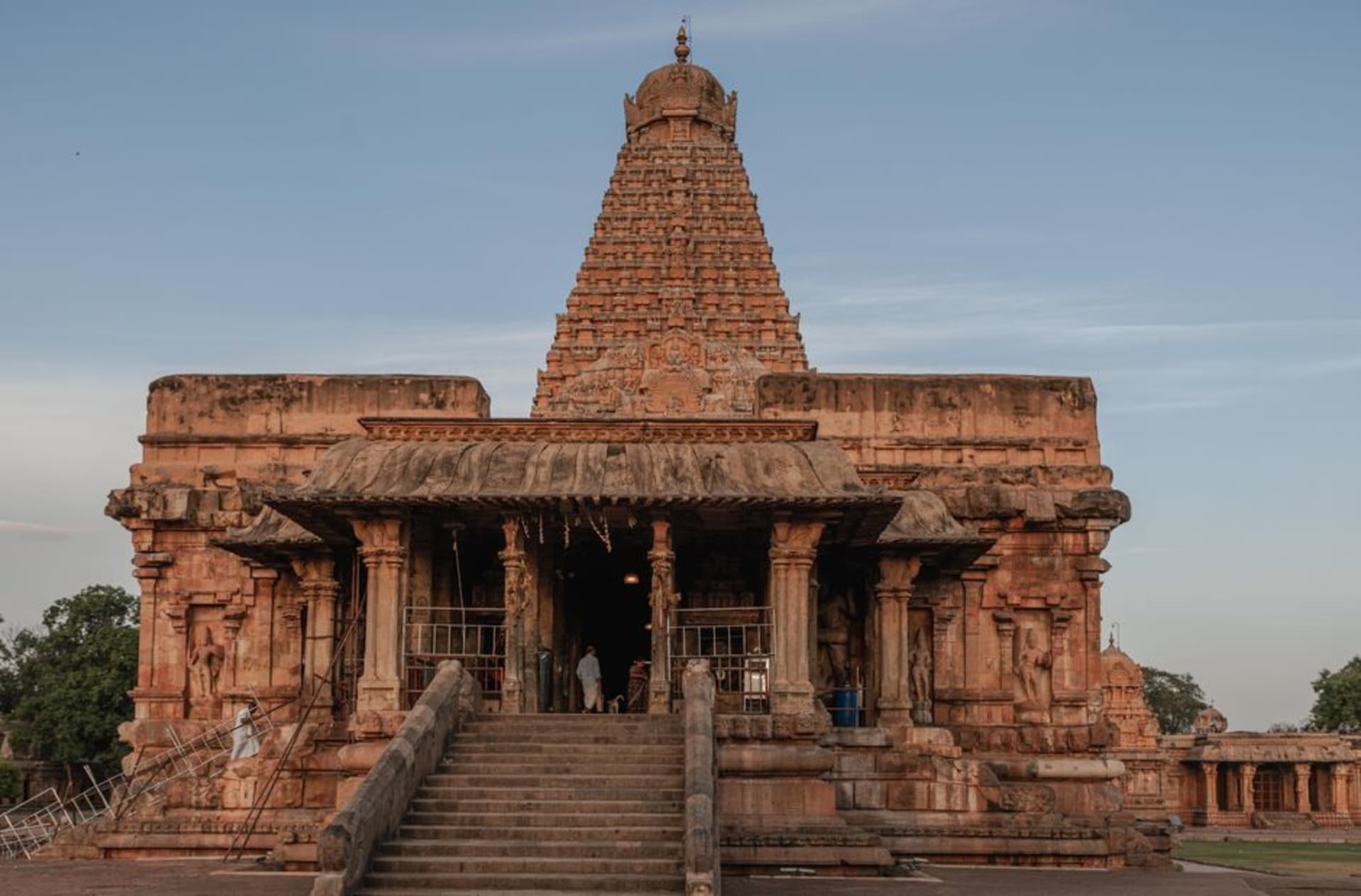
I’ve stood under a lot of temple towers in India by now, and Brihadeeswarar Temple still made me stop and actually do the math out loud. The vimana, the temple’s central tower, rises just over sixty meters — one of the tallest of its kind in the world at the time it was built — and it is topped by a single dome-shaped capstone carved from one block of granite estimated at around eighty tons. Nobody has fully settled how the Chola engineers of the 11th century got it up there; the leading theory involves a four-kilometer earthen ramp built specifically for the purpose and then removed afterward, which is either brilliant or slightly maddening depending on how you feel about lost engineering knowledge.
The temple was completed around 1010 CE under Rajaraja Chola I, at the height of an empire that at its peak stretched across South India and into Sri Lanka and parts of Southeast Asia, and it’s built almost entirely from granite — a stone with no local source, meaning every block was hauled in from quarries far outside the city. I walked the temple’s outer courtyard barefoot on stone that had absorbed the whole day’s heat, past a Nandi statue carved from a single rock and large enough that I had to actually crane my neck, and up close to inscriptions along the base of the sanctum that Chola administrators used to record the temple’s finances, staff, and land grants in obsessive bureaucratic detail — an entire economy documented in stone, still legible a thousand years later.
The Painters Downstairs
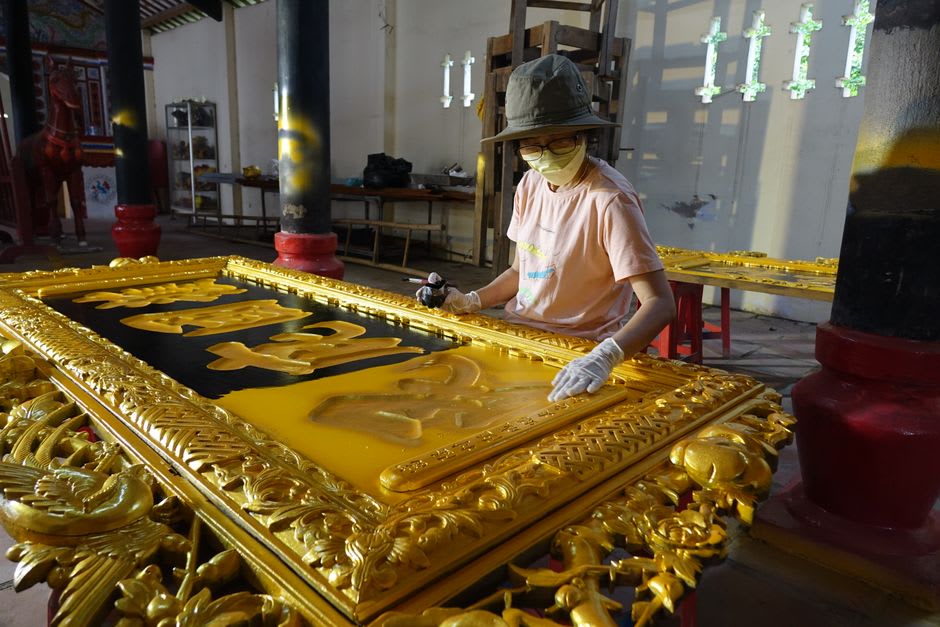
Thanjavur’s other legacy is smaller in scale but no less specific. The town gave its name to Thanjavur painting, a style developed under later Maratha and Nayak patronage that layers gold foil, semi-precious stones, and glass beads onto a wooden base to create richly embossed images, almost always of Hindu deities. I visited a small family workshop near the palace where three generations were working in the same room — the grandfather sketching the base outline, his son applying gesso relief work, a granddaughter carefully pressing gold leaf onto a finished panel of Krishna as an infant. The gold seemed to catch every angle of light in the room at once.
An Instrument Older Than the Temple’s Roof
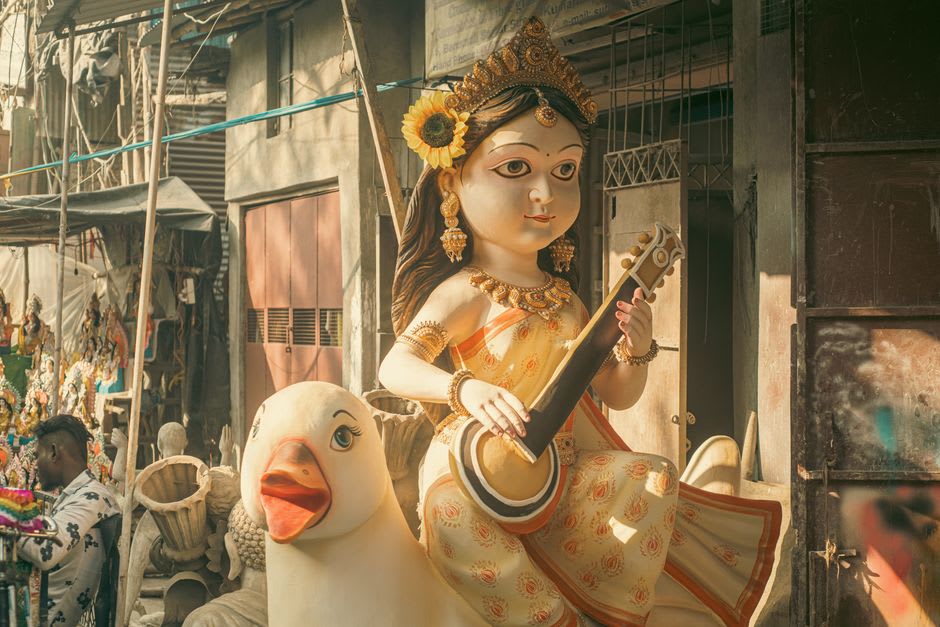
Thanjavur is also one of the last places in India where veenas — the long-necked, gourd-bodied stringed instrument central to Carnatic classical music — are still handmade start to finish, carved from a single block of jackfruit wood by craftsmen whose families have done nothing else for generations. I found a small workshop tucked behind the Saraswathi Mahal Library, where a craftsman let me hold a half-finished veena, its body still rough where the gourd resonator hadn’t yet been shaped, and played a few notes on a completed one hanging on the wall. The sound filled the small room in a way that felt entirely disproportionate to the modest workshop it came from.
When to go: November to February for comfortable temperatures on the temple’s stone courtyards. Early morning visits let you see the vimana’s shadow-play on the granite before the midday sun turns the courtyard punishing underfoot.