
Ajanta-Ellora
"Ellora made me stop and ask how, exactly, a human being decides to carve a temple downward instead of building it up."
Two UNESCO cave complexes carved into Deccan rock -- one a horseshoe gorge of Buddhist painting, the other a temple hacked top-down from a single mountain.
Ajanta hits you geographically before it hits you artistically. The thirty caves are carved into the inner wall of a horseshoe-shaped gorge above the Waghur river, and the viewpoint across the ravine — the one every photo of Ajanta is taken from — makes the whole complex look less like architecture and more like something the cliff grew on its own. It was abandoned around the seventh century and swallowed by jungle for a thousand years until a British officer, John Smith, supposedly stumbled onto it while tiger hunting in 1819. I walked the horseshoe path in the mid-morning, and the light was already doing the thing it apparently does every day: catching the gorge wall at an angle that makes the cave entrances look carved from shadow.
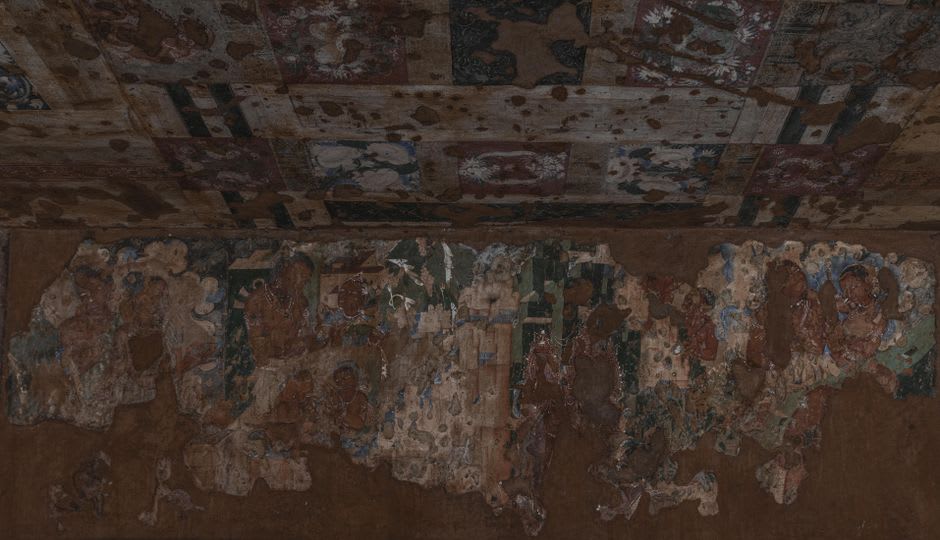
Inside, the caves are almost entirely Buddhist — chaityas (prayer halls) and viharas (monasteries) cut between roughly the 2nd century BCE and 480 CE — and the paintings are the real reason people fly across the world for this. Cave 1’s murals of the Bodhisattva Padmapani and Vajrapani are painted in mineral pigments that have survived over a thousand years in complete darkness, and seeing them requires a guard aiming a battery torch at an angle so the fresco reveals itself in slow, deliberate reveals. The effect is closer to a magic trick than a museum visit. Faces, elephants, court scenes, and jataka tales — stories of the Buddha’s previous lives — unfold across walls in colors that somehow never faded because no sunlight ever touched them.
Ellora and the temple carved downward
Ellora is a hundred kilometers away and a completely different kind of astonishment, because instead of one religion in one ravine, it holds thirty-four caves representing Buddhism, Hinduism, and Jainism carved side by side across roughly five centuries — physical proof of a period when these traditions coexisted, borrowed from each other, and competed for royal patronage without apparently needing separate mountains to do it.
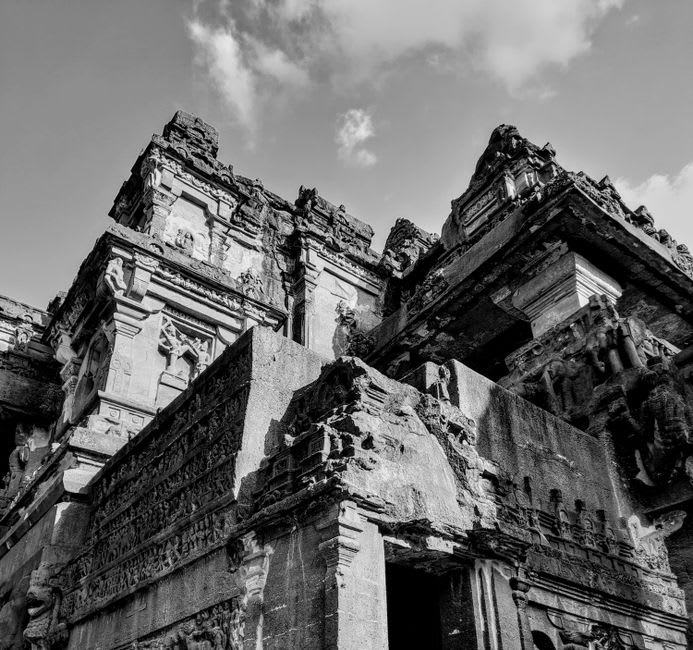
Cave 16, the Kailasa Temple, is the reason Ellora is mentioned in the same breath as Ajanta. It is not built. It is subtracted — an entire two-story temple complex, complete with courtyard, gateway, assembly hall, sanctuary, and a tower over ninety feet tall, carved downward and inward out of a single basalt cliff face by removing an estimated two hundred thousand tons of rock, reportedly over roughly a century of Rashtrakuta-era labor starting around 760 CE. There is no scaffolding trick that explains this. Someone stood on top of a mountain and decided the temple was already inside it, and then several generations of stonemasons spent their working lives proving that decision correct. I stood in the courtyard looking up at elephant carvings along the base, sized as if they were holding the entire structure on their backs, and felt genuinely light-headed trying to picture the planning that preceded the first chisel strike.
The Jain caves at the far end of Ellora, numbers 30 through 34, are smaller and later, from the 9th and 10th centuries, and get a fraction of the visitors — which meant I had cave 32, with its intricately carved pillars and lotus ceiling, almost entirely to myself on a Tuesday afternoon.
When to go: November to February for cooler days at Ellora’s exposed courtyards, and note that Ajanta closes on Mondays while Ellora closes on Tuesdays — plan around both if you’re only doing a single overnight from Aurangabad.