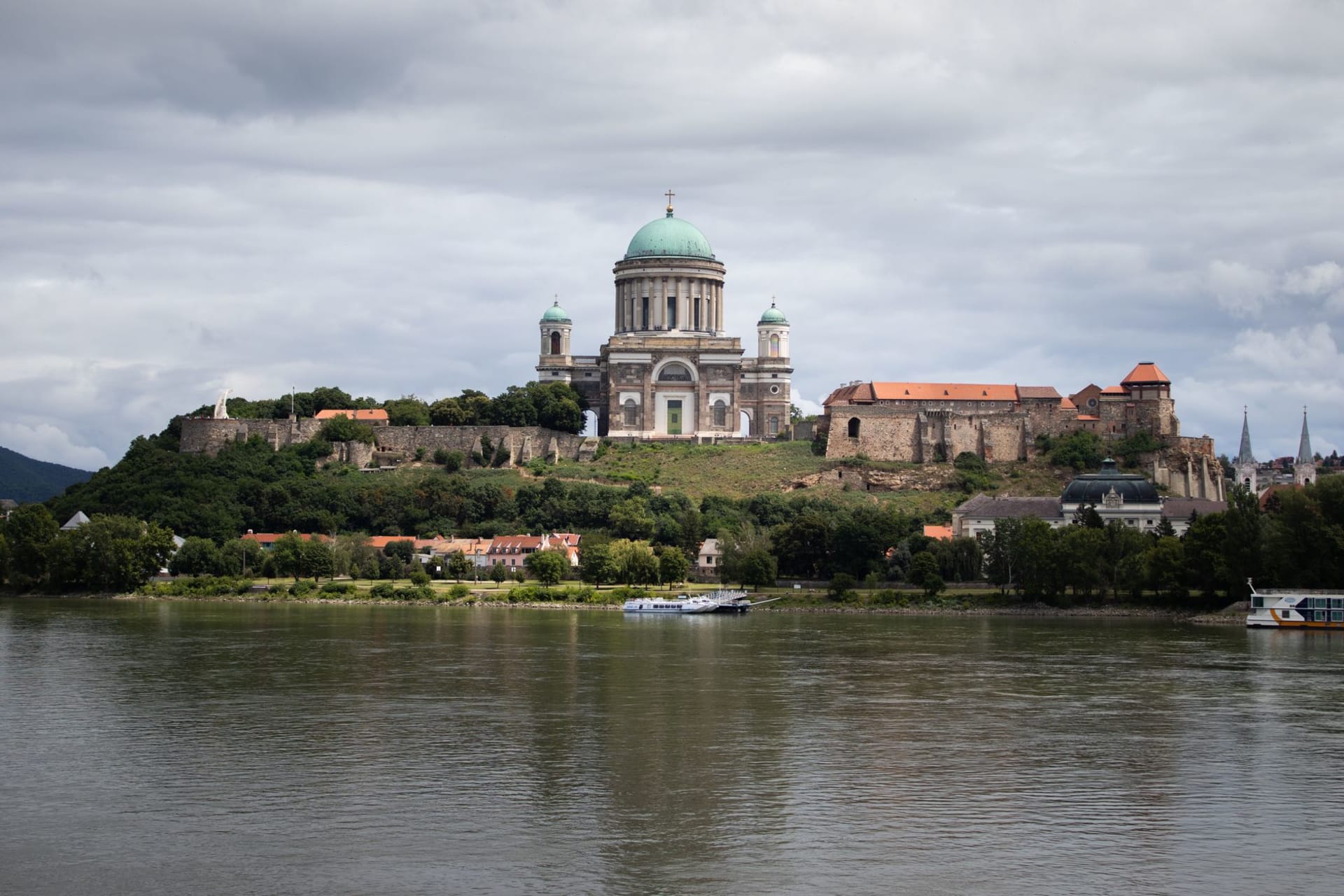
Esztergom
"You see the basilica of Esztergom long before you reach the town, and it does not get less improbable as you get closer."
Esztergom sits on the Danube about an hour north of Budapest, right where the river makes its great bend and forms the border with Slovakia, and it is dominated — there is no other word — by a basilica so enormous that it seems to have been dropped on the town by mistake, intended for some far larger city. This is the seat of the Primate of Hungary, the heart of Hungarian Catholicism for a thousand years, and the current building is the largest church in the country. I had seen photographs and assumed they exaggerated the scale. They did not. If anything they undersold it.
The basilica and the dome
We climbed up to the basilica on a cold, bright morning, the kind of light that makes Central European stone look scrubbed. The dome is the thing. You can climb it, up a series of increasingly narrow stairs that culminate in a walkway around the cupola, and from up there the view runs out over the Danube bend, the river splitting around its islands, the hills of Slovakia rising on the far bank, and the rooftops of Esztergom laid out below like something on a model railway. Lia, who does not love heights, made it to the top through sheer stubbornness and then refused to go near the railing, narrating the view to me from a safe distance against the central column.

Inside, the basilica is vast and rather cold in feeling as well as temperature — neoclassical churches can have that quality, all marble and proportion and not much warmth — but the Bakócz Chapel, a Renaissance survival in red marble that was dismantled and rebuilt inside the newer church, is genuinely beautiful, and the treasury holds the richest collection of ecclesiastical objects in Hungary. I am not much for treasuries as a rule, but there is a monstrance or two in there that stopped even me.
Down by the river
The better part of Esztergom, for me, was down at the river. The Mária Valéria Bridge crosses the Danube to Štúrovo in Slovakia, and you can walk across it in a few minutes, passport in pocket, crossing an international border on foot for the price of nothing at all. The bridge was destroyed in the war and not rebuilt for decades — for most of the twentieth century the two riverbank towns stared at each other across a gap of broken stone — and there is something quietly moving about walking the span that was finally reconnected.

We ate lunch on the Slovak side, because we could, at a place by the water where a waiter brought us fried cheese and beer and seemed mildly amused by the two people who had walked over from Hungary purely to eat lunch and walk back. Then we walked back. The basilica was catching the late sun by the time we returned, glowing gold above the river, and I understood for a moment why someone had thought a building that size belonged in a town this small.
When to go: Late spring and early autumn give the best light on the river and the mildest weather for climbing the dome. Summer is busy with day-trippers from Budapest; winter is quiet and atmospheric but the dome climb can be closed in bad weather.