Mogadishu
"Mogadishu didn't ask to be understood in an afternoon, and I stopped trying by the second day."
A shattered, luminous capital where ninth-century trade routes, Italian colonnades, and Indian Ocean surf collide in ways I still think about.
I’ll admit I was nervous before Mogadishu, and I don’t think there’s any point pretending otherwise. Lia and I had talked about it for over a year, reading everything we could find, adjusting plans, second-guessing ourselves more than once. What finally got us on the plane was a conversation with a Somali friend in Mexico City who kept saying the same thing: “You have to see it for yourself, it’s not what people think.” He was right. Nothing about the city matched the flattened image I’d built in my head from years of headlines.
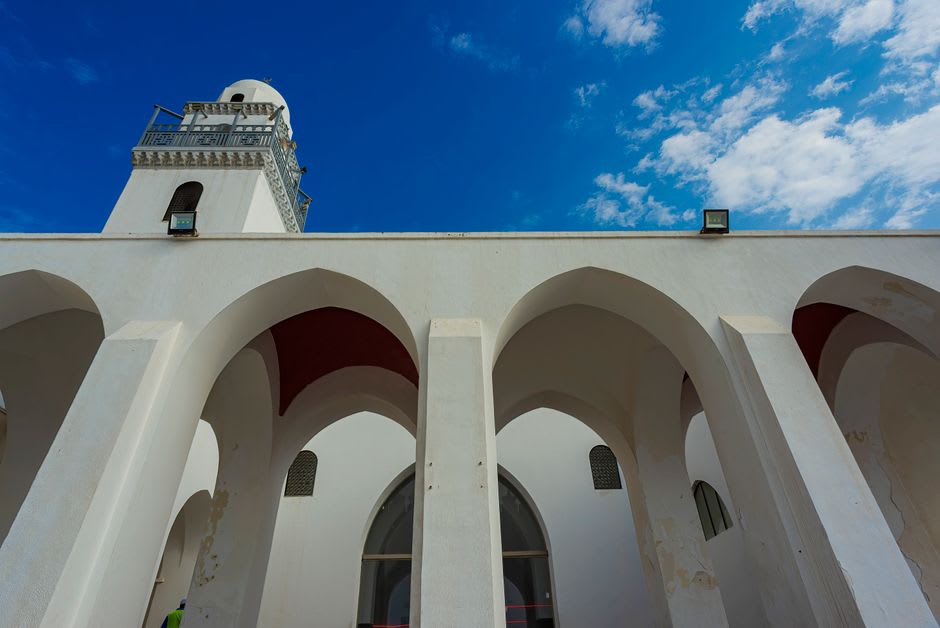
We stayed close to the Old Town, and on our first morning we walked to the Arba’a Rukun Mosque before the heat set in. It dates to around 1269, one of the oldest mosques in sub-Saharan Africa, and standing next to its coral-stone walls I kept thinking about how casually old this city actually is — Ibn Battuta came through in 1331 and already called it “an enormous town.” That’s the strange gift of Mogadishu: you’re not visiting a place trying to become something, you’re visiting a place remembering what it already was.
The Italian colonial buildings caught me off guard too — arched facades and faded pastel walls sitting a few streets over from the mosque, some crumbling, some still lived in, laundry strung between balconies that once belonged to a very different city. Lia photographed one for almost twenty minutes while our guide, patient as ever, told us which families had moved back into which blocks over the past decade. Decades of civil war since 1991 hollowed out huge parts of Mogadishu, and you feel that history in the gaps between buildings as much as in the buildings themselves.
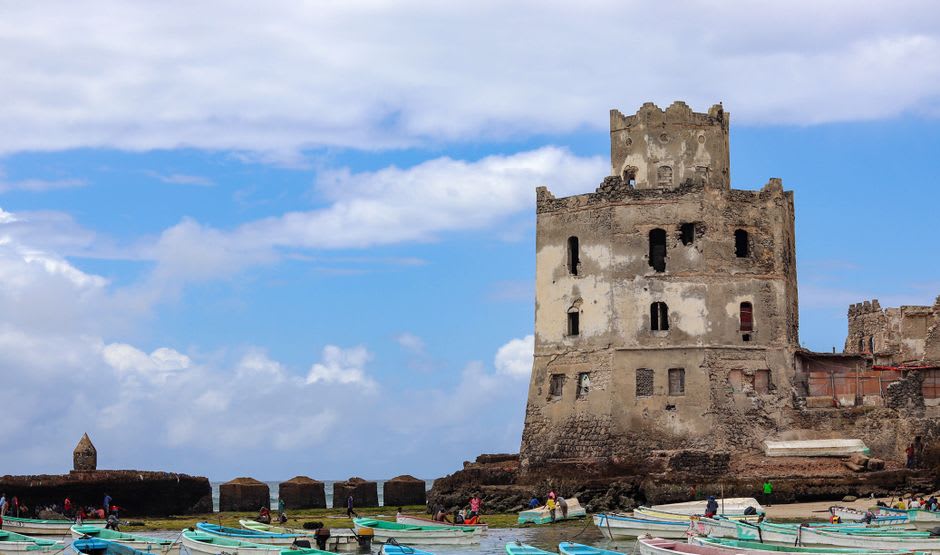
In the evening we drove to Lido Beach, and it undid something in me. Kids playing football barefoot in the last light, men hauling in nets from small wooden boats, the deep-water harbor beyond them catching the sun as it dropped into the Indian Ocean. We ate grilled fish from a stall near the shore — Lia still brings up that fish — and just sat there while the city, cautiously, kept coming back to life around us.
When to go: We went in January, and I’d point anyone toward that December-to-February window — the air is noticeably cooler and drier, which makes the walking and the beach evenings far more comfortable than they’d otherwise be.
Keep exploring
More from Horn of Africa
 horn-of-africa
 Simien Mountains
A fractured highland plateau in northern Ethiopia where gelada baboons graze at cliff edges and the horizon is too large for a single field of vision.
Explore horn-of-africa
 Socotra Island
A geological orphan in the Arabian Sea where dragon blood trees spread their mushroom canopies over beaches that barely seem to belong to this planet.
Explore horn-of-africa
 Asmara
Eritrea's capital is a perfectly preserved Art Deco city at 2,400 metres, where Italian espresso culture survived decolonisation with remarkable serenity.
Explore horn-of-africa
 Axum
The ancient capital of the Aksumite Empire, where stone obelisks rise from dry earth and the city quietly claims to hold the original Ark of the Covenant.
Explore horn-of-africa
 Berbera
Somaliland's ancient port where Ottoman limestone warehouses face a Gulf of Aden beach so undiscovered it makes you feel like the first person to find it.
Explore horn-of-africa
 Danakil Depression
One of the hottest and lowest places on earth, where sulphur vents bubble in alien colours and Afar salt miners still work the ancient white flats.
Explore