
Graham Street Market
"Two hundred metres from the stock exchange, a woman was still selling bok choy off a wooden cart the way her grandmother probably did."
Hong Kong's oldest wet market, squeezed between Central's glass towers, still selling vegetables off wooden carts the way it has since the 1840s.
I found Graham Street by accident, cutting through on my way to somewhere else in Central, and stopped so abruptly that a man carrying two crates of Chinese broccoli nearly walked into me. One block earlier I had been surrounded by banks. Here, the street narrowed into a corridor of stalls selling live fish out of aerated tubs, chickens still feathered and hanging by the feet, mounds of ginger and choy sum, and fruit stacked in pyramids precise enough to make an engineer jealous. Graham Street has been a market since the 1840s, which makes it older than most of the buildings now looming over it, and it has survived redevelopment attempts more than once by sheer stubborn usefulness.
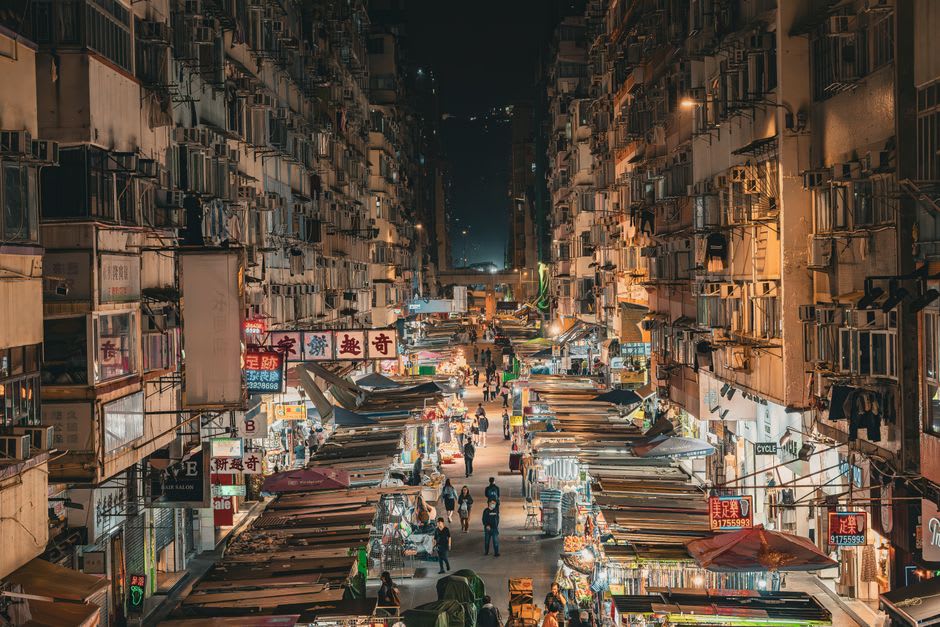
What struck me was the compression of it — the market runs maybe two hundred metres, but every metre is doing something different. Butchers with cleavers moving so fast I couldn’t follow the strokes. A stall selling nothing but dried mushrooms and herbs in glass jars, the owner weighing portions on a hand scale that looked older than me. Fishmongers keeping their catch alive in shallow tanks until the moment of sale, because in Hong Kong “fresh” is not a marketing word, it’s a baseline expectation. I bought a bag of lychees from a woman who peeled one for me to prove they were good, unprompted, before I’d said a word about buying anything.
The market survives today squeezed between two forces that should have killed it decades ago — the supermarket chains that dominate most of the rest of the city, and the property developers who would very much like this land for something taller. It persists because the older residents of Central and the Mid-Levels still shop here daily, and because the quality genuinely beats the supermarket alternative. Lia and I came back a second morning just to buy ingredients for a dinner we cooked in our hotel’s tiny kitchenette, and the whole shop cost less than one restaurant appetizer would have a few blocks away.
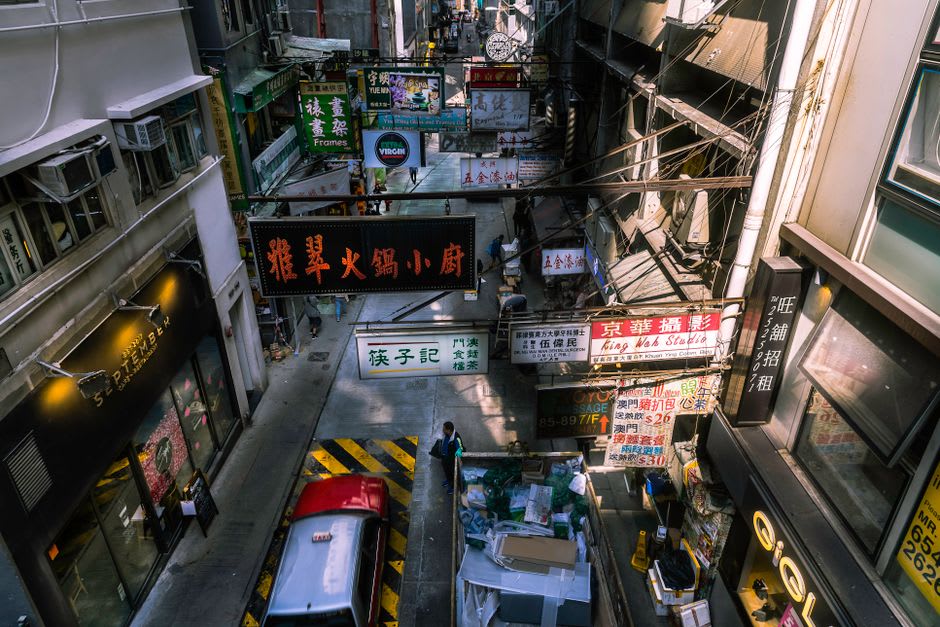
The surrounding lanes — Peel Street and Gage Street — extend the market’s reach with dried goods shops, a scattering of cha chaan tengs where market workers eat between shifts, and the occasional incense stall tucked behind a vegetable cart like it wandered in from a different century. It’s easy to walk through in fifteen minutes. It’s better to give it an hour and actually watch how the transactions happen — the shorthand, the trust, the total absence of anyone trying to sell you a souvenir.
When to go: Early mornings, ideally before 9am, when the produce is freshest and the market is running at full working pace rather than winding down for the day. Sundays are quieter since many stalls close or reduce hours.