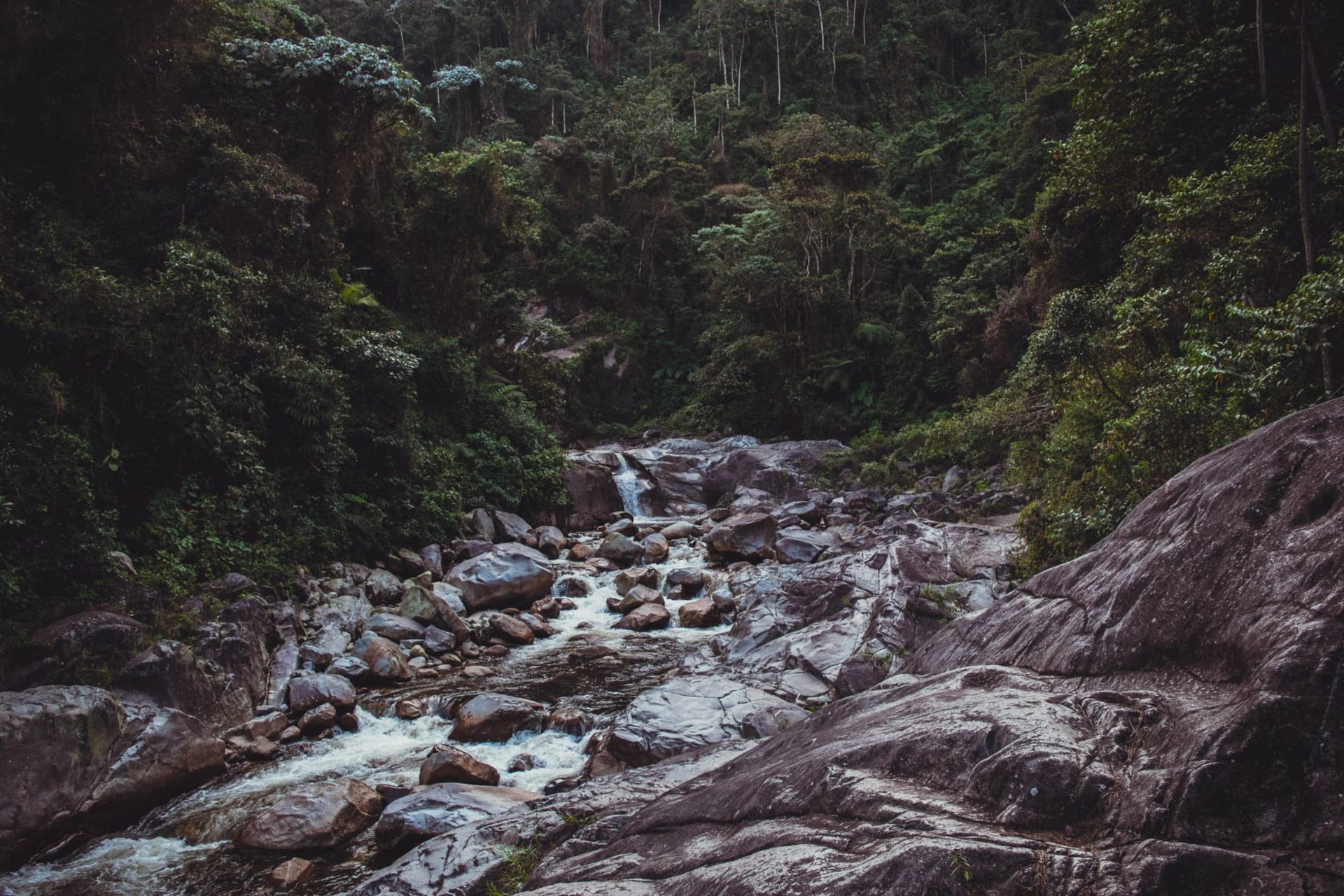
Pico Bonito
"The trail disappeared into cloud at about 1,200 meters and I kept walking anyway, which I can only explain as momentum."
Pico Bonito is the mountain you can see from La Ceiba’s waterfront — that abrupt wall of green rising from the coastal plain, its upper slopes usually wrapped in cloud by ten in the morning, its summit (2,435 meters, though the actual Pico Bonito peak is technically off-limits) only rarely visible from below. The national park covers over a hundred thousand hectares and remains largely roadless. You enter from the village of El Pino on the park’s southern edge, pay a small fee at the ranger station, and then the forest swallows you with a speed that is somewhat startling.
The Lower Trails and the River
The best introduction to Pico Bonito is the trail system along the Río Coloradito — a series of paths that cross the river several times over footbridges (and once where a footbridge used to be), running through primary forest so dense that the light at midday is the quality of early evening. The air at this elevation — still low, maybe 200 meters — smells of wet earth and decomposing vegetation, which sounds unpleasant and is actually the opposite. I kept stopping and taking inventory: heliconia in the understory, a morpho butterfly so blue it looked photoshopped, the constant background percussion of the river. A group of white-faced capuchin monkeys in the canopy above me threw sticks and swore at each other or at me — I couldn’t determine the target.
The Lodge at Pico Bonito
The Lodge at Pico Bonito is the most famous accommodation in the park — an eco-lodge set directly in the forest with a bird list that runs to well over four hundred species and guides who know exactly where the resplendent quetzal has been nesting for the past three years. I didn’t stay there; I stayed in a guesthouse in El Pino and paid a lodge guide for a morning walk instead, which worked out to a reasonable compromise. The hummingbird feeders at the lodge attract species I’d never seen before and several I haven’t seen since, including a violet sabrewing that sat on a branch two meters from my face for long enough that I genuinely began to feel self-conscious.
The Canopy Trail and Upper Forest
Above the main trail systems, a series of hanging bridges cross the forest canopy — not the zipline tourism of Costa Rica but actual walking bridges at about fifteen meters elevation, swaying gently and giving access to the mid-canopy layer where most of the bird life actually concentrates. The sound from up there is different: less river, more birds, and the wind moving through the top of trees in a way that the understory never feels. I crossed four bridges in a row, gripping the cables with the grip of someone who understands intellectually that the bridges are engineered safely and whose palms disagree.
Night in the Forest
I hired a guide for a night walk from El Pino — two hours in the lower forest after dark, with headlamps and considerable alertness. The forest at night is not frightening so much as it is busy in ways daylight conceals: tarantulas on tree trunks, a sleeping hummingbird folded on a branch, the red eye-shine of something in the leaf litter that the guide identified as a fer-de-lance and suggested we not approach. I did not approach. We watched a kinkajou work a fruiting tree by torch and walked back to El Pino with the forest still audible behind us.
When to go: December through April is the dry season and best for hiking — trails are passable and the river crossings are safer. The rainy season (May–October) brings intense afternoon downpours that can make upper trails impassable and rivers dangerous. Birding is excellent year-round, with migratory species present November–March adding to an already extraordinary resident list. Weekdays are notably quieter than weekends when Hondurans from La Ceiba make day trips.