Tabo
"A thousand years of devotion in a building that looks like it was made from the same mud as the earth it stands on."
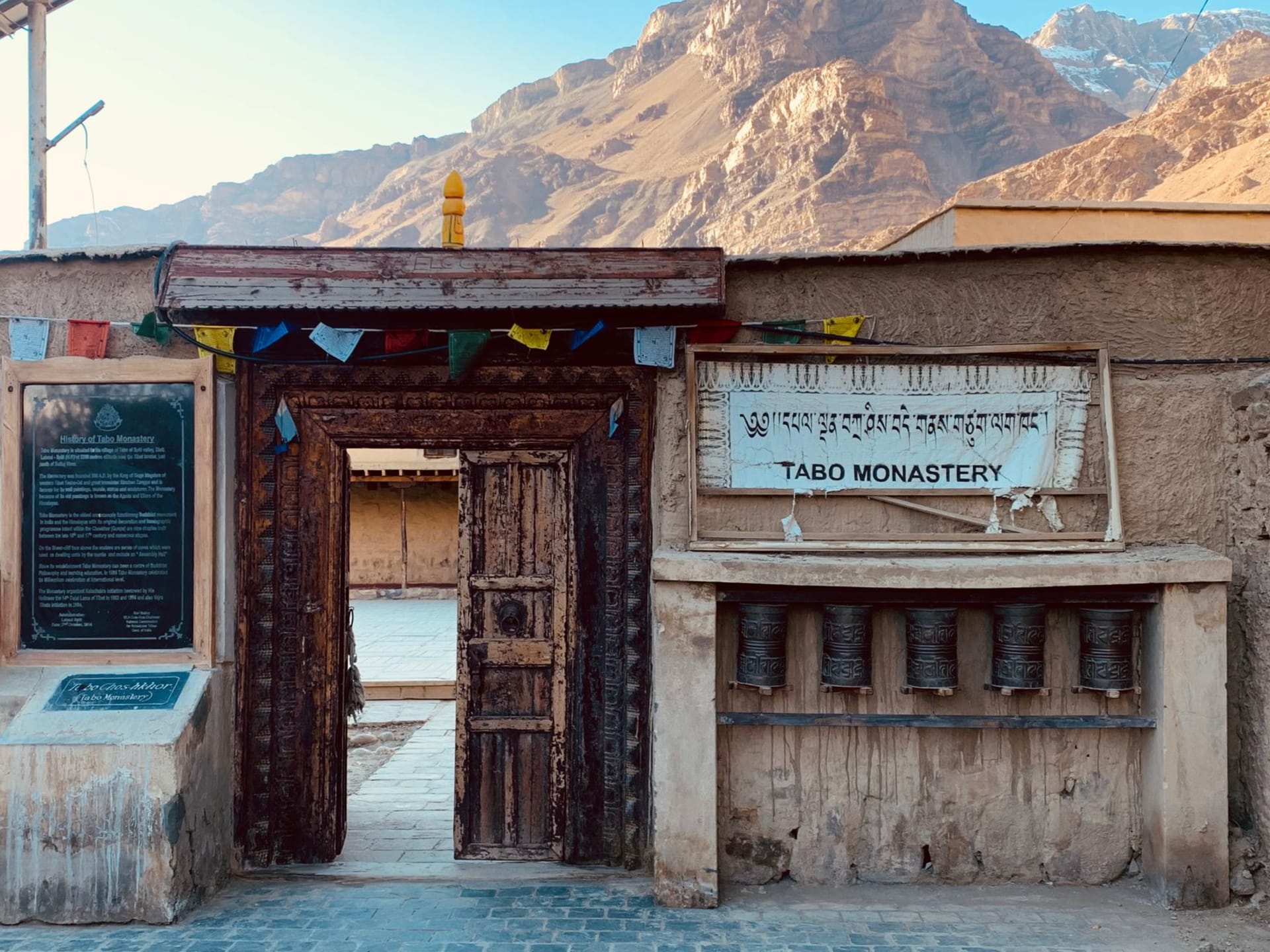
The bus dropped me at Tabo in the early morning, when the light was still horizontal and the mud walls of the monastery were glowing the colour of old terracotta. There are no hotels on the main road here — just a few guesthouses, a line of prayer wheels, and the monastery compound itself, which extends back from the road into a cluster of low buildings that look less like they were constructed and more like they grew from the desert floor. The surrounding cliffs are the same colour: ochre shading to rose in the morning light, eroded into columns and overhangs by centuries of freeze-thaw. You could be in Cappadocia or in some imagined corner of the American Southwest, except that those places don’t have this particular monastery, and this particular monastery has been continuously functioning since 996 CE.
Tabo is, simply, the oldest continuously operating Buddhist monastery in the Himalayas. It was founded by the great translator Rinchen Zangpo, who established it as one of 108 monasteries meant to revitalize Buddhism across the trans-Himalayan region. Inside the main assembly hall — the Tsuglakhang — the murals that cover every surface from floor to ceiling represent a tradition of painting so precise and so devotionally intense that Indian art historians still argue about the Persian and Central Asian influences folded into the iconography. I am not a Buddhist and I am not an art historian, and I still sat in that hall for the better part of an hour, watching the light shift through a small high window and feeling the weight of all those accumulated centuries pressing gently down.

The cave temples above the monastery are reached by a path that climbs the ochre cliff directly behind the compound. These are carved into the rock itself — small chambers with low ceilings where monks once meditated and painted, and where many of the most important murals have survived precisely because no one could get to them easily for several centuries. The current monks will sometimes open caves that are normally locked, if you ask with appropriate patience and no particular agenda. I spent a morning in a cave barely large enough to stand in, looking at a figure of Avalokiteshvara whose eyes had been rendered with a precision that seemed to suggest the painter had been working toward something that wasn’t fully visible yet. The plaster smelled of old dust and mineral pigment. Outside, a crow called from the cliff face.
The village of Tabo, which occupies the flat ground around the monastery, is one of those Spiti settlements where daily life proceeds with a particular unhurried attention. Women in traditional dress carry loads of dry grass on their backs along the irrigation channels. Old men sit in the sun outside the monastery walls and do not appear to be doing anything in particular — which, given the altitude and the quality of the light and the age of the walls behind them, seems like exactly the right activity. The local guesthouses serve the same dal and rice that you eat everywhere in Spiti, but here the meal comes with the sound of monastery bells in the evening and the silhouette of the eroded cliffs turning purple against the stars.

The Dalai Lama has designated Tabo as the place where he wishes to spend his final years, should he have the choice. I find this information impossible to forget when visiting: it gives the place a quality of chosen significance, of being recognized from outside by someone who knows what significant places look like.
When to go: June to September when the Spiti Valley is accessible. The Kalachakra initiation ceremony, held here periodically by the Dalai Lama, draws thousands of pilgrims and is an extraordinary (if crowded) time to visit — check dates in advance. October brings dramatic autumn light on the cliffs but the road may close early. Avoid winter unless you are prepared for genuine isolation.