Bir Billing
"On the ground it's butter tea and chortens; up there it's just air and the whole valley below you."
I came to Bir with no intention of paragliding. I had been moving through the higher altitudes for weeks — Spiti, Kinnaur, a difficult road back through Mandi — and Bir felt like somewhere to stop and breathe and eat something that wasn’t dal. Within twelve hours of arriving I had signed up for a tandem flight from Billing the next morning, which is not how I had planned to spend the money, but which turned out to be one of those decisions that you forgive immediately upon landing.
Bir is not what you expect from the phrase “paragliding capital.” There is no alpine resort architecture, no ski-lift aesthetic. The town is, at its core, a Tibetan exile community that settled here in the 1960s — smaller and less famous than McLeod Ganj, but in some ways more itself for the relative obscurity. The main Tibetan Colony area has a monastery (the Chokling Monastery, with its remarkable prayer hall and a thangka collection of genuine depth), a handful of guesthouses run by Tibetan families, and a market street where you can get butter tea and momo and excellent fresh-roasted coffee made by a Tibetan woman who learned the process from a YouTube channel and has refined it over five years into something surprisingly good.

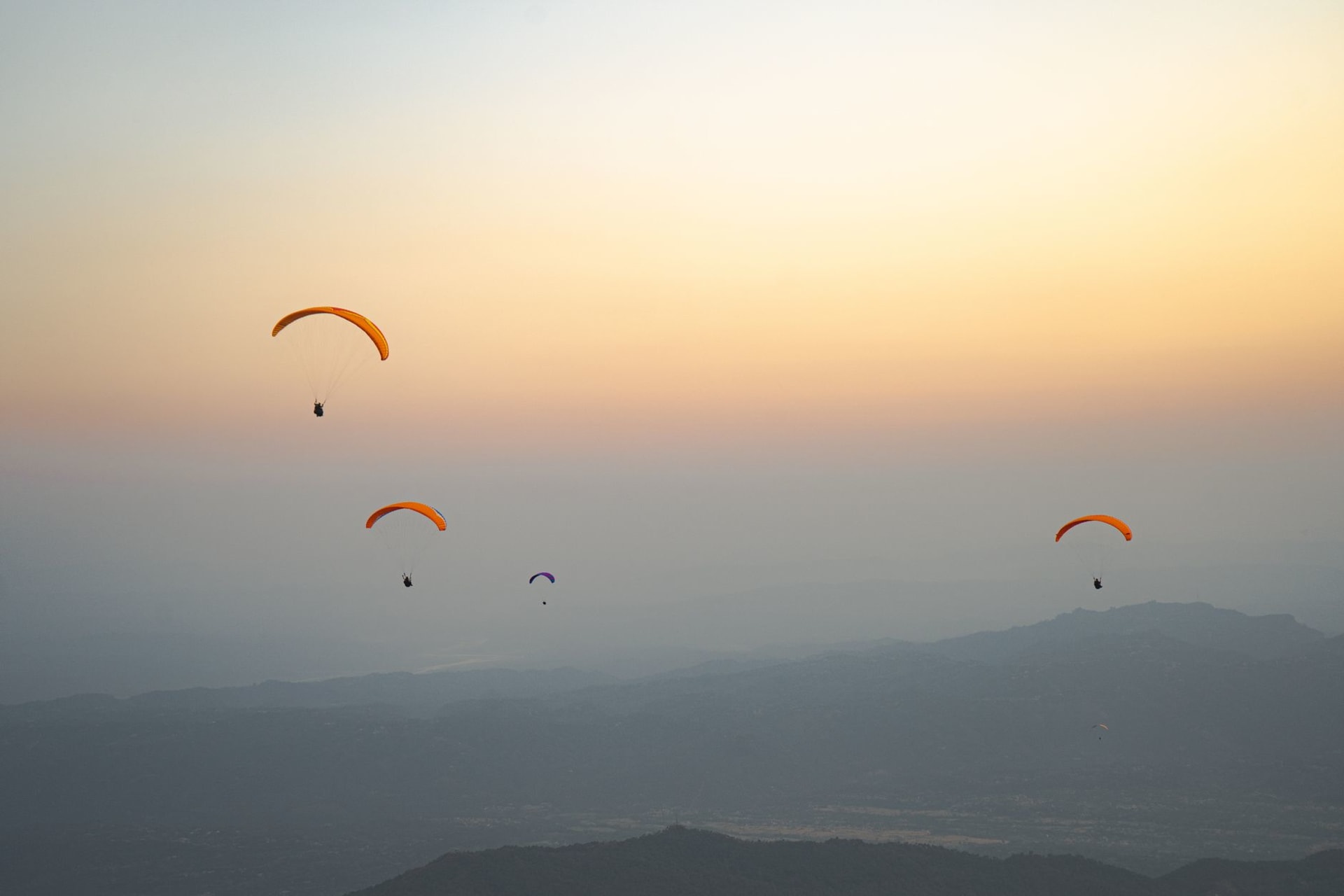
The Billing launch site is 14 kilometres above Bir along a switchback road that climbs through oak and rhododendron forest to a high meadow at 2400 metres. The morning I went, there were maybe thirty pilots preparing equipment in a meadow wet with dew, checking wind instruments, studying the sky with the focused attention of people who have staked professional reputation on their ability to read air. My instructor — a man from Bir who had been flying for twelve years and had the calm of someone for whom altitude is simply the natural condition — briefed me in eight minutes and then we ran off a ridge into air that felt like it had no right to hold us.
What struck me about the flight was not the fear — there was remarkably little, though I expected more — but the quality of the silence. At 1500 metres above the Kangra Valley, with the Dhauladhar range filling the northern skyline and the valley spreading south in its green geometry of rice terraces and rivers and village clusters, the sound was simply: nothing, and then wind, and then the occasional creak of the harness. The Beas River was a silver line in the valley floor. The Bir monastery roof was a pink square in the village below. A hawk turned in a thermal fifty metres to our left, uninterested in us.
The Kangra Valley below Bir is a destination in its own right that most visitors miss entirely. The valley is wide and lush and full of history — the Kangra Fort, once one of the wealthiest temples in India before Mahmud of Ghazni sacked it, still occupies an enormous promontory above the Banganga and Manjhi rivers. The Masrur rock temples, cut from a single sandstone ridge in the 8th century, sit in a location so incongruous (a flat agricultural plain, nothing dramatic on the approach) that their actual quality of carving comes as a genuine shock. These are not afterthoughts to a paragliding trip. They are the reason the valley deserves more time than most people give it.

Bir works as a base with less sense of deprivation than many Himachal destinations. There are good guesthouses at various price points, a yoga center that is genuinely well-regarded rather than Instagram-marketed, and a cafe culture around the paragliding community — European instructors, Israeli travelers, Indian adventure enthusiasts — that produces the kind of mixed conversation I find reliably more interesting than the monoculture of the standard traveler circuit.
When to go: October and November are the peak paragliding months — the monsoon is over, the skies are clear, and the air thermals that make Billing one of the world’s premier flying sites are at their most reliable. March to June is the second season. Avoid July and August (monsoon). The Bir Billing Paragliding World Cup, held in October, brings international pilots and is worth planning around for the spectacle of professional flying.