South Point
"The wind here has apparently never once stopped to reconsider its direction."
The southernmost point in the United States — wind-scoured cliffs, cliff-jumping fishermen, and a trail to a green sand beach found almost nowhere else on Earth.
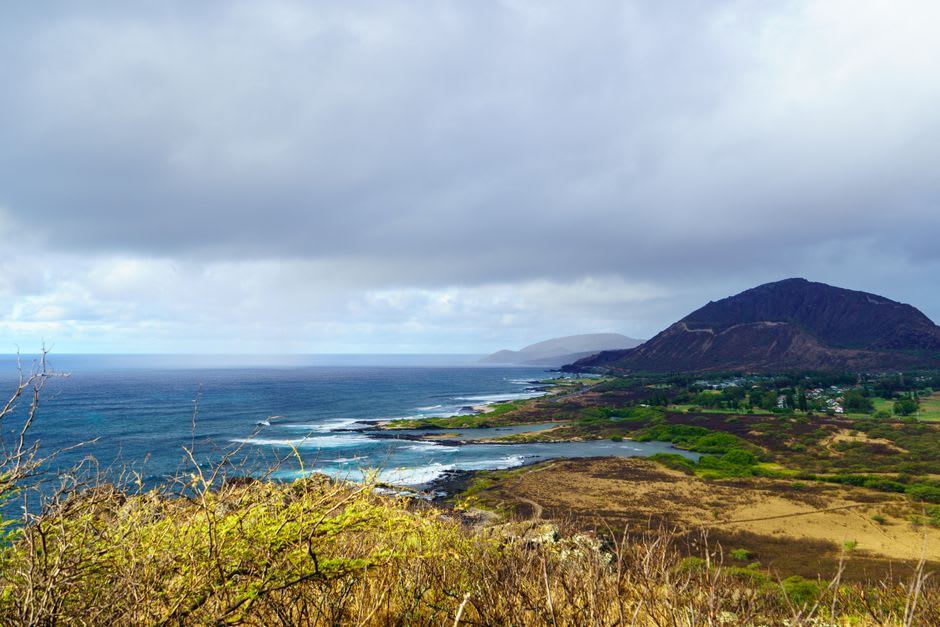
Ka Lae — South Point in most conversations, though the Hawaiian name means simply “the point” — is the southernmost spot in the fifty states, and it announces this fact the way nature usually announces superlatives: not with a monument, but with wind. It hit the car sideways as we turned off the highway onto the twelve-mile access road, and it did not let up once in the two hours we spent there. The trees along the road grow permanently bent, combed flat by decades of the same trade wind, which told me everything I needed to know before we even reached the coast.
The Cliffs and the Fishermen
At the point itself, a scatter of small wooden platforms cling to the cliff edge — ladders bolted into the rock, ropes coiled beside them. Local fishermen use them to lower boats and gear directly into the deep water below, since there is no harbor for miles. A couple of teenagers were cliff-jumping when I arrived, a twenty-five-foot drop into startlingly blue water, climbing back up a knotted rope afterward like it was the most ordinary Tuesday activity imaginable. I did not jump. Lia called me sensible. I suspect she meant something else.
The Road to Green Sand
From the parking area near the boat ramp, a rough four-mile round-trip track leads east to Papakolea, one of only four green sand beaches on the planet. The color comes from olivine crystals eroding out of a collapsed cinder cone, and from a distance the sand genuinely reads as olive-green against the black cliff walls — I kept expecting my eyes to be exaggerating and they were not. The walk is hot, shadeless, and longer than it looks on a map; locals in pickup trucks offer rides for a few dollars each way, and after forty minutes of full sun I was glad to take one back.
Standing at the Edge
What stayed with me longest was not the green sand but the plain fact of the geography: standing at Ka Lae, the nearest landmass south is Antarctica, roughly 7,500 miles of open Pacific away. Ancient Hawaiians navigated here first from the Marquesas over a thousand years ago, using only stars, swells, and birds. Looking at that empty horizon, I understood the scale of that achievement in a way no museum exhibit had ever managed.
When to go: Wind is a constant here regardless of season, so dress for it year-round. Go early to beat both the heat on the green sand trail and the midday crowds. Swimming near the point itself requires strong local knowledge of the currents — this is not a casual beach day.