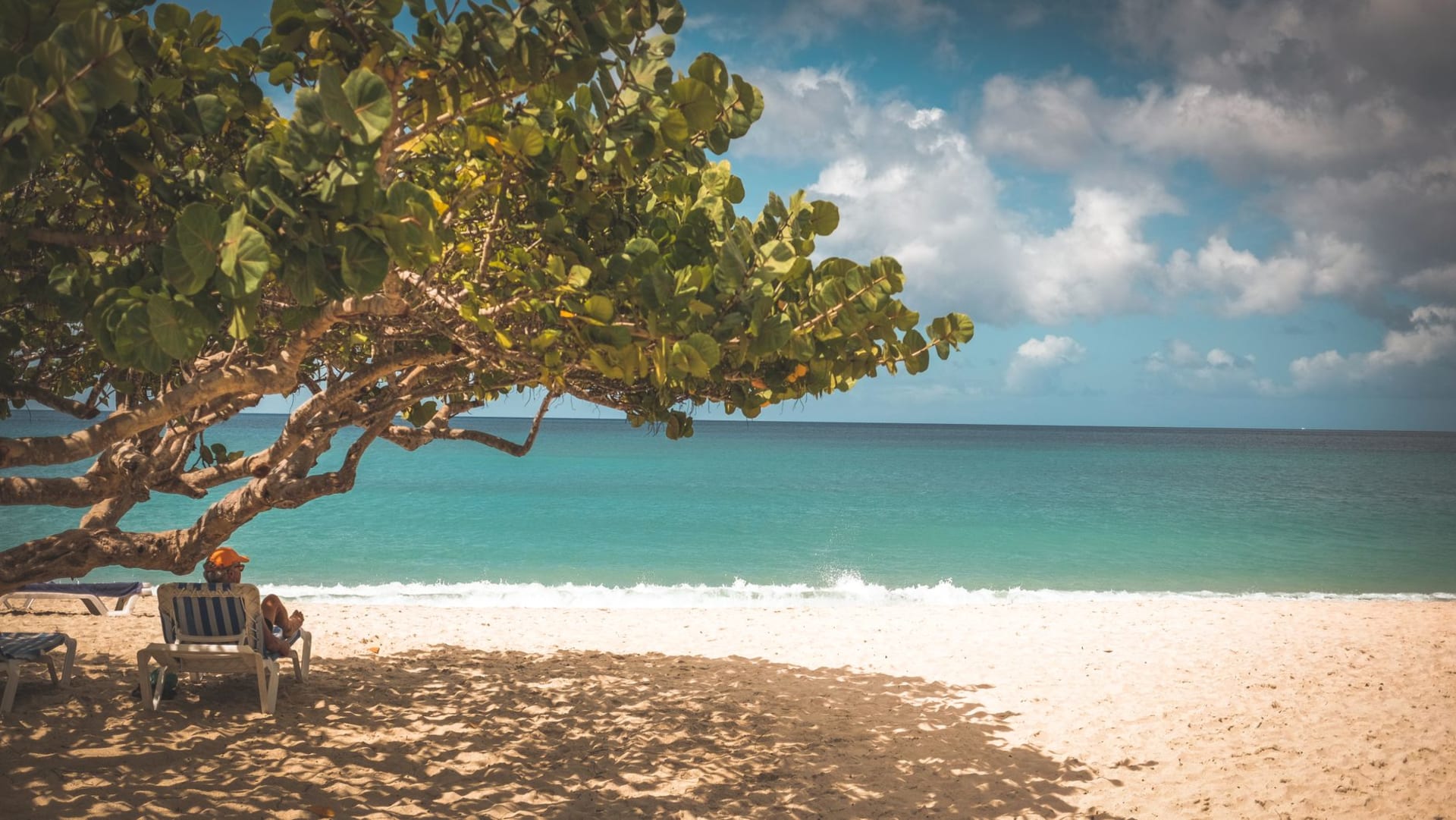
I walked down to Grand Anse for the first time at seven in the morning, before the sun had cleared the ridge behind me. The beach was almost empty — a couple of joggers, a man raking the sand near one of the shuttered bar structures, a dog moving with great purpose toward nothing in particular. The water was the colour I expected it to be from the photographs, which is to say I expected to be disappointed, and I was not. That particular shade of pale blue-green, where the sand shows through in the shallows and the depth darkens gradually toward the horizon — it was exactly that. A few things in life turn out to match their reputation. Grand Anse is one of them.
The beach runs for nearly two miles, curving in a gentle arc from the southern point toward the low bluff at the north end. It is not secret. The resorts line the upper part of the beach, and by midday on a good-weather day there are umbrellas and vendors and the general activity of a popular Caribbean beach. But it is long enough that the crowds thin toward the ends, and there are hours in the early morning and at sunset when it empties back into something closer to itself.

The swimming is as good as the view. The sea here is protected by the geography of the southwest bay — no serious Atlantic swell, gentle waves, a sandy bottom that stays shallow for a good fifty meters before it deepens. I spent an hour one afternoon just floating, which is not something I normally do. The temperature was around 29 degrees. A pelican crossed overhead. I thought about nothing useful.
There are beach bars along the upper stretch, and the range in quality is what you would expect. The ones that have been there longest — low wooden structures with plastic chairs and a chalkboard menu — tend to be better. I had grilled fish at a place called Umbrellas that had been at the same spot for years; the snapper was whole, charred at the edges, served with a hot sauce made in-house that had a delayed hit, arriving about thirty seconds after you swallowed. A Carib beer, cold enough. The conversation at the next table was in Creole, the speed of which I tracked but could not follow.
What most people miss about Grand Anse is that it is a working beach as much as a resort beach. In the early morning and late afternoon, local fishermen come in through the surf and beach their boats, unloading catches directly onto the sand. The catch changes daily — mahi-mahi, kingfish, red snapper, sea urchins. You can buy directly from them if you know to ask and look like you mean it. I bought a bag of sea eggs — local name for urchin roe — and ate them with a piece of bread I’d picked up in town, standing at the water’s edge. Better than anything I’d ordered from a menu.

The sunsets are the other thing. The beach faces southwest, which means in the late afternoon the light comes from behind you and hits the water at a low angle, and then everything turns slowly from gold to pink to a kind of smudged orange before the sky goes purple. It happens every clear evening and it is never the same twice. I know because I watched it four times.
When to go: Grand Anse is calmer and clearer between January and May during the dry season. The water temperature stays warm year-round. Avoid the period between July and September when passing tropical weather can chop the sea and bring sudden heavy rain.