Concord Falls
"You smell the nutmeg before you see the trees, and you hear the waterfall before you see either."
I left St. George’s early, before eight, to beat the heat in the river valley. The road into the interior climbs quickly through the St. John’s parish hills, and within twenty minutes of the coast the landscape changes entirely: banana plants giving way to cocoa trees, the air cooling and thickening with moisture, the light changing from direct Caribbean sun to something filtered and green. The first sign for Concord appeared handwritten on a board at a junction. I followed it.
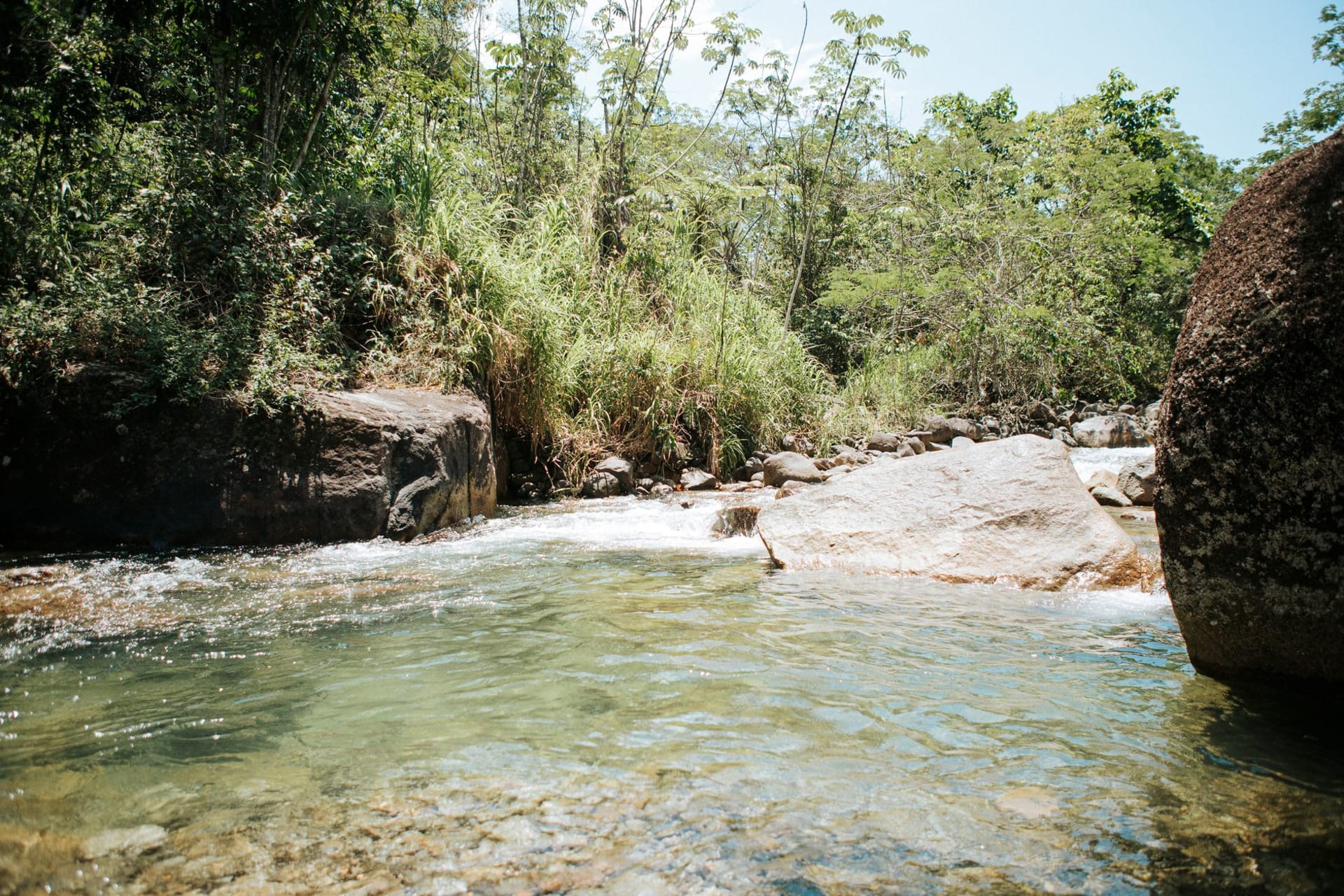
The Concord Valley holds three waterfalls at different elevations, and most people only see the first — the lowest fall, accessible from the car park by a short level path, and legitimately beautiful. A wide curtain of water drops into a green pool, the surrounding rocks mossy and wet and permanently in the spray zone. A few local kids were using it as a swimming hole when I arrived, launching themselves from a rock ledge with the recklessness of people who know the depth by body memory. I swam there too. The water was cold enough to feel medicinal.

The upper falls are a different proposition. The trail to reach them climbs steeply through the plantation — this is not a manicured nature walk but a working landscape, and the path runs through active nutmeg groves where the trees bear their strange fruit: a yellow-green pod that opens to reveal a dark seed wrapped in brilliant red mace. I had never seen a nutmeg on a tree before, only in markets and in the spice containers in French kitchens growing up. On the tree, it looks almost artificial, too vivid, as though someone placed it there to demonstrate a point. A plantation worker came down the path carrying a heavy bag and we negotiated around each other with the brief politeness of people who are both busy.
The upper fall — locally called the Fontainbleu fall — is the payoff for the climb. Fewer people reach it and the ones who do tend to be in no hurry to leave. It is higher, narrower, more forceful than the lower fall, dropping into a deep oval pool surrounded on three sides by sheer green walls. The sound in that enclosed space is total. I sat on a rock at the edge for perhaps forty minutes and did not feel the need to move.
On the way back down through the plantation, I was invited by a man named Clifton to see the nutmeg processing shed he ran with his family. It was an open-sided wooden structure with flat drying racks and the mechanical smell of the grinding apparatus, and Clifton explained with real patience the difference between nutmeg grades, the role of the mace in pricing, the fact that the outer shell itself gets ground and used in the local Grenadian nutmeg syrup. He handed me a piece of fresh mace — the scarlet lacy coating from the seed — and told me to chew it. It tasted like the best possible version of the spice, still resinous and alive, nothing like the powder in a jar.

The Grenada Chocolate Company operates near the valley road, and stopping there before or after the falls is not optional — it is the kind of place that makes you understand why food can be a serious subject. Their dark bars are made from estate cocoa grown within a few kilometers of the factory, and the chocolate carries a flavour profile that is genuinely complex in the way that good wine is complex: a fruit note at the front, something earthy in the middle, and a clean finish that doesn’t leave you sticky. I bought six bars. Four made it back to France with me.
When to go: The dry season between January and May is ideal — the river levels are manageable and the trail is drier underfoot. The upper falls trail requires good footwear and basic fitness; it takes about 45 minutes each way and gets steep. A local guide from the village at the trailhead is worth hiring both for safety and for the education they provide about the plantation ecology.