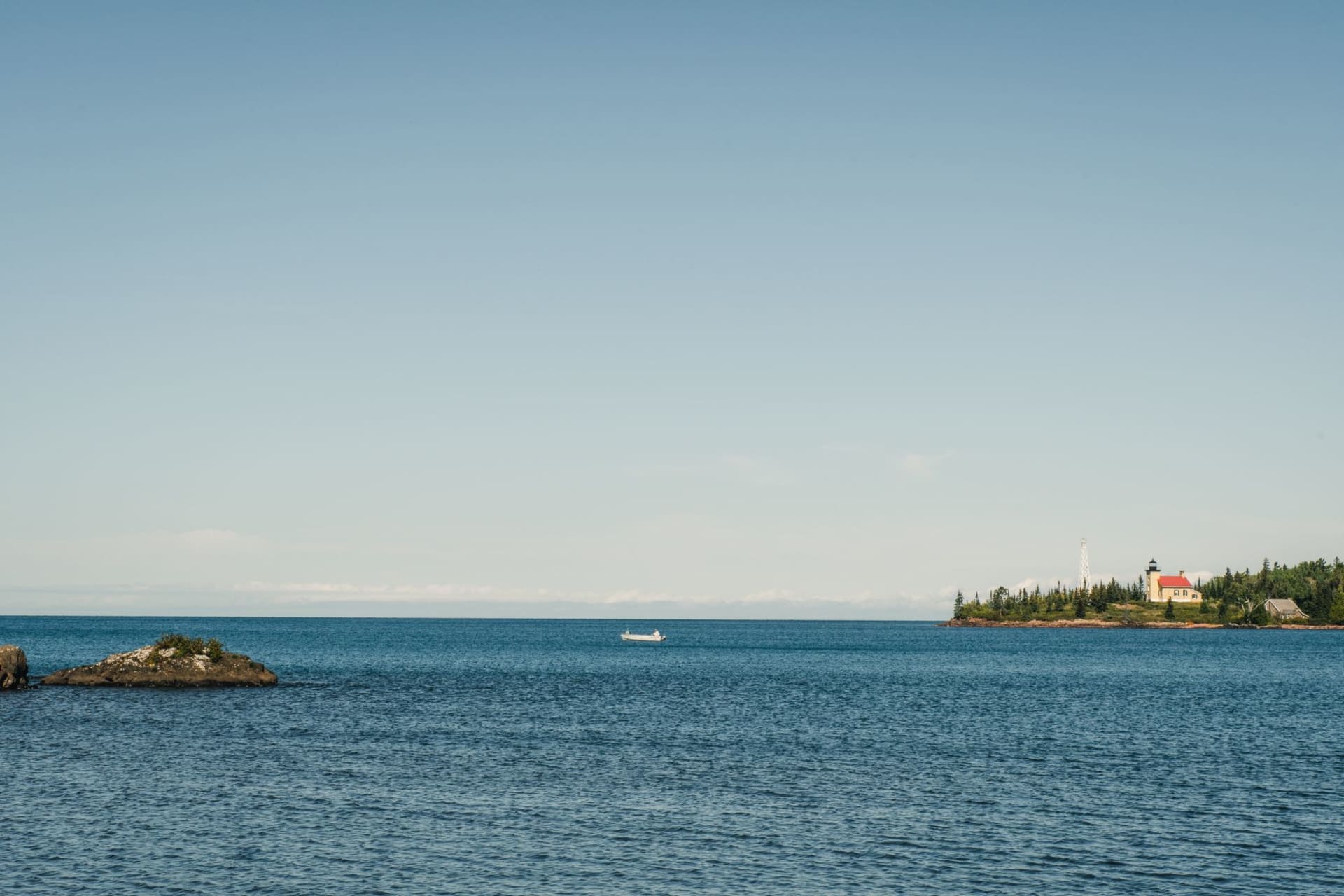
Isle Royale
"Lia asked how far the nearest road was, and the answer — there isn't one, anywhere on the island — rearranged something in both of us."
Isle Royale is the least visited national park in the contiguous United States, and the statistic that everyone repeats is that more people visit Yellowstone in a single day than visit Isle Royale in an entire year. I believe it. Getting there is the first filter: a three-hour ferry across open Lake Superior from Michigan’s Copper Country, on water cold enough to kill you in minutes and rough enough that the railing was lined with quiet, focused people. Lia, who has now been seasick on two of the three trips I have dragged her on, regarded the lake with open suspicion the entire way.
A wilderness with no shortcuts
The island closes completely in winter. There are no roads, no cars, no cell signal worth the name, and the only way to move once you arrive is on foot or by paddle. We based ourselves at Rock Harbor on the eastern end, in one of the simple lodge rooms, and used it as a launching point for day hikes along the Greenstone Ridge trail and out to the smaller satellite islands by water taxi. The forest is boreal — spruce, fir, paper birch — and the ground is a sponge of moss and exposed billion-year-old basalt, some of the oldest exposed rock in North America.

What struck me most was the silence, which is not really silence at all but the absence of everything mechanical. No engines, no distant highway hum, none of the low-frequency background noise that I had not realised I carried in my ears until it was suddenly gone. At night the loons called across the harbour, a sound that goes straight past your rational mind and into something older. I lay awake the first night not because I was uncomfortable but because I kept listening, the way you keep probing a missing tooth.
Wolves, moose, and a famous experiment
Isle Royale is where biologists have run the longest continuous predator-prey study in the world, tracking the island’s wolves and moose since 1958. The wolf population crashed almost to extinction in recent years and the park has since brought new animals over the ice and by air to rebuild it. We did not see a wolf — almost nobody does — but moose are everywhere, and we watched a cow and her calf wade chest-deep into a beaver pond at dusk, feeding on aquatic plants with the unbothered confidence of animals that have never been hunted here.

The thing nobody tells you about Isle Royale is how the slowness gets into you. With no way to rush and nowhere external to be, the days stretched and softened. We ate dinner watching the light leave the harbour and went to bed when it was dark, like people did before electricity decided otherwise. By the third day I had stopped reaching for a phone that had nothing to tell me.
The ferry season runs roughly mid-spring through autumn, and the park shuts entirely from November to mid-April — the only national park in the country that does. Book the lodge or your backcountry permit early; capacity is genuinely limited, which is part of why the place still feels like a secret.