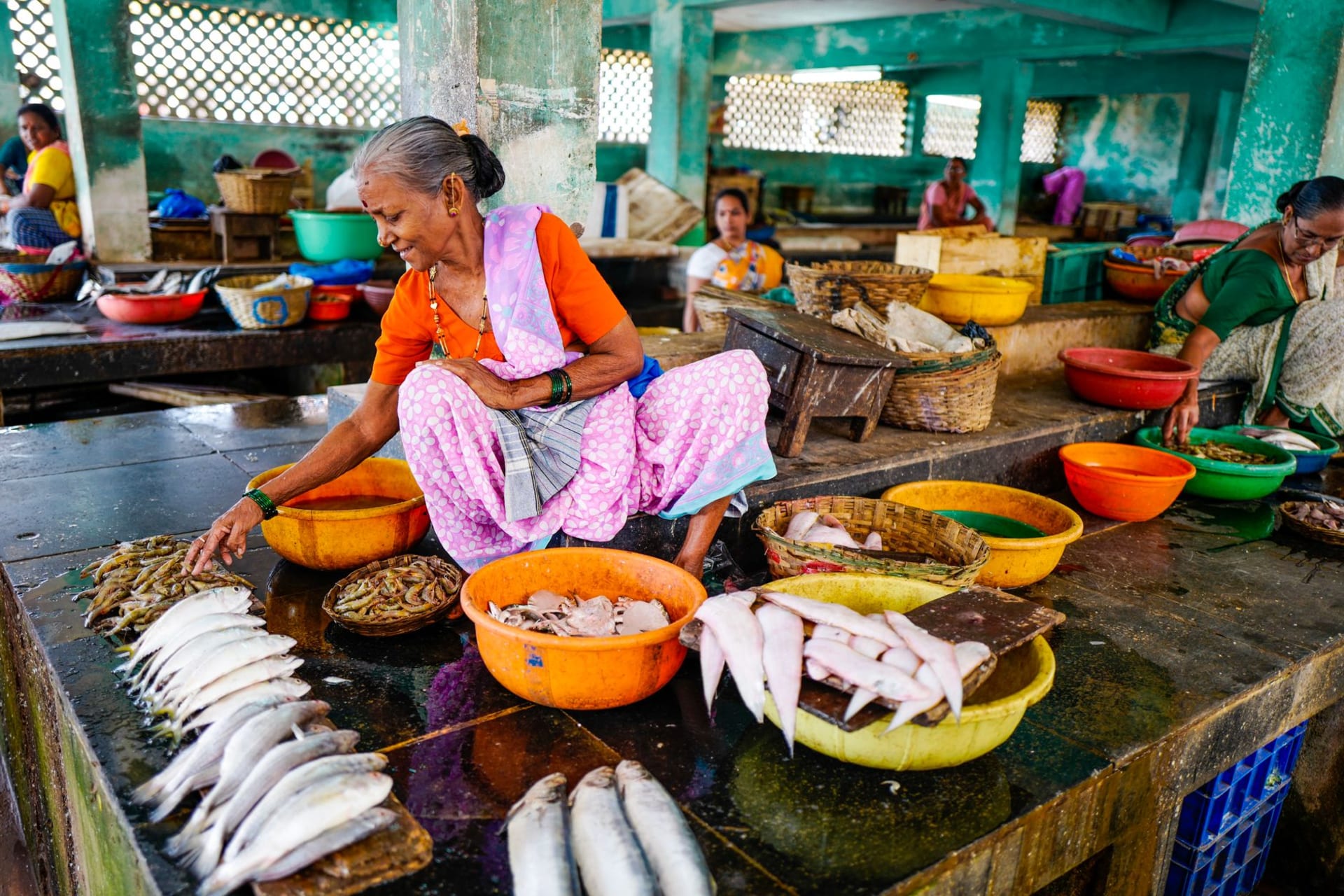
The fish market in Margao opens before the tourists are awake, which is its best quality. I got there at quarter past seven on a Thursday morning — the autorickshaw driver had looked at me with mild suspicion when I said the market, not the beach — and found several hundred people already deep into the business of the day. The kingfish were arranged by size in rows on ice. The pomfret were fanned out like silver hands of cards. A woman sold dried shrimp from enormous baskets, and the smell of those dried shrimp — intense, oceanic, compressed — hit me from twenty metres and didn’t let go for the rest of the morning.
Margao is the commercial capital of South Goa — louder, busier, less aesthetically considered than Panaji, more genuinely useful to Goans than any beach town. It is not a place that markets itself to travelers, which is precisely what makes it interesting. The colonial history is present but worn and utilitarian rather than preserved: the Church of the Holy Spirit on Largo de Igreja sits on a large square that would be picturesque if it weren’t also a bus terminus. The Portuguese mansions on the streets behind the church have their plasterwork crumbling, their gates rusting, their gardens going to seed. Nobody has decided to turn them into heritage hotels yet.

The covered market — a sprawling 19th-century structure that has expanded organically into the surrounding streets — is where I spent most of my time in Margao. Konkani and Portuguese pepper the conversations. The vegetable section has kokum, which is the defining souring agent of Goan cooking — a dried purple fruit that gives the fish curry its particular sharpness — and also the tiny, intensely sour bilimbi and the varieties of banana that are native to Goa and taste nothing like the Cavendish. I bought a bag of dried kokum from a vendor who threw in a handful of cashews from the new season and told me, unprompted, that the new cashews were better than last year’s because the rains had been correct.
I ate fish thali in a restaurant near the market that had ten tables, a handwritten menu board, and a television showing cricket at a volume that precluded conversation. The thali arrived on a stainless steel plate with a pile of rice, a small bowl of fish curry, a piece of fried kingfish, solkadhi made from kokum and coconut milk, a pappadum, and a small mound of salad. I ate everything. I ordered another piece of fish. The bill was somewhere around two hundred rupees.

The streets around the market have a particular physical quality in the late afternoon — the light slanted and amber, the crowd thickening as the offices close, the snack vendors setting out their wago and ros omelette stalls. Ros omelette — an egg omelette submerged in a thin, fiery chicken curry sauce served on a bread roll — is a Margao street food I had not encountered in descriptions of Goa. I ate three of them over two days. I don’t apologize for this.
When to go: Year-round. Unlike the beach towns, Margao functions through the monsoon — the market slows but doesn’t stop. The best time for the fish market is any morning during November through March, when the sea is calm and the variety of catch is at its greatest. Avoid arriving during the midday heat; the covered market becomes genuinely punishing after noon.