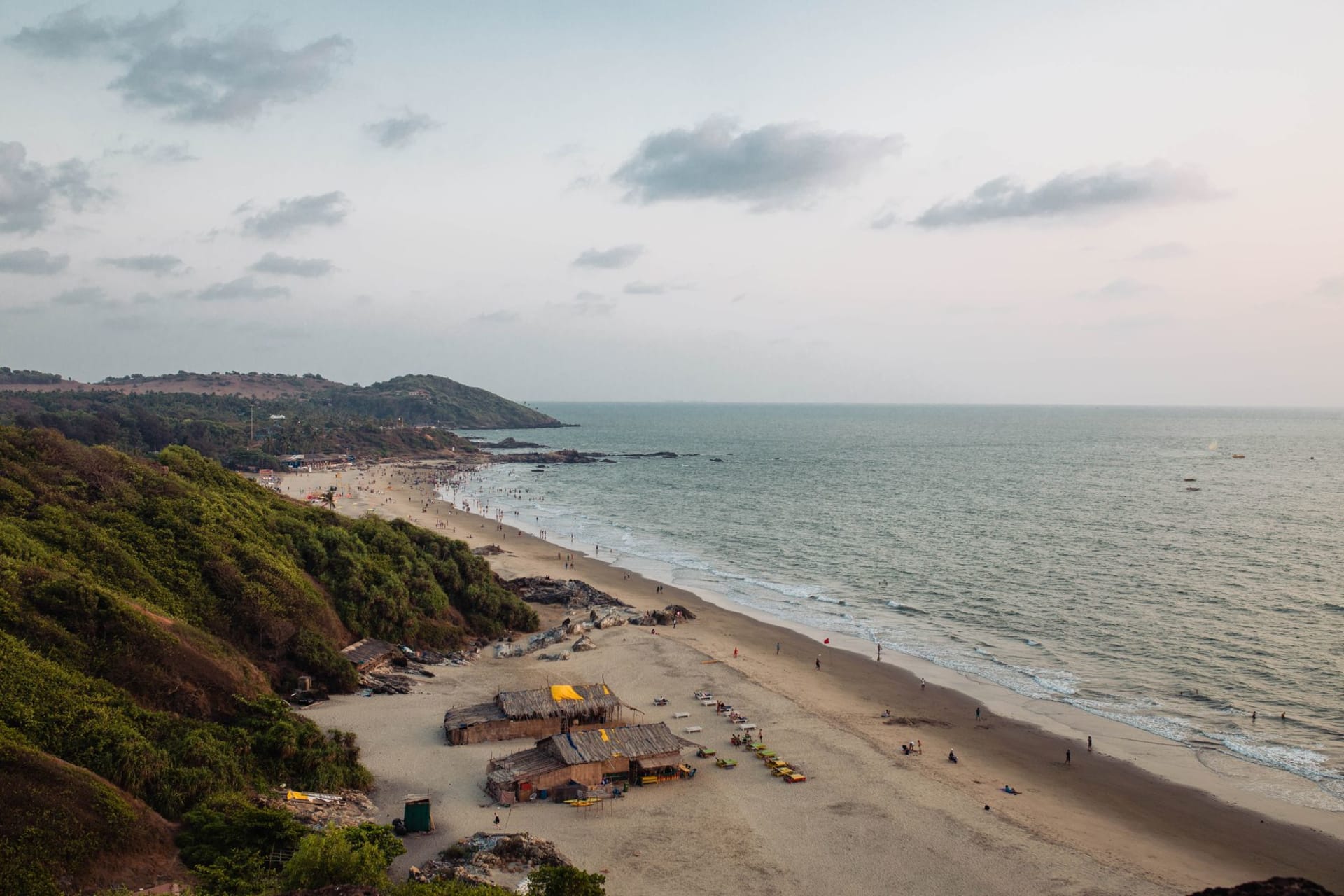
Arambol
"The drum circle at Arambol is the last honest hippie thing left in Goa — and it's honest because no one is selling it."
I had been told by three different people in three different contexts that Arambol was “the real Goa” — which is exactly the kind of claim I distrust, because the place that everyone agrees is the real version of something is usually the most performing version of it. So I arrived at Arambol skeptically, on a rented Activa, coming north on the coastal road from Morjim through the casuarina forests, and pulled up on the beach in the late afternoon as the vendors were folding their session in and the drum circle at the cliff end of the beach was just beginning.
And here is what I found: a drum circle that had no organizer, no schedule, no amplification, no money changing hands. About forty people — Goan, Israeli, Russian, French, one man from Kerala in a lunghi who played a small tabla with tremendous focus — sitting on the sand around a collection of hand drums, djembes, a cajon, and various things people had fashioned from materials to hand. The playing was genuinely good in places and genuinely terrible in others and the sun went into the sea directly in front of us while it happened. I sat for two hours and did not look at my phone once, which is either a recommendation or a warning depending on who you are.

Arambol is the northernmost significant beach in Goa, and it has retained more of the long-stay traveler culture than any other point on the coast. The guest houses are simple and cheap. The cafes run on Goa time, which means they open when they feel like it. There are yoga shalas on the cliff path and alternative health practitioners in the village and the kind of handwritten notices on community boards that you don’t see in the more developed beach towns — workshops, drum lessons, shared transport to the full moon, a kitten that needs a home.
Behind the main beach, a path along the cliff leads to the sweet water lake — a freshwater lagoon separated from the sea by a narrow strip of sand, shaded by trees, fed by a hot spring that enters from the rock face. People float here in the afternoons in a state of suspension between the mineral water and the shade. The sulfur smell from the spring is faint but unmistakable, and the combination of warm fresh water, the sound of the sea fifteen metres away, and the tree cover gives the lake a quality that I can only describe as actually restorative rather than aspirationally so.

In the mornings, the paragliders launch from the cliff above the beach and ride the thermals south, their coloured canopies catching the wind against the blue of the sky and the darker blue of the sea. I watched from below rather than participating. I am not, I have established, a person who enjoys leaving the ground voluntarily. But from the beach, the paragliders give the scene an accidental beauty — slow colour against blue, circling for a long time before the thermal gives out and they spiral down to the sand.
When to go: November through February. The drum circle happens most evenings in season but is best in December and January when the crowd is largest and the musicians most varied. Arambol is drier than the central and southern beaches, so it heats up earlier in spring — late February can already feel punishing by afternoon.