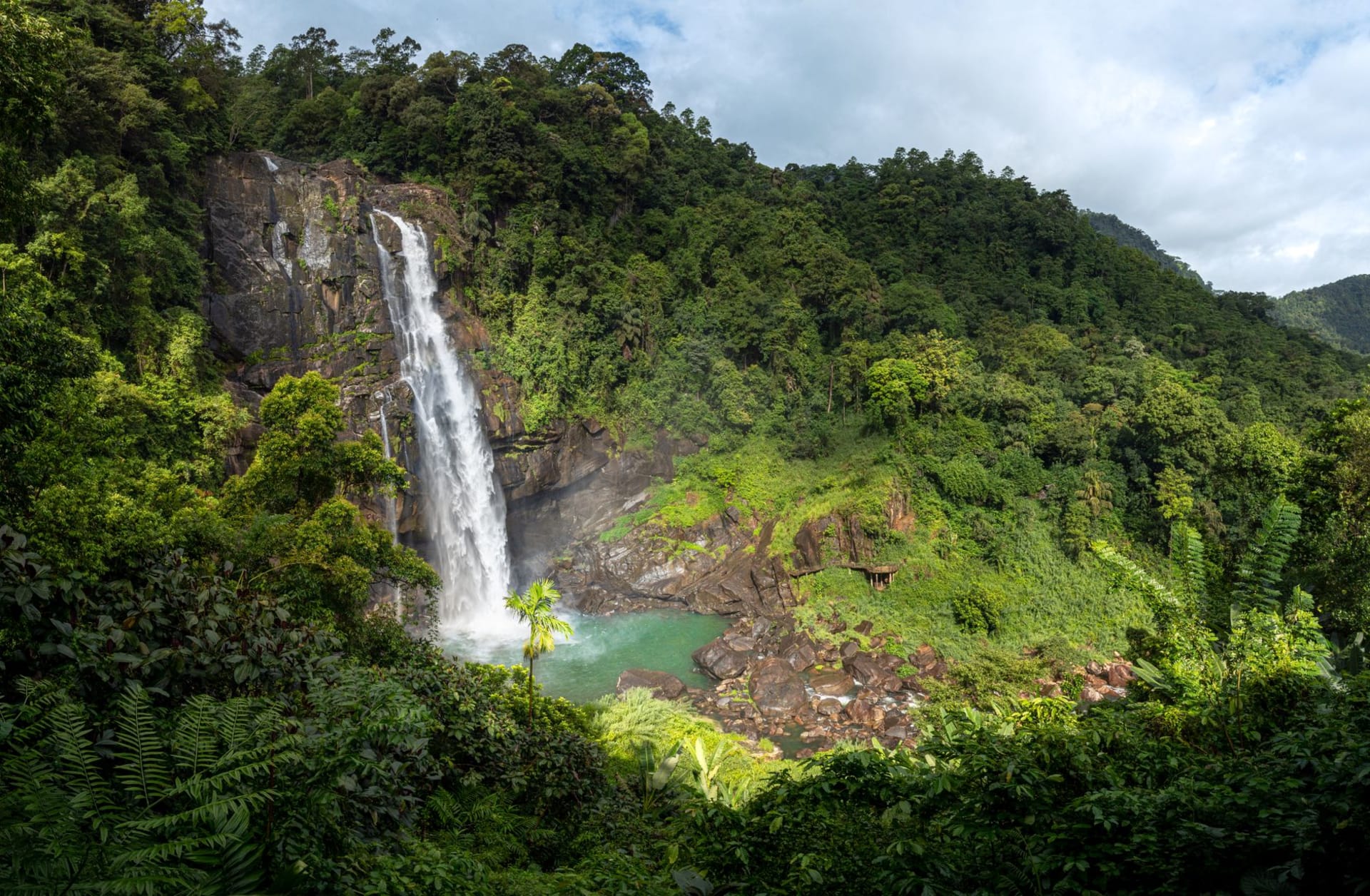
Wli Falls
"A hundred thousand fruit bats launched from the cliff face and the sound was like something tearing open."
I had not expected the bats. I had known about the waterfall — Wli Falls is listed in every Ghana itinerary as the country’s signature natural landmark, the highest falls in West Africa at around 80 meters — but the bats come as a surprise even when you’ve been told about them. There are roughly 250,000 of them roosting on the rock face behind the falls, and when you approach and the noise disturbs them, they launch in waves. The sound is enormous. The sky fills with what looks like black smoke. Standing in the mist at the base of the falls, watching them circle and resettle, I went very quiet.
The Walk In
The trailhead starts at Wli village, about 45 minutes east of Hohoe in the Volta Region. The walk to the lower falls takes about 45 minutes through dense secondary rainforest — figs, palms, the occasional enormous buttressed trunk that forces the path sideways. The air gets progressively cooler and more humid as you approach. You hear the falls well before you see them: a deep, sustained thunder that seems to come from everywhere at once.
The path crosses a river several times on stepping stones, which are submerged after significant rain. I wore sandals I could get wet. The guide, a young man from Wli named Emmanuel who had clearly answered every possible tourist question many hundreds of times, remained patient and quietly amused by my enthusiasm about the buttress roots.
Lower and Upper Falls
Most visitors only do the lower falls, which is understandable — the view is dramatic, the pool is swimmable, and the bats are there. The upper falls require an additional two-hour climb up a trail that gets genuinely steep in places. I did it on a second morning, alone except for Emmanuel, and found a completely different experience: a higher, wilder drop into a smaller pool, no other tourists, and a view back over the forested hills into Togo that justified every switchback. The upper falls are worth it specifically because they require enough effort to discourage most people.
Hohoe and the Volta Region
The nearest town, Hohoe, serves as a base and is more substantial than you might expect — real hotels, a reasonable restaurant scene for the eastern Volta, a market worth an hour. The surrounding Volta Region is underexplored by foreign visitors, which makes it one of the more genuinely relaxed corners of Ghana. The Agumatsa Wildlife Sanctuary that encompasses the falls is home to more than just bats: green mambas, monkeys, hornbills, and an impressive list of butterfly species live in the forest around the trail.
The Pool
Lia swam in the pool at the base of the lower falls and reported that the water is cold enough to make your chest seize briefly when you first go under — a different kind of cold from the Atlantic, something that comes from altitude and shadow. The bats overhead had mostly resettled by this point. A thin mist drifted off the falls and caught the light. A few other tourists arrived, took photos, and left. We sat on rocks at the edge for another thirty minutes, not particularly talking, listening to the water.
When to go: November through early March offers manageable conditions and passable trails. The lower falls are accessible year-round, but the upper trail becomes slippery and potentially dangerous during the rainy season (April–July). Go early in the morning — by 9am you have an hour or more before tour groups arrive. The bats are year-round residents.