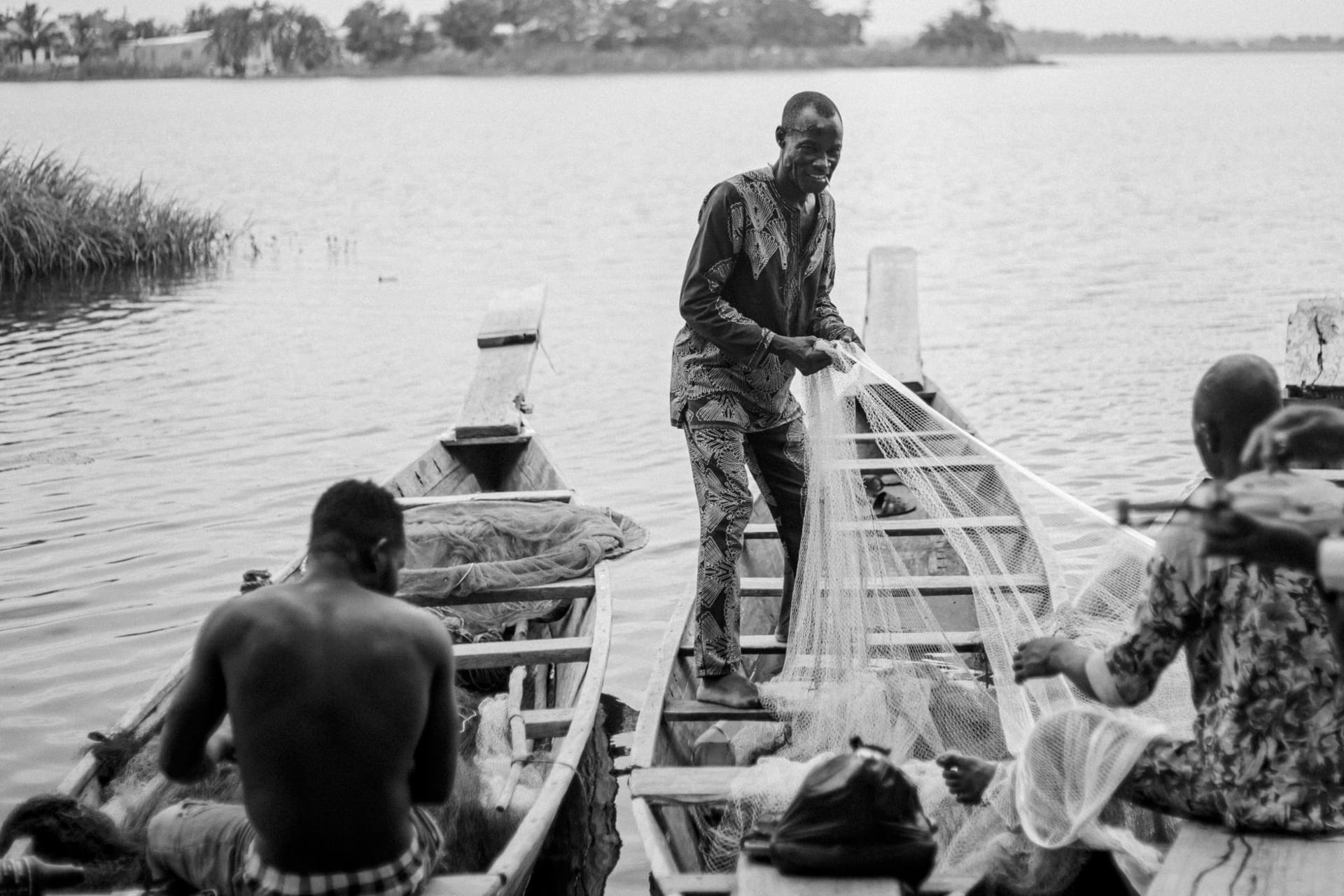
Lake Volta
"I've never seen a body of water that felt so much like it was still deciding what it was."
The Akosombo Dam was completed in 1965, and when the reservoir filled over the following years, it swallowed something like 700 villages. I thought about that while standing at the dam’s viewing platform watching the spillway churn white below me. The scale of Lake Volta — it covers about 8,500 square kilometers, roughly the size of Lebanon — is hard to hold in your head. It doesn’t feel like a lake. It feels like a sea that wandered inland.
Akosombo and the Dam
The town of Akosombo was built specifically to house the workers who built the dam, which gives it an unusual tidiness for Ghana — a grid of bungalows, a company club, streets that were planned rather than grown. The dam itself is an engineering monument from a specific moment in African independence-era optimism: it was meant to power Ghana’s industrialization. I walked the viewing area in the early morning, before the heat settled in, and watched a pair of men fishing from rocks far below the dam face, their lines invisible from that distance.
The dam generates most of Ghana’s electricity. The lake created by it also displaced roughly 80,000 people. Both of those facts are true and neither one cancels the other.
The Ferry to Yeji
The most committed way to experience Lake Volta is the government ferry from Akosombo to Yeji — a journey of roughly 20 to 25 hours depending on stops, departing twice a week and covering the lake’s full length. I did it without entirely knowing what I was getting into. The lower deck fills with traders, sacks of produce, motorbikes, live chickens. The upper deck has a few plastic chairs and a kiosk selling instant noodles and Fanta. The lake opens around you slowly as the bank disappears. By nightfall there’s nothing to see in any direction but water and stars, and you realize you’ve effectively gone to sea.
Dodi Island
A shorter and more comfortable excursion from Akosombo goes to Dodi Island, about two hours by boat. The island is small enough to walk in an afternoon — narrow paths between palm trees, a few families, a beach of soft sand that feels improbably remote given you’re still technically in a landlocked reservoir. Canoe trips around the island show you the drowned tree trunks that still poke above the surface in shallower areas, ghostly remnants of the forest that was here before the water came.
What the Lake Requires of You
Lake Volta rewards patience and an appetite for slow travel. There is no highlight that resolves in under an hour, no famous view that reads obviously. What’s here is scale, and quiet, and the particular quality of equatorial light on still water in the early morning when everything turns copper and rose. I sat on the ferry’s deck as dawn broke over nothing but lake in every direction and thought: this is one of the stranger places I’ve been, and I don’t entirely understand what I’m looking at, and that feels exactly right.
When to go: November through February offers dry conditions and manageable temperatures for the ferry journey. Avoid the main rains (April–June and September–October), when the lake can become choppy and some crossings less predictable. The ferry schedule changes — confirm at the port in Akosombo before building plans around it.