Kiang West National Park
"An antelope standing in dry woodland above a mangrove river. The Gambia has no business being this wild."
The first thing you notice about Kiang West is that there is nobody there. Not the no-one-around of a resort beach at low season or the emptiness of a museum on a Tuesday morning, but a genuine, structural absence of other visitors that gives the whole park a quality of discovery that most protected areas in Africa have long since traded away for visitor centers and marked trails. I came in from the north, through the village of Kudang, on a track that required a vehicle with genuine ground clearance and a driver who knew which grass tussocks could be driven over and which concealed drainage channels. We made it without incident. Barely.
Kiang West runs along the south bank of the Gambia River for about thirty kilometers, protecting a sweep of woodland savannah, gallery forest, and mangrove shoreline that together constitute the most intact piece of habitat in the country. The interior is dryland — dry savannah with termite mounds, red laterite outcrops, and stands of woodland dominated by silk-cotton trees whose buttressed roots rise to your shoulder. Walking here in the dry season, in the heat of mid-morning, the landscape goes quiet in a way that feels like pressure. Then a roan antelope steps out of the treeline fifty meters ahead, registers you, and stands.

The roan are the flagship species — large, leggy, steel-grey antelope with curved horns and black-and-white facial markings that make them look permanently theatrical. There are also bushbuck, red colobus monkeys in the gallery forest, and a healthy population of bushpigs that I never saw but heard repeatedly, crashing through undergrowth in a way that initially sounds much more alarming than it turns out to be. Chimpanzees have been recorded but are extremely rare and I wasn’t holding out hope.
The park’s southern edge drops to the river in laterite cliffs that are striking in an unexpected way — the red-orange rock cut by erosion into columns and shelves, the mangroves beginning immediately below, the river opening out beyond. At dusk, from one of the clifftop vantage points, the whole scene goes amber and then rose and then that particular deep blue that the Gambia River seems to save for the hour just before darkness. I sat on a cliff edge with the park warden, a quiet man who had worked here for eleven years, and we watched a fish eagle work the river below us. He pointed out the nest site, visible as a large bundle of sticks in a riverside tree, and told me it had been occupied for as long as he’d worked here. Longer, probably.

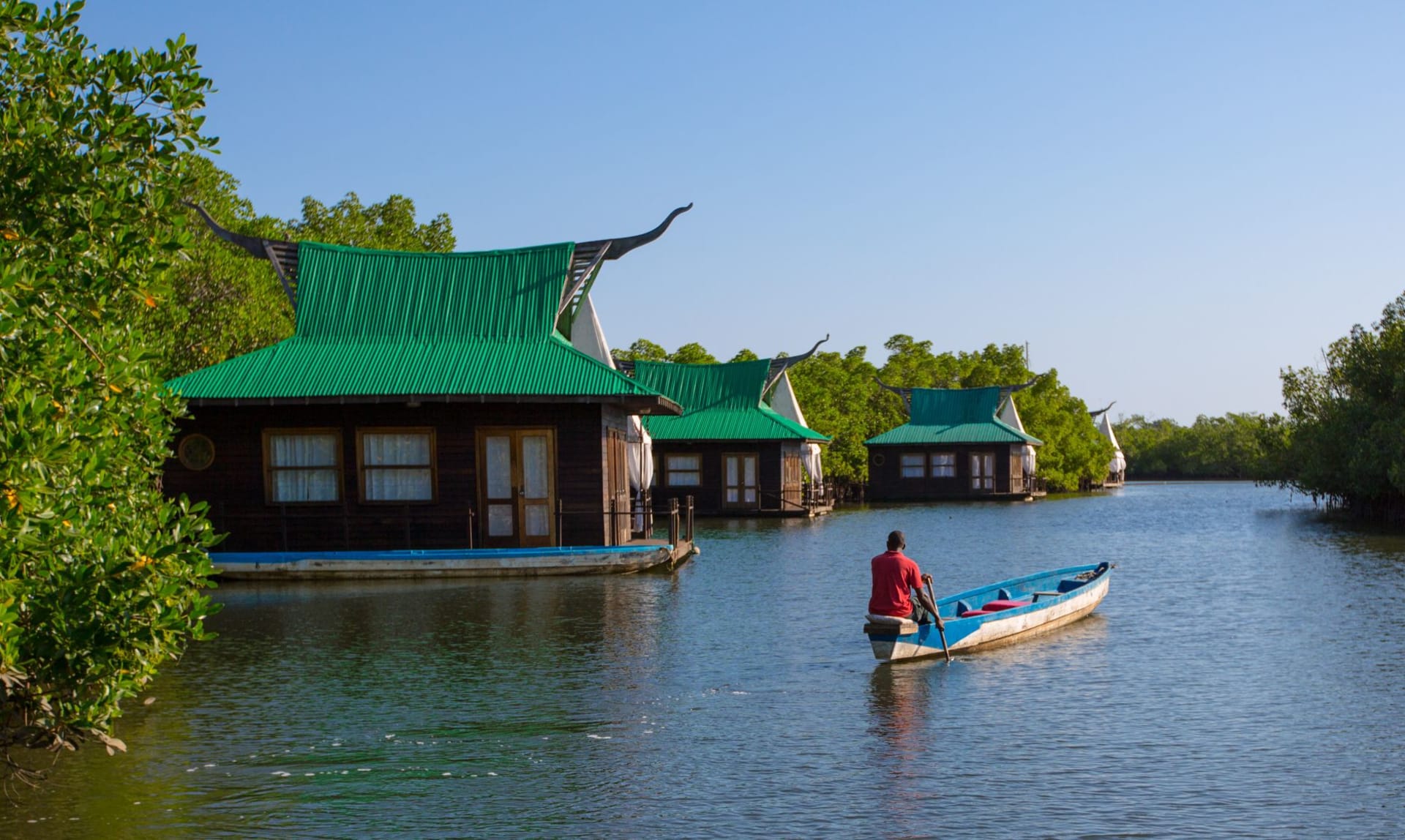
Getting into Kiang West requires either a 4WD vehicle or a pirogue along the river to one of the creek landing points. The park headquarters at Dumbuto can arrange guides — necessary not for safety but for navigation, as the trail system is minimal and the laterite topography is disorienting. Half-day and full-day walks can be organized with advance notice. There is a basic campsite near headquarters for those who want to be in the park at dawn, which is strongly recommended.
When to go: November through April, with January and February peak for game-viewing as water sources dry up and animals concentrate near the river. The park becomes largely inaccessible after heavy rains, which fall July through September. The drive from the coast takes two to three hours depending on river ferry schedules.