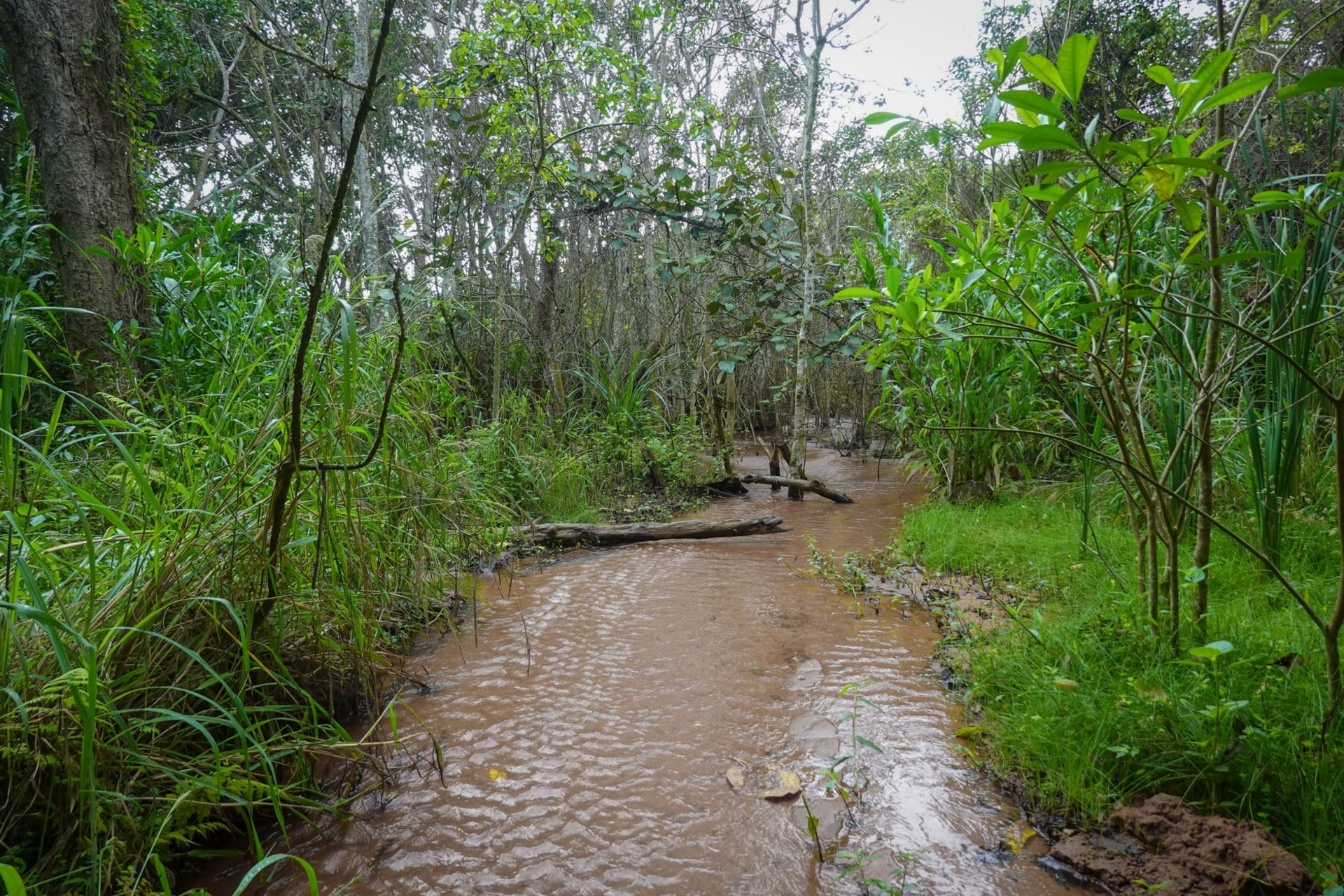
Réserve Naturelle des Nouragues
"The scientists have been here for thirty years and they are still finding things they cannot explain."
The helicopter peeled away the moment I was out, and then there was nothing but forest and the diminishing sound of the rotors and the kind of silence that is not quite silence — that insect-and-bird-and-leaf density of sound that a primary Amazonian forest produces at all hours, a texture rather than a noise, something you feel in the ears rather than hear with them. I had flown in from Cayenne, about a hundred and twenty kilometers to the north, following a river course that had no roads running beside it and no settlements visible from the air for the entire forty-minute flight. The Réserve Naturelle des Nouragues began below us somewhere south of the Approuague river and extended for 94,000 hectares of forest that has never been logged, never been converted, never been anything other than what it is.
The CNRS research station at Parare is one of the most significant tropical biology research centers in the western hemisphere, and it shows in the quality of what has been documented here: more than a thousand bird species recorded in and around the reserve, reptile diversity that makes herpetologists emotional, plant species still being named and classified, interactions between species that reconfigure what was thought possible. The scientists I met during my three days there had been working in this reserve for years, some for decades. One woman showed me photographs from her long-term study of a single fig tree — seventeen years of data, flowering and fruiting cycles, the specific animals that use it at each stage — with the quiet fervor of someone describing something sacred.
Visiting Nouragues is not simple. Access requires advance coordination with the CNRS station, a helicopter charter that is expensive, and a genuine tolerance for conditions that are remote rather than rustic. The hammock accommodation is basic and the insects are thorough. But walking in this forest — with a researcher who can name what you’re looking at, who can explain why the relationship between this wasp and this orchid matters, who can show you a leaf-cutter ant trail that has been running along the same line for longer than any living memory — is a different category of experience from any guided jungle walk I’ve taken elsewhere.
The inselberg — the granite dome that rises above the forest canopy near the station — is the landmark visible from the air and the place to go at dawn. You walk from the station in the dark, following a path that climbs through forest and then suddenly onto open granite, and by the time the light comes the canopy spreads to every horizon below you like something held by the sky. From up there the forest is featureless in the most awe-inducing way: no roads, no clearings, no smoke — just green going in every direction until it meets the atmosphere. This is the largest contiguous block of intact Amazonian forest east of the river Maroni, and standing on that rock in the morning you understand why the scientists stay.
I woke the second morning at 4am to the sound of something very large moving in the forest maybe fifty meters from the station. It moved for about ten minutes and then was gone. At breakfast I described what I’d heard and the researcher across from me, who studies large mammals, looked up from her coffee and said it was probably the tapir she’s been trying to photograph for six weeks. She did not seem bothered. This is what deep field science looks like: patient, slow, perpetually inconclusive, living in proximity to things that do not cooperate.
When to go: The dry season from July to November offers the most accessible conditions, with lower river levels making helicopter approaches easier and trail conditions more passable. Access must be pre-arranged through the CNRS Nouragues station or through authorized research tourism operators — individual visits without coordination are not possible.