Parc Amazonien de Guyane
"No road reaches here. That fact alone changes the quality of the air."
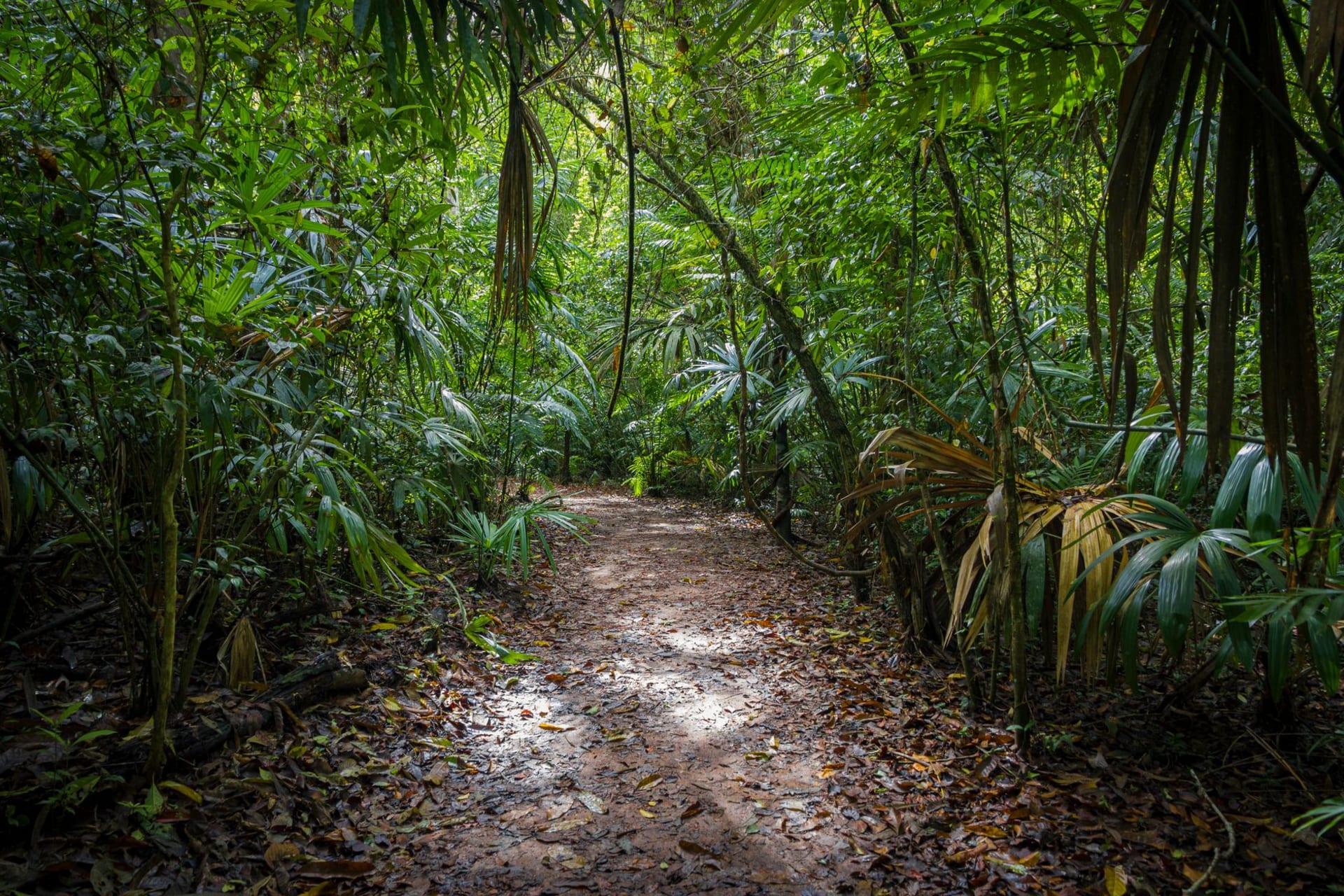
The small plane banked south from Saint-Georges and the road disappeared within two minutes. What replaced it was green — a solid, rolling green that went to every horizon without interruption, the canopy of primary Amazonian rainforest so dense and so continuous that from altitude it looks almost solid, like a surface you could land on. Occasionally a river appeared below, copper-colored, looping back on itself with the casual illogic of water that has never had to negotiate with infrastructure. The Parc Amazonien de Guyane covers 3.4 million hectares of this — roughly the size of Belgium, entirely roadless, the southern third of the territory — and from the air the numbers stop being abstract and become something you feel in your chest.
The park is the largest in France and in the European Union, which produces one of those cognitive dissonances that French Guiana specializes in. Bureaucratically, this is a European nature reserve with French regulations and an EU funding structure. Ecologically, it is a functioning piece of the Amazon basin, home to jaguars and tapirs and giant anteaters and more bird species than the entirety of France. The Wayampi and Teko — Amerindian peoples who have lived in this territory for millennia — inhabit the core zone, where outside visitors require special authorization and are never simply tourists. The park runs a controlled access zone around the core where lodges and guided trips are possible, but even that is not casual travel: reaching it requires a multi-day pirogue journey up the Oyapock or Maroni rivers, or a charter flight to one of a handful of grass airstrips.

I spent three nights at a lodge on the edge of the controlled zone, reached by pirogue from Saint-Georges in a journey that took most of a day. The river narrowed as we went upriver and the canopy closed overhead in places, the trees so tall that the light reaching the water surface had traveled through forty meters of leaves first and arrived the color of old amber. Caiman watched us from the banks with the patience of things that have been watching rivers longer than rivers have been needing watching. My guide was a young Teko man from an upriver village who spoke French with an accent I couldn’t place and pointed at birds without naming them — just pointed, so I would look, and then moved on.
The sounds at night are the thing I was least prepared for. The jungle at three in the morning is not quiet — it is a different kind of loud, textured and layered and present in a way that urban sound never manages. Frogs on multiple frequencies, insects doing something rhythmic and collective, something larger moving through the undergrowth maybe thirty meters from where I was sleeping. I lay in a hammock under a mosquito net and listened and felt the particular alertness that comes from being in a place where you are genuinely not the most significant animal.

The biodiversity is not something you fully process in real time. My guide showed me a species of poison-dart frog the size of my thumbnail that was a color blue so saturated it looked edited. A troop of spider monkeys passed overhead and shook the canopy above us for about five minutes, raining leaves and small fruit, then was gone. In the evening light a harpy eagle — the largest eagle in the Americas — circled once above the clearing and disappeared. I recorded none of it adequately.
When to go: July to November offers the best river levels for pirogue access and the driest trail conditions. All visits to the controlled zone should be organized through approved operators with Wayampi and Teko guides — this is non-negotiable and appropriate. Plan a minimum of five days; the journey alone requires two.