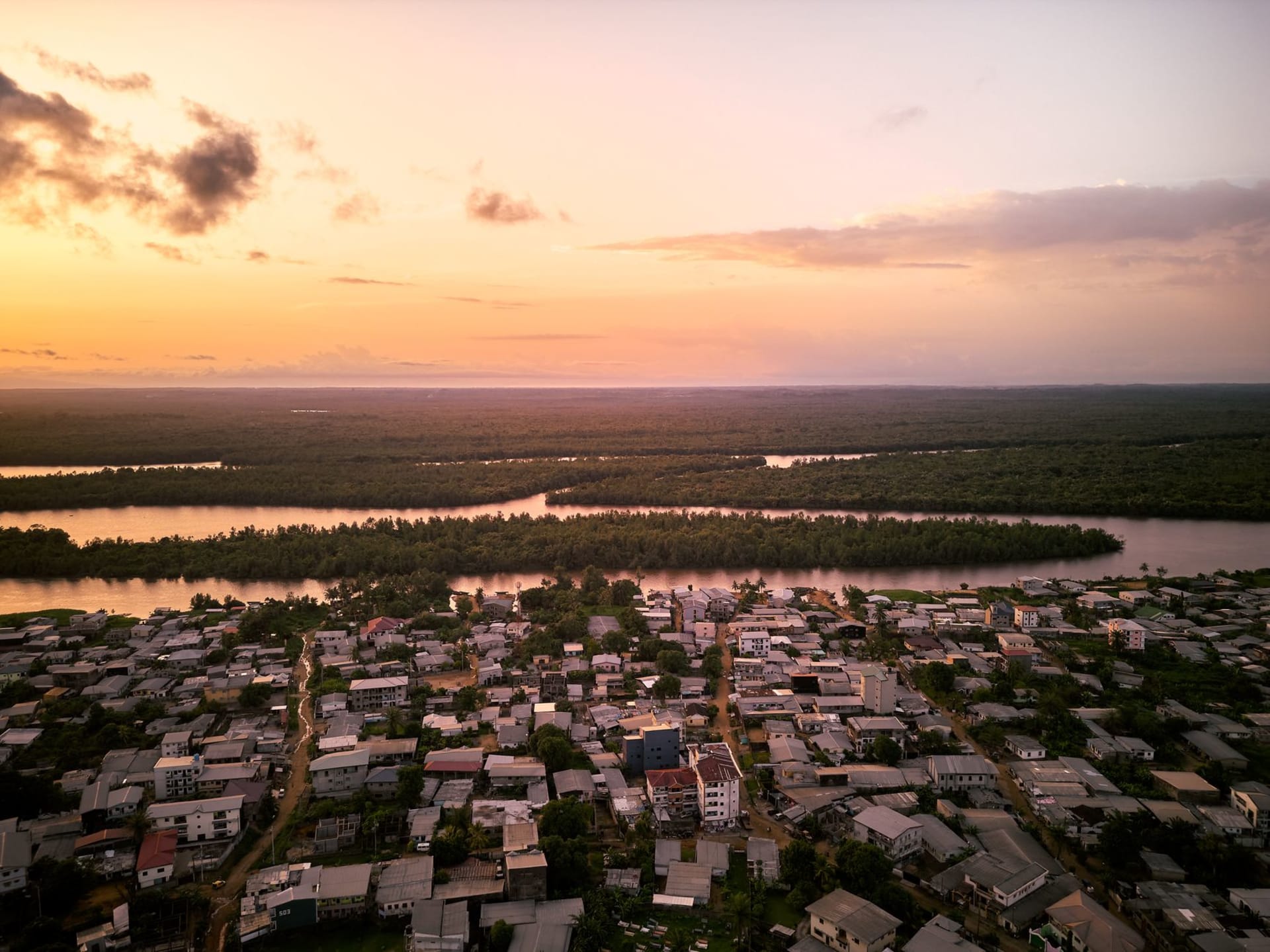
Maroni River
"The engine cut and we drifted in the mist and I thought: this is a kind of freedom I had no word for."
The pirogue left Saint-Laurent at five in the morning, before the light had settled into anything definitive. I was in the bow, sitting on a plank of wood with my bag between my knees, watching the river appear out of the dark in front of us and disappear again behind. The engine — a long-shaft outboard that the boatman handled with one hand and no apparent attention — was the only sound for the first forty minutes, and then a heron lifted from the left bank with a noise like a sheet of paper tearing, and then silence again. At some point during the first hour, the guide cut the engine to let a log drift past and we sat in the sudden quiet and listened to the jungle on both sides waking up, and it was the most alert I had felt in months.
The Maroni forms the entire western border of French Guiana with Suriname — three hundred and fifty kilometers of river road into the country’s interior. Going upriver means going into the territory of the Maroon communities: the Aluku, the Ndjuka, the Saramaka, the Matawai. These are the descendants of enslaved Africans who escaped from Dutch Surinamese plantations in the seventeenth and eighteenth centuries and built free societies in the jungle. They fought a guerrilla war against the Dutch colonial authorities for decades, won their freedom by treaty in 1760, and have been here — self-governing, largely self-sufficient — ever since. Nowhere else in the Americas does freedom have this specific, wooded address.

We stopped in a village above Apatou at midday. The houses were wooden, built on stilts above the bank, with shutters painted in colors — deep red, bright blue, yellow ochre — that had no precedent in anything around them and clearly didn’t need one. Inside the house where we were given lunch, every surface that could be carved was carved: the bed posts, the storage boxes, the doors, the stools. The Maroon wood-carving tradition is centuries old and museum-worthy in its technical sophistication, but these pieces were not in a museum. They were in a house. They were being used. The woman who served us rice and peanut sauce and smoked fish had them around her the way someone has furniture, without ceremony, because they were made by her husband and her father and her grandfather and they were just part of the room.
The food on the river is its own argument. I ate pepperpot — the slow-cooked meat stew preserved with cassiri bark that can be maintained indefinitely, each pot enriched continuously over years — and smoked fish so intensely flavored it lasted on my palate through the afternoon. The pepper was fresh from a garden plot I could see from where I was sitting. Nothing came from far away.

We came back downriver in the late afternoon, with the sun behind us and the current carrying us faster than the engine alone would. The guide pointed out species of birds I couldn’t name, and a caiman in the shallows that I would have missed entirely. At one point we passed another pirogue going up — two women and a load of provisions from the market, heading home — and they waved and we waved and the river swallowed the distance between us immediately. I had been told that the Maroni was the real road into French Guiana’s interior, that without it the territory would be unknowable. Floating back to Saint-Laurent with the jungle sliding past in both directions, I understood what that meant in my body rather than just my head.
When to go: July through November offers the most navigable river levels and best conditions for multi-day trips upriver. At minimum three days are needed to reach Maroon villages of real depth; a week allows you to reach Maripasoula and the edge of the Parc Amazonien. Arrange guides through recognized operators in Saint-Laurent.