Collonges-la-Rouge
"Every village in France claims to be beautiful. Collonges-la-Rouge is the one where the stone itself does the arguing."
A village built entirely from deep red sandstone, so uniformly the colour of dried blood that Lia asked, half-joking, whether the whole place had been dyed on purpose.
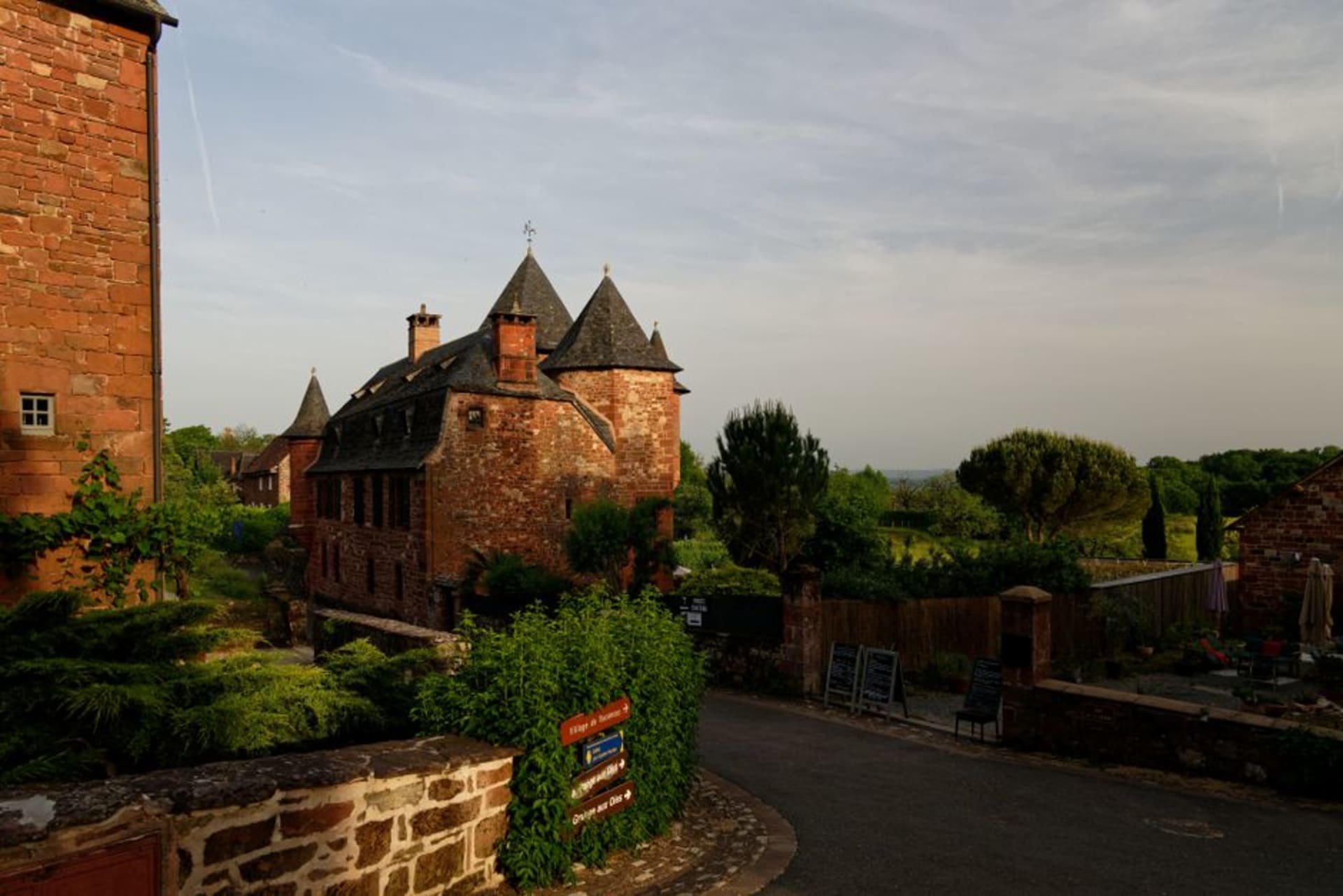
Collonges-la-Rouge is one of the founding members of Les Plus Beaux Villages de France, the official association of France’s most beautiful villages, and it earns the title in the most literal way possible: nearly every building in the village is built from the same local red sandstone, quarried nearby, which turns the entire place a deep, saturated rust-red that looks almost artificial in strong sun. We drove up from the Dordogne valley expecting a nice stop for lunch and ended up staying until closing time.
A village the colour of its own quarry
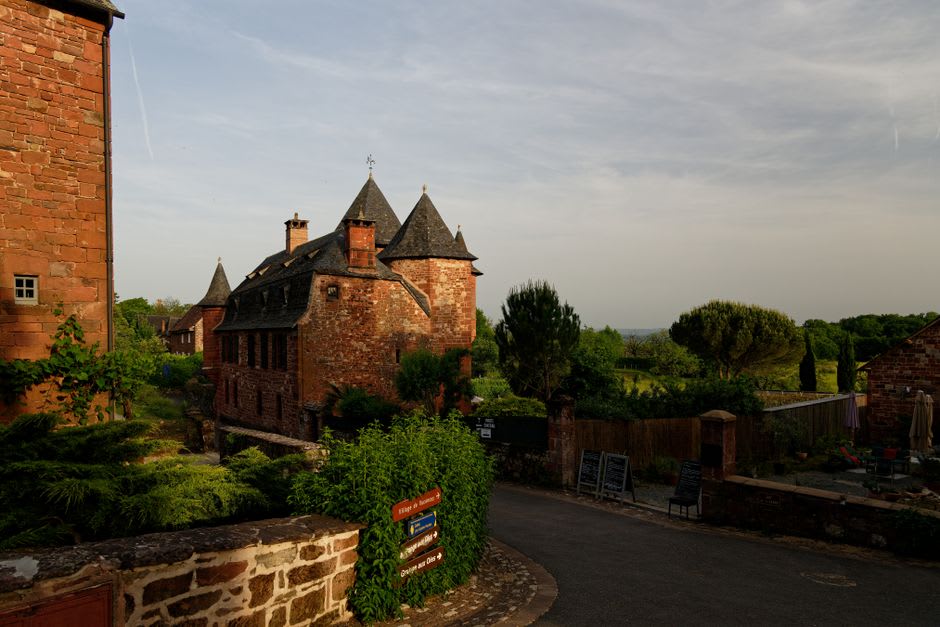
The effect isn’t subtle. Turreted manor houses, a fortified church, narrow lanes, walnut-tree courtyards — all of it in the same red stone, which was used here because it was simply what the ground offered, not for any decorative theory, and the uniformity is what makes it striking rather than gimmicky. Many of the grander houses date from the 15th and 16th centuries, built by minor nobility and wealthy merchants from nearby Turenne, whose viscounts held sway over this whole area and granted Collonges certain privileges that let it prosper without ever needing to fortify itself as heavily as its neighbours. Walking the lanes in late afternoon, when the sun catches the stone at an angle, the whole village genuinely seems to glow.
The church that hedged its bets in the Wars of Religion
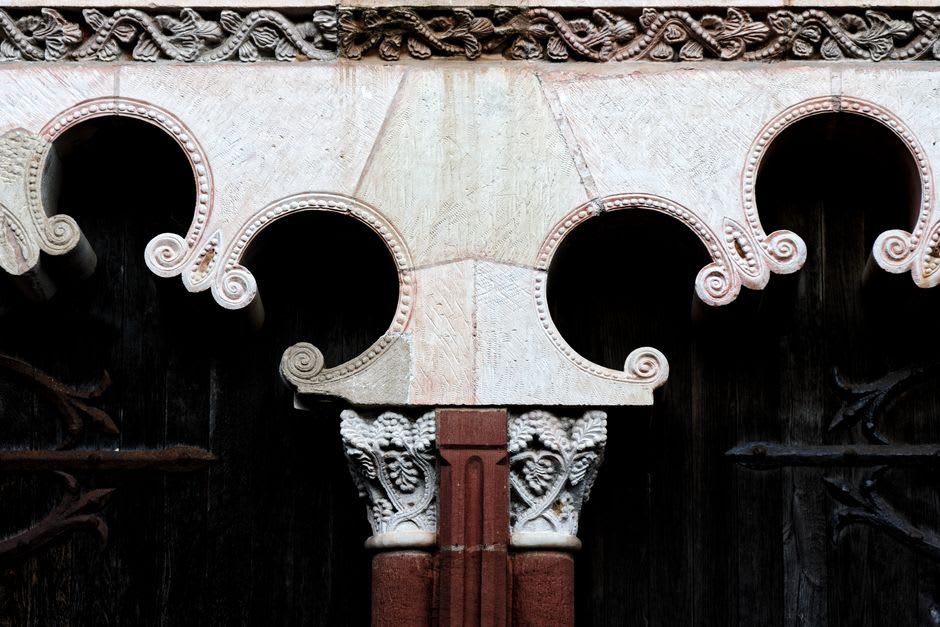
At the centre of the village stands the Église Saint-Pierre, an unusual church with two naves side by side, one that served Catholic worship and one that, during the Wars of Religion in the 16th century, was used by the village’s Protestant population — a rare physical record of a village that tried to let both faiths coexist under one roof rather than tearing itself apart, at a time when most of France was doing exactly that. The tympanum above the entrance, carved in the 12th century, depicts Christ in Majesty and is one of the finer pieces of Romanesque sculpture in the region. We sat for a while on the low wall of the covered market hall across from it, eating walnut cake bought from a stall run by a woman who told us, unprompted, that her grandmother’s recipe hadn’t changed in decades.
When to go: Late afternoon in spring or early autumn, when the light is warm and low enough to set the red stone properly glowing and the summer coach-tour crowds have thinned; it’s small enough to see fully in two or three unhurried hours.
Keep exploring
More of Dordogne & Bordelais