Auray
"Everyone stops in Vannes and skips Auray. That's their loss and my quiet advantage."
A steep little port quarter below the main town where the boats, the wine bars, and the smell of low tide mud make it hard to leave before dark.
Auray sits close enough to Vannes that most people treat it as an afterthought, a name on the map they drive past on the way to the Gulf of Morbihan proper. We nearly did the same thing until a friend in Vannes told us, with the slight defensiveness of someone recommending their actual favorite over the famous one, that Auray’s port quarter at Saint-Goustan was where she’d rather spend an evening. She was right, and I’ve been mildly annoyed at every guidebook that buries this place in a footnote ever since.
Down the hill to Saint-Goustan
The town itself sits on a plateau, but its real character is down a steep hill at the river’s edge, in the quarter called Saint-Goustan — a jumble of cobbled streets and half-timbered merchant houses built when Auray was a serious trading port, shipping goods up and down the Loch river to the sea. Benjamin Franklin actually landed here in 1776, on his way to negotiate French support for the American Revolution, and there’s a small plaque commemorating the spot where he first set foot on French soil, a fact that surprised me enough that I looked it up twice to make sure I hadn’t misheard our friend. The quarter today is a tight grid of bars and crêperies threaded between houses that lean into each other over the narrow lanes, and it fills up on a summer evening with a mix of sailors off the boats moored along the quay and locals who clearly treat it as their regular spot rather than a tourist stop.

Gateway to a gulf full of islands
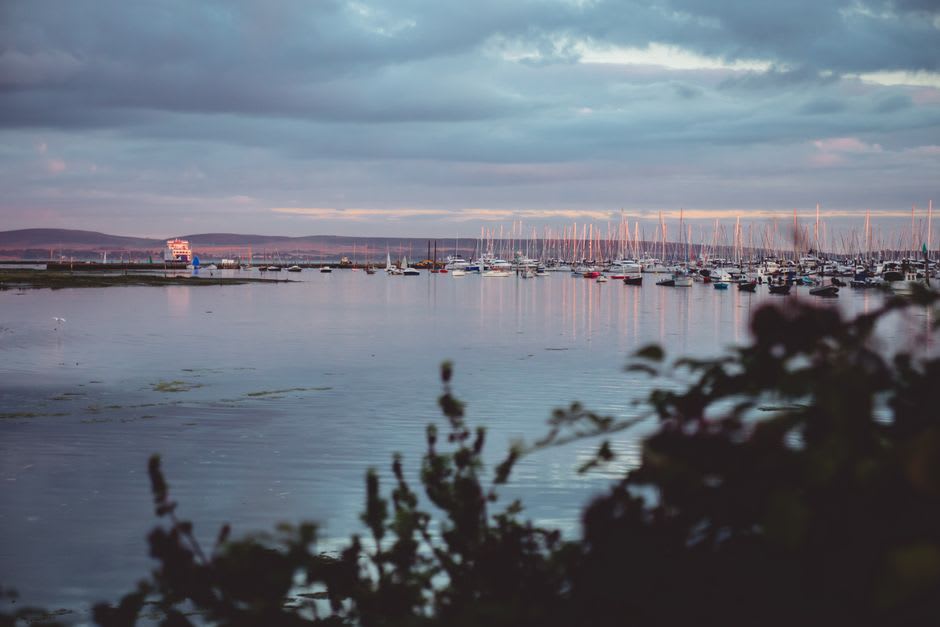
Auray’s other role is as one of the quieter entry points to the Gulf of Morbihan, the vast tidal inland sea dotted with dozens of islands that gives this stretch of coast its name — “Morbihan” means “little sea” in Breton, and sailing out from the marina below Saint-Goustan gets you into that maze of islets and channels without the crowds that build up at Vannes’s own port. We took a half-day boat trip out of Auray that wound between islands with names most maps don’t bother printing, past oyster farms and herons standing motionless in the shallows, and came back at low tide to find the river below Saint-Goustan reduced to a trickle of water threading through exposed mudflats, boats resting on their sides waiting for the water to return — a reminder of just how much this whole stretch of coast runs on the tide’s schedule rather than the calendar’s.
When to go: Come for an evening in Saint-Goustan between May and September, when the quayside terraces are busiest and the boat trips into the Gulf of Morbihan run most frequently. If sailing out into the gulf is the priority, check tide times — some of the smaller channels between islands are only navigable a few hours around high water.
Keep exploring
More of Brittany