Orcival
"The basilica is too big for the village around it, and that mismatch is the whole reason to come."
A Romanesque pilgrimage basilica sitting in the bottom of a volcanic valley, in a village so small the church seems to have been built for a much bigger town that never showed up.
Orcival is one of those villages where the church arrived first and the settlement grew up around the pilgrims it attracted, and eight hundred years later the arithmetic still looks slightly off: a handful of streets, a scattering of lava-stone houses, and in the middle of it, rising out of a narrow valley in the Monts Dômes, one of the finest Romanesque basilicas in France. It’s officially listed among the Plus Beaux Villages de France, and unlike some villages that earn that label mostly on cuteness, Orcival earns it on the strength of a single, genuinely important building.
A basilica the village grew around
The Basilique Notre-Dame d’Orcival was built in the twelfth century in the distinctive Auvergne Romanesque style — a stepped chevet with radiating chapels, round towers, and walls of dark volcanic stone — and it has never been significantly altered since, which is rare enough in France to be remarkable on its own. Inside, above the altar, sits a twelfth-century silver-gilt Virgin, the Vierge en Majesté, seated stiffly on her throne in the Romanesque manner, and she has drawn pilgrims to Orcival every Ascension Day for centuries in a tradition, the Grande Procession, that still fills the valley with worshippers once a year. We came on an ordinary Tuesday and had the crypt-like interior almost entirely to ourselves, the light falling through small windows onto stone that has held its color and shape since before the cathedral of Paris was finished.
A valley worth walking
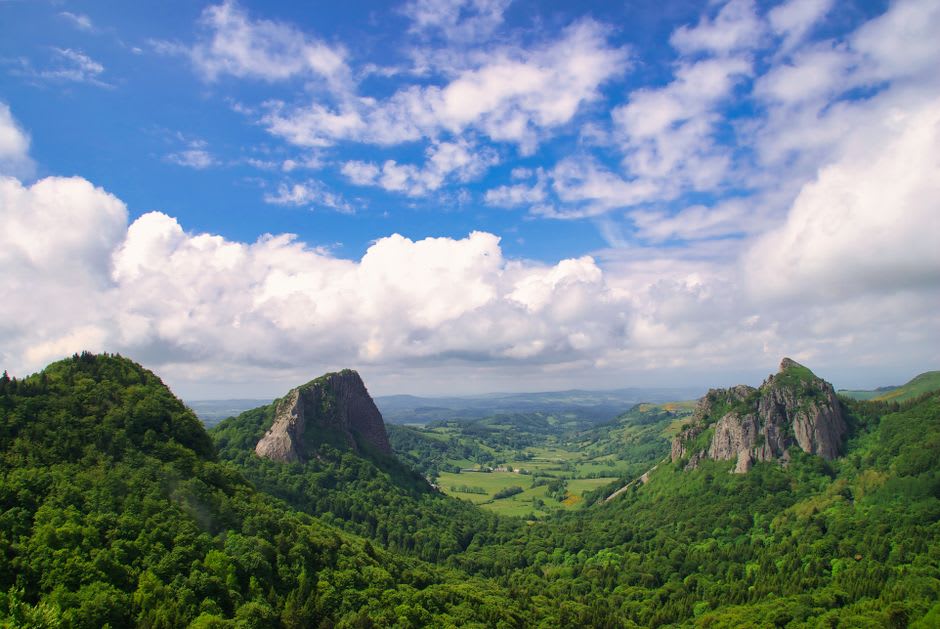
Orcival sits at the bottom of the Sioulet valley, and a short walk out of the village along the stream leads past a working watermill and up into pasture where the volcanic origins of the whole region become obvious in the shape of the hills — smooth, round, and unmistakably the eroded remains of old cinder cones. We followed one of the marked trails for maybe an hour, climbing just high enough to look back down at the basilica’s towers poking above the village roofs, small stone chapels along the route reminding you that this has been a walked landscape, not just a driven-through one, for a very long time.
We ended up back in the village for lunch, at a small restaurant serving truffade, the regional dish of crushed potatoes melted through with Cantal cheese, which is exactly the kind of food you want after a morning walk in volcanic hill country.
When to go: May through September for the walking trails and warm valley light, or specifically around Ascension Day in late May if you want to see the centuries-old procession that still fills the village once a year.
Keep exploring
More of Auvergne