Thann
"The wine road gets more famous the further north you go. Thann is where it actually starts, and nobody warns you it might be the best bit."
The southern gateway to the Alsace wine road, where a single flamboyant Gothic spire and one of the steepest, strangest vineyards in France quietly outdo half the more famous villages to the north.
Everyone plans the Route des Vins d’Alsace from the north — Riquewihr, Kaysersberg, the villages that show up first in every guidebook — and by the time most people reach Thann at the southern end, they’re already tired and heading home. We did it backwards on purpose, starting in Thann, and I think it gave us the better version of the drive: a town confident enough to be underrated.
A cathedral in miniature, three centuries in the making
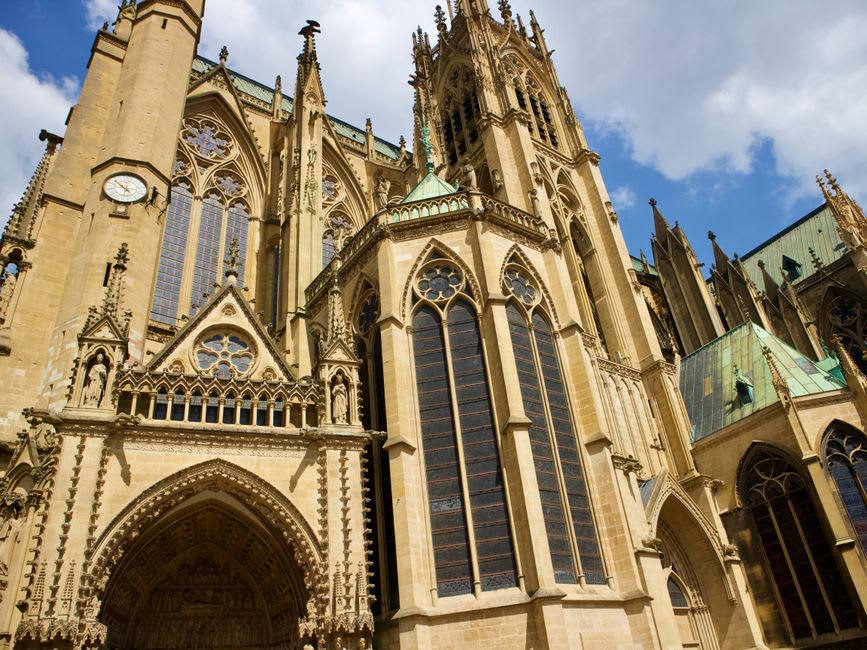
The Collégiale Saint-Thiébaut dominates the old town with a facade of flamboyant Gothic stonework so intricate it looks almost textile, and an openwork spire that took roughly three hundred years to finish, spanning the fourteenth to the sixteenth century, which explains why the style shifts subtly the higher your eye travels up it. Inside, the choir stalls are carved with a strange, lively menagerie of real and imagined animals that the craftsmen apparently worked in for their own amusement, half hidden in the woodwork where a bored child — or a distracted father, in my case, while Lia read the informational panels properly — could spend a happy ten minutes finding them. Legend has it a local shepherd found the relics of Saint Thiébaut here after his ox refused to walk any further, which is as good an origin story as any for a town that has otherwise gone slightly overlooked.
The Rangen, a vineyard clinging to a volcano
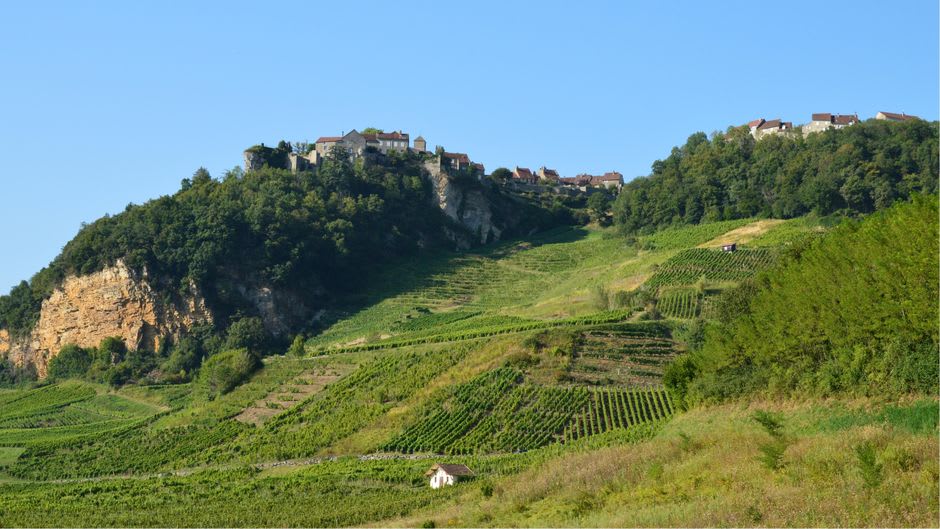
Above the town rises the Rangen, a grand cru vineyard planted on slopes so steep — over sixty percent gradient in places — that some of the vines have to be tended by hand or with the help of ropes, on soil formed from an ancient volcanic outcrop that gives the Rieslings and Gewurztraminers grown there a mineral intensity unlike anything else along the wine road. We tasted a few at a small cellar door near the base of the slope, and the winemaker pointed out the ruined Tour des Sorcières on the hillside above, a lone medieval tower that’s all that survives of a chapel supposedly linked to the witch trials once held nearby — a genuinely eerie landmark for a vineyard already famous for how hard it fights to produce anything at all. Looking back down at Thann’s spire from partway up the Rangen, with the town compact and orderly below the vines, felt like getting the postcard view most people only get of the villages further north.
When to go: September and early October put you right in the middle of the Rangen harvest, with cellar doors busiest and most willing to pour; a Sunday in early autumn also brings the annual Crémation des Trois Sapins festival if the dates line up, one of the oldest surviving folk festivals in Alsace.
Keep exploring
More of Alsace