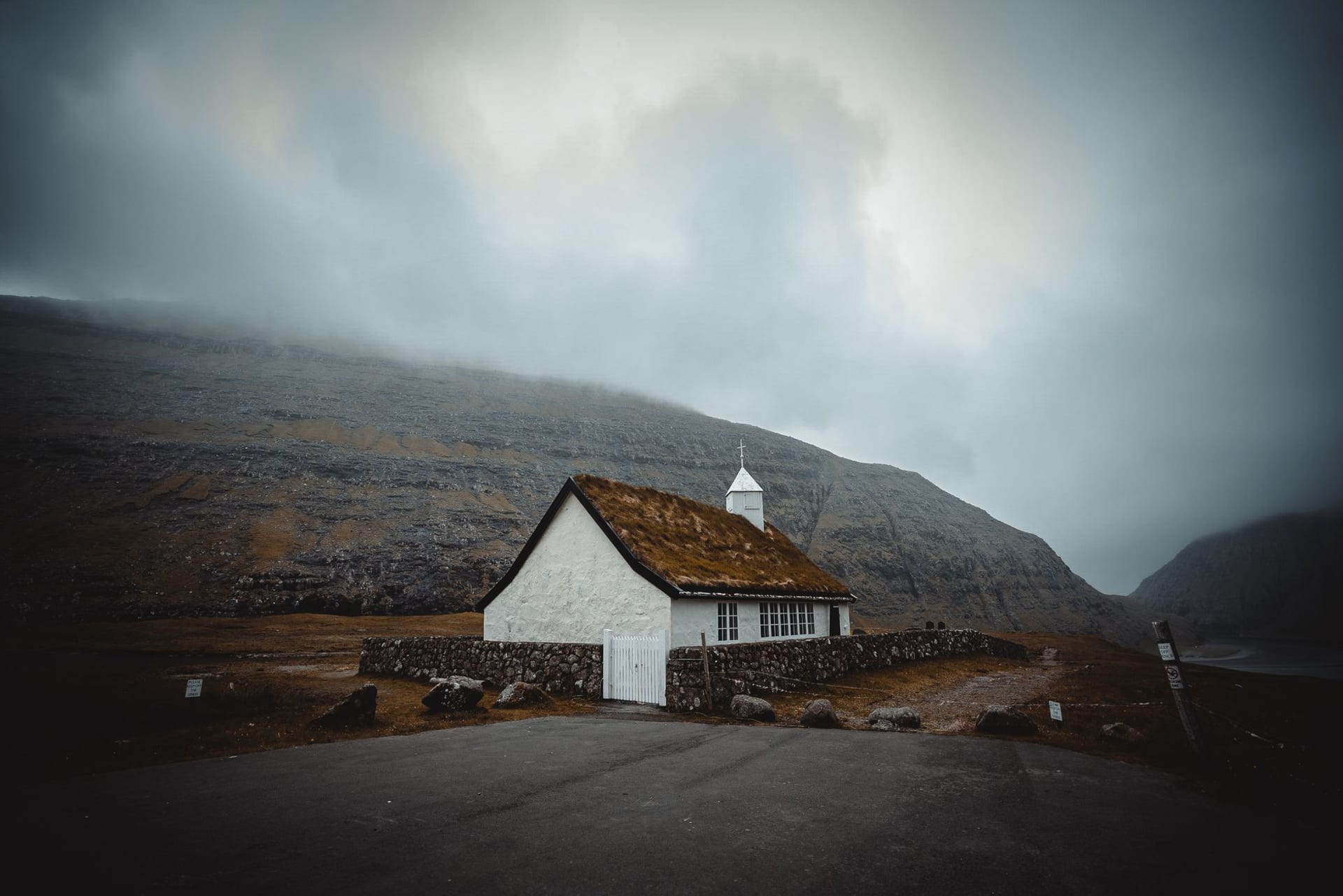
Saksun
"The road simply stopped, and there it was — a valley that looked like the last inhabited place before the edge of the map."
Saksun is at the end of a single-track road on the northwest tip of Streymoy, and you reach it by driving deeper and deeper into a valley that keeps narrowing until you are certain you’ve taken a wrong turn into someone’s farm. Then the road stops, and you’re there: a scatter of black timber houses with grass growing thick on their roofs, a tiny white church, and below them a lagoon ringed by cliffs down which thin waterfalls slide whenever it has rained, which in the Faroes is more or less always. Lia turned off the engine and neither of us said anything for a while, which is the highest review I can give a place.
A lagoon that used to be a harbour
The lagoon — Pollurin — is the strange heart of Saksun. It looks like an inland lake, but it’s tidal: a narrow sandy channel connects it to the open sea, and at low tide you can walk out across the exposed sand toward the gap in the cliffs. Local history says it was once a working harbour, deep enough for boats, until a great storm choked the entrance with sand and shut the village off from the sea it had depended on. Whether that’s exactly true or pleasingly embroidered, I couldn’t tell you, but standing on the wet sand watching the tide creep back in, the story felt entirely believable.
We timed our walk badly and got the tide coming in faster than expected, which turned a contemplative stroll into a slightly undignified scramble back toward the grass, boots squelching, Lia laughing at me. A reminder that the Faroese landscape is beautiful precisely because it is not tame, and does not particularly care about your schedule.

Turf roofs and a contested footpath
The houses of Saksun are the postcard — black tarred timber, white window frames, and roofs of living turf so thick that sheep have been known to graze on them. The old farm of Dúvugarðar, partly a museum, shows how a Faroese farming family lived for centuries: low dark rooms, smoke-blackened beams, the whole life of the place arranged around weather and wool and the sea. It’s the kind of small, honest museum I always prefer to the grand ones, because it doesn’t ask you to be impressed, only to pay attention.
A word of caution that I wish someone had given me: the people of Saksun actually live here, in a village of a couple of dozen souls, and there have been long-running disputes about tourists tramping across private farmland to reach the best photo spots. Some paths have been closed; some carry a small fee. Stick to the marked routes, close the gates behind you, and remember that the postcard valley is also somebody’s front garden. It costs nothing to behave, and it keeps places like this open.

Practical notes
Saksun is an easy day trip from Tórshavn — under an hour’s drive, mostly on a good road that narrows to single track at the end, with passing places you’ll need to use. Check a tide table before you go if you want to walk the lagoon, and never get caught between the rising water and the cliffs. Bring full waterproofs regardless of the forecast; the weather here changes by the quarter-hour. Combine it with a stop at the village of Tjørnuvík further along the coast for one of the best short drives in the islands.