Europe
Faroe Islands
"The clouds don't pass over the Faroes — they live there, and so does something in you."
I landed in Vágar in fog so thick the runway appeared only at the last possible second, a grey smear materializing beneath the wings. My first thought was that something had gone wrong. My second thought, ten minutes later driving through a tunnel blasted under a mountain and emerging beside a lake suspended above the sea, was that I had arrived somewhere I was completely unprepared for. The Faroe Islands do not ease you in. They start immediately.
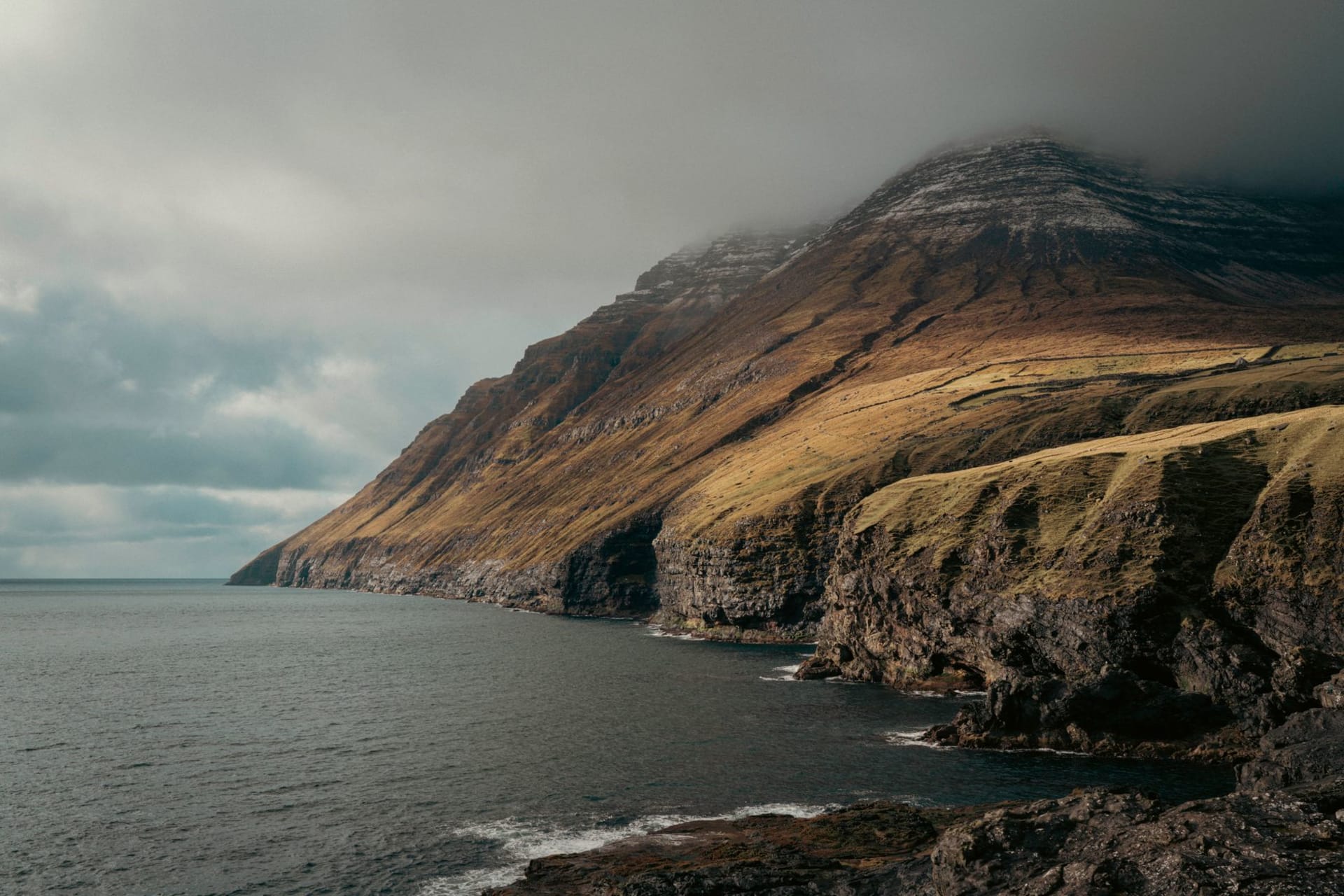
The archipelago sits roughly equidistant between Norway, Iceland, and Scotland — north of almost everything — and looks like it was assembled by someone who had never seen a photograph of what land is supposed to look like. Cliffs drop five hundred meters straight into the ocean at Enniberg, the highest sea cliffs in the world. Villages of turf-roofed houses cling to hillsides with a logic that becomes clear only when you understand that these are the only flat surfaces available. The lake of Sørvágsvatn appears to float above the Atlantic — a trick of perspective that looks like digital manipulation and is entirely real. I hiked out there in mist that came and went in curtains, and the lake appeared and disappeared with the weather, never quite the same twice.
The food here runs through lamb and fish, cooked with a confidence that comes from centuries of not being able to get anything else. Skerpikjøt — wind-dried mutton hung in open-air sheds called hjallur — is one of those foods that divides people sharply. I ate it on dark bread with butter in a kitchen in Tórshavn and found it deeply satisfying, fermented and rich and nothing like what any European city would serve you under that description. The capital, Tórshavn, is the smallest capital in Europe by some metrics, a harbor town of painted wooden houses with a fortress that dates to the tenth century. It has good coffee now and a handful of restaurants doing serious things with local ingredients. It has changed, but not too much.
When to go: Late May through September offers the most light and the most accessible hiking — long days, wildflowers on the ridges, puffins on the cliffs of Mykines from late April into August. July is the most stable month, though “stable” on the Faroes means perhaps two days in a row without rain. Winter strips everything back to rock and wind and sea, and has a raw, elemental atmosphere for those who want the islands with no softening.
What most guides get wrong: They treat the Faroes as a set of Instagram coordinates — Múlafossur waterfall, Sørvágsvatn, Gásadalur — and miss that the island chain is best understood slowly, on foot, in whatever weather arrives. The iconic views are iconic for a reason, but they are surrounded by equally arresting landscape that has no hashtag attached to it. Rent a car, take the ferries between islands, and walk off the marked trail. The Faroes reward the unscheduled hour more than almost anywhere I have been.