Funningur
"I went to Funningur to walk off the tourist trail and found myself genuinely lost in something beautiful — which is the best version of lost."
The GPS lost its confidence somewhere around the third bend past Eiði and I drove the rest of the way to Funningur by reading the road rather than the screen. The valley closes around you as you descend — mountains rising steeply on either side, the stream following the road as both run toward the sea, the light changing every few minutes as cloud moved across the peaks above. By the time the village appeared at the head of the fjord, I had the distinct feeling of arriving somewhere that had not particularly been expecting me.
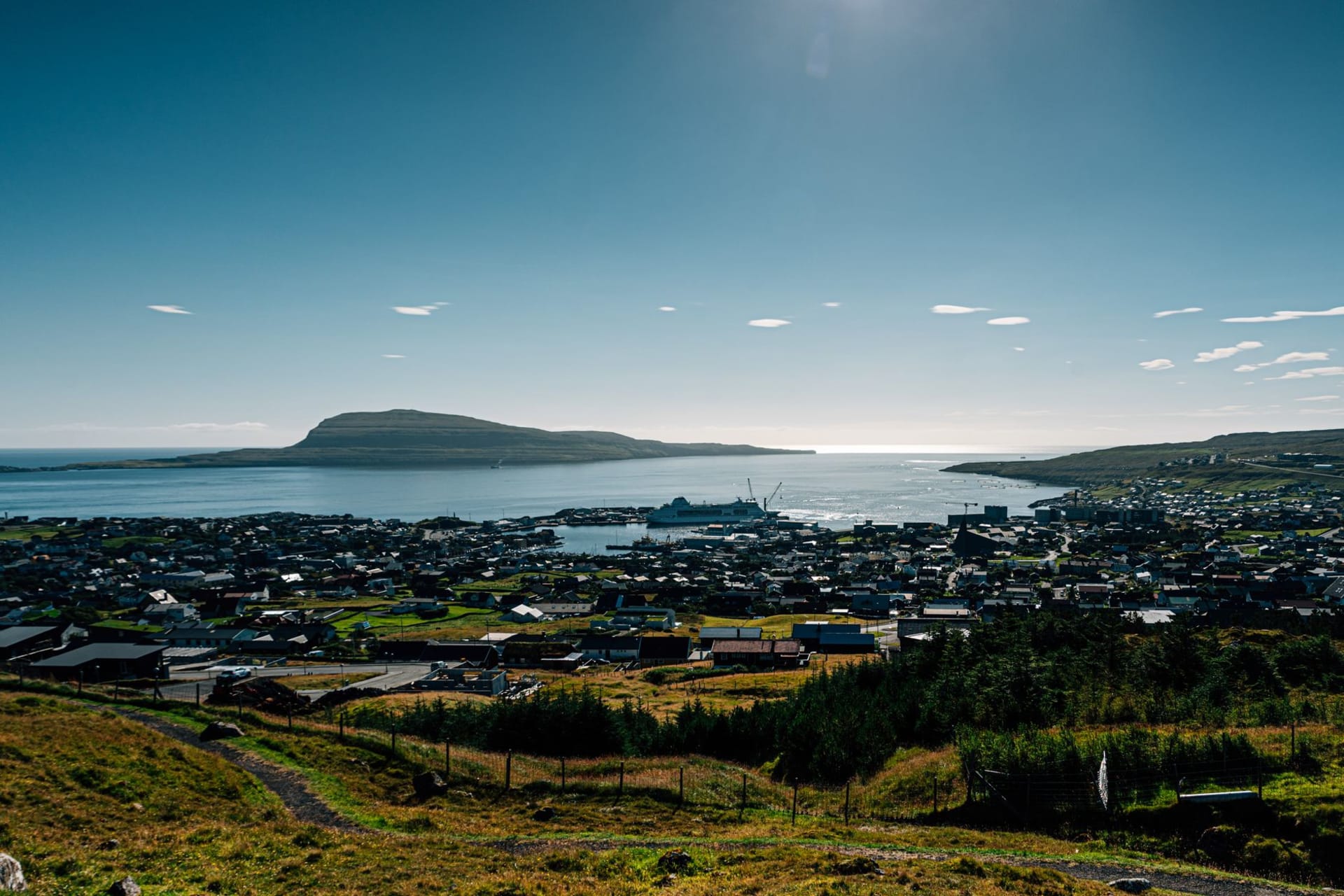
Funningur sits where Funningsfjørður turns east and the valley behind the village narrows toward a gorge. The mountains here are among the most dramatic on Eysturoy — Slættaratindur, the highest peak in the Faroe Islands at 882 metres, stands above the northern rim, and the approach to its summit from the Funningur side offers a different and less-travelled route than the standard path from Gjógv. I had not come to summit it, but I climbed a few hundred metres up the slope behind the village in the afternoon and found a view back down the fjord that required repeated stopping to absorb: the small cluster of houses, the church on its knoll, the water of the fjord running to a gap in the mountains where the sound beyond showed as a strip of pale blue.

The church at Funningur is one of the oldest sites in the Faroes, or at least stands on the site of one — white painted, red-roofed, positioned on a knoll that gives it an authority over the village that a building of its modest size does not ordinarily command. I sat on the churchyard wall in late afternoon when the light was coming in at a low angle over the western ridge, painting everything that specific shade of yellow that made the green grass and the white church and the dark water of the fjord into a composition I would have doubted if I had seen it in a painting. The photography instinct is a complex thing. I took a few frames and then put the camera away, aware that I was trying to preserve something that was already happening only once and could not be carried out of the moment in any container I owned.

There is almost nothing in Funningur in the way of services — no café, no guesthouse, nothing commercially available. The few people I saw were doing things: tending a garden, walking a dog down the road that ends at the water, unloading something from a car outside one of the houses. The village has perhaps ten to fifteen permanent inhabitants and a summer population of hikers using it as a trailhead. I had packed food and ate it sitting on the low wall by the church with the window of the car open, listening to the fjord and the wind in the hillside grass, thinking that the Faroes have a particular talent for places like this — not spectacular in the waterfall-cliff way, but quietly extraordinary in their accumulation of specific, unrepeatable detail.
When to go: June and July for the long evening light and the best hiking conditions on the Slættaratindur approach from the south. The drive from Eiði takes twenty to thirty minutes on a narrow road that is passable year-round but rewards patience. Bring everything you need — the village has no facilities — and give yourself the afternoon, because the light here earns more time than a quick stop allows.