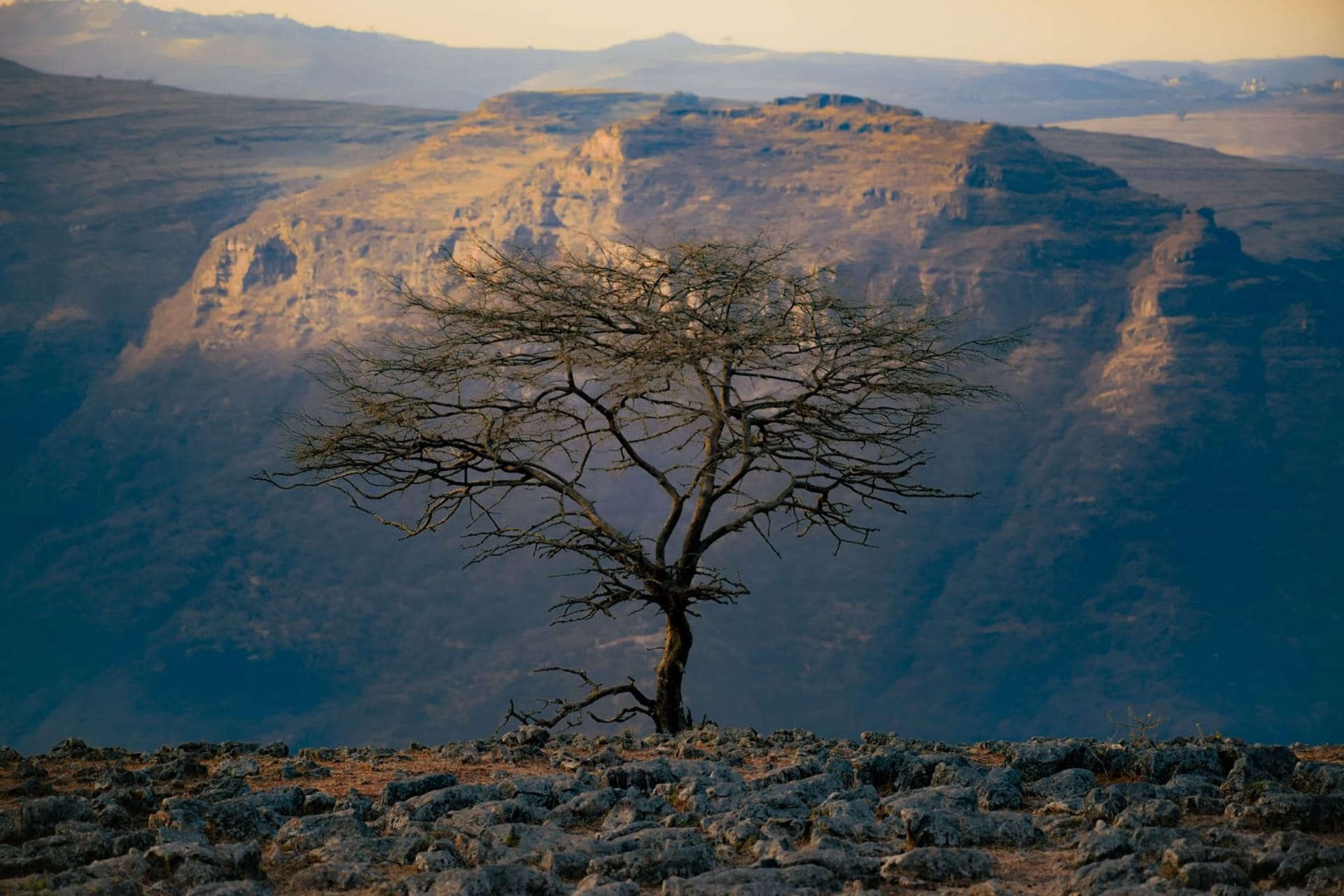
UNESCO highlands trekked by gelada baboons and lammergeiers, with escarpment views that steal all language.
I had been warned, in the pleasant offhand way that seasoned travelers warn you about things they know words will not cover, that the Simien Mountains would be unlike anything I had seen. I nodded and smiled and privately assumed they meant the usual category of unlike — the kind that still fits inside the frame of experience. I was wrong.
The Escarpment at Imet Gogo
The trail from Sankaber camp climbs through giant lobelia and heather trees gnarled by altitude, their trunks draped in pale lichen that moves in the wind like slow breath. At 3,926 meters, the viewpoint at Imet Gogo opens without ceremony onto an escarpment that drops roughly 1,500 meters into the Tekezé River basin. Lia sat down on a flat basalt slab and said nothing for a long time. That silence was the most accurate response either of us managed.
The light at that elevation does something peculiar in the late afternoon — it thickens, turns amber-bronze, and catches the cliff faces at an angle that makes the rock glow as if heated from within. The valley floor, far below, is a different climate, a different season. You are standing on the edge of the world and also on the roof of it, and the mind cannot quite hold both facts at once.
The Geladas
Nothing prepared me for the geladas. Not the photographs, not the wildlife documentaries. A troop of three hundred grazed along the escarpment rim near Chenek camp, entirely indifferent to us, the males with their extraordinary scarlet chest patches catching the morning light like open wounds that somehow don’t disturb. They communicate in a rolling, almost human murmur — a chorus of low voices that sounds, at a distance, like a crowded café heard through a closed door. I crouched two meters from a juvenile for nearly twenty minutes. He never looked at me.
The unexpected thing — the genuine surprise — was a lammergeier appearing directly overhead while I sat eating injera and shiro from a tin plate outside our tent at Geech camp. The wingspan must have been close to three meters. It rode a thermal without a single wingbeat for perhaps a minute, close enough that I could see the wedge-shaped tail, the rust-colored underside, the almost serpentine neck. Then it was gone over the ridge. The whole encounter lasted less time than it takes to describe.
Getting There and the Trek Itself
The gateway is Debark, a dusty market town four hours by road from Gondar. Scouts are mandatory and non-negotiable — ours, Tadesse, knew every gelada troop by loose territory and carried a rifle he never once unslung. The standard four-day trek covers Sankaber, Geech, Imet Gogo, and Chenek before descending. The altitude is real: the first night at 3,260 meters, I woke twice with a low headache and lay listening to the wind pulling at the tent fabric and the distant murmur of the baboons settling in the cliffs below.
When to go: October through March offers dry trails and clear escarpment views; the short rains arrive around April and the heavy season runs June through August, when the high paths turn to mud and cloud obscures the valleys for days at a stretch.