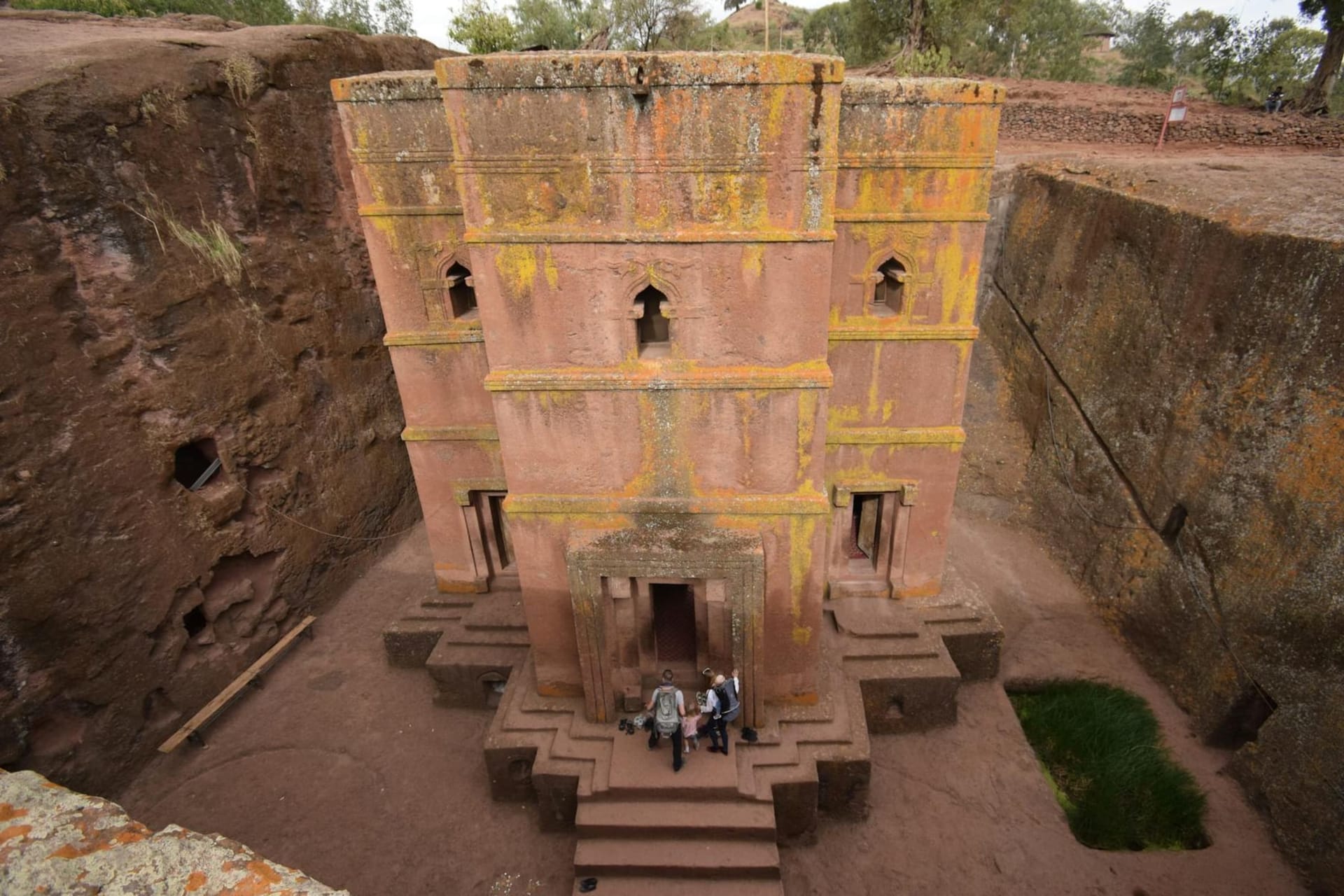
Eleven rock-hewn medieval churches carved below ground — Ethiopia's Jerusalem, still alive with Orthodox pilgrimage.
The first thing I noticed was not the churches but the light. At seven in the morning, a thin highland mist still clung to the escarpment above town, and the sun came through it sideways, turning the volcanic rock the colour of dried blood. I had come from Addis on a night flight and walked straight from the guesthouse without coffee, following a sound I could not immediately identify — low, rhythmic, resonant — until I reached the trench-like entrance to Bet Medhane Alem and understood it was chanting, rising from below ground.
Below the Surface
Lalibela is a town of about fifteen thousand people on a ridge in the Lasta highlands, sitting at roughly 2,600 metres. The air is cool and dry and smells of eucalyptus and frankincense. The churches — all eleven of them — are not built. They are subtracted. King Lalibela’s craftsmen in the twelfth century carved downward into the volcanic tuff, removing stone until they had isolated a monolithic block, then hollowed it further into a sanctuary. The result is architecture that reads as negative space: you stand in a courtyard and the church is level with your knees.
Bet Giyorgis is the one that stops people mid-sentence. It sits alone in its own pit, connected to the surrounding rock by a single narrow trench, and its roof — a Greek cross in perfect relief — is exactly flush with the ground around it. I walked the trench toward it with my hand trailing along the stone wall, which was cold and slightly damp, and the church emerged incrementally, one carved course at a time, until I was standing beside it in the pit and looking up at the rock face above, where small openings cut into the cliff held the remains of the ancient dead.
What I Did Not Expect
Lia had stayed behind to rest, so I was alone when a priest led me into Bet Maryam without announcement, unrolled a cloth from around a wooden panel, and held it toward a shaft of light coming through a small window. It was an icon, very old, the pigment cracked and dark, Mary with a particular expression I would describe as tired rather than serene. He explained something in Amharic, then in fragments of English: six hundred years, maybe older, no one knows exactly. He rewrapped it with the same quiet economy. The whole encounter lasted four minutes.
Later, on the path between the northern and eastern church clusters — a route that dips through a small ravine where women sell injera and roasted barley — I ate a bowl of ful, fava beans in oil, sitting on a stone wall while pilgrims in white shammas moved past in both directions, some of them having walked for days from the lowlands.
When to go: The dry season runs October through May, and the pilgrimage festival of Genna — Ethiopian Christmas — falls in early January, when the churches draw thousands of worshippers and the chanting continues through the night.